
 Fax: (239) 692-9436
 Tel: 239-430-3668
Yes—orthotics can help some knee pain, particularly pain around the kneecap when changing foot support reduces symptoms during movement. They do not repair knee cartilage, heal a torn ligament, or replace strengthening and an examination to identify the cause.
- Can orthotics help with knee pain? Yes, for selected patients with patellofemoral pain—not every knee condition.
- Prefabricated foot orthotics can support short-term relief alongside hip and knee exercises.
- Custom orthotics are not automatically better for knee pain; fit, diagnosis, and response matter.
- Naples Podiatrist provides foot and ankle care for patients considering whether foot mechanics contribute to knee symptoms.
Can orthotics help with knee pain too?
Orthotics can reduce symptoms in selected people with patellofemoral pain: pain around or behind the kneecap during activities such as stairs, squats, or running. The key is whether changing support under your foot makes those activities more comfortable—not simply whether your arch looks flat.
The 2019 Journal of Orthopaedic & Sports Physical Therapy clinical practice guideline recommends prefabricated foot orthoses for short-term relief, up to 6 weeks, in people with patellofemoral pain and greater-than-normal pronation. It recommends combining orthoses with exercise and reports insufficient evidence that custom devices work better than prefabricated devices for this condition.
For your 2026 treatment decision, that means an insert is a possible addition to care, not a stand-alone cure. Naples Podiatrist offers custom orthotics and specialist foot and ankle care; a knee-focused examination is also necessary when symptoms suggest a problem within the knee.
| Approach | Best for | Main benefit | Main limitation |
|---|---|---|---|
| Prefabricated orthotics | A clinician-guided trial for selected patellofemoral pain | Changes foot support without an individually manufactured device | Shape and support are not individually prescribed |
| Custom orthotics | An identified foot problem requiring individualized support | Allows a prescription tailored to foot structure and pressure needs | Not proven automatically better for patellofemoral pain |
| Hip and knee exercises | Improving strength and movement tolerance in patellofemoral pain | Addresses important contributors beyond the foot | Requires a suitable program and consistent participation |
| Footwear adjustment | Shoes that crowd the foot or do not accommodate an insert | Improves the environment in which an orthotic works | Does not diagnose or treat every cause of knee pain |
Why this matters
Knee pain can interrupt pickleball, walking, golf, and running long before you stop being interested in those activities. Buying an insert without understanding the pain risks treating the wrong problem.
Foot motion, ankle mobility, hip strength, and knee loading interact during movement. That connection explains why a foot orthotic sometimes helps a knee—but it does not prove that every painful knee starts at the foot.
The goal is more comfortable movement, not an arch that looks a particular way. An insert that changes your posture but leaves stairs just as painful has not demonstrated a useful benefit for that task.
How foot support can affect your knee
As you walk, your foot adapts to the ground and helps transfer load up the leg. Pronation is part of normal movement; it is not automatically a defect that needs correction.
An orthotic changes contact and pressure beneath your foot. Depending on your movement pattern, that change can alter comfort and loading through the leg, including around the kneecap.
A clinician looks at more than your standing arch height. Foot flexibility, ankle movement, walking pattern, shoes, and the activity that brings on pain all help determine whether a trial makes sense.
A gait analysis explains how foot and ankle movement are assessed. Walking observations are useful, but they do not replace checking the knee itself when pain, swelling, or instability points there.
Flat feet do not automatically explain knee pain
You can have flat feet without knee pain, and you can have knee pain with a typical-looking arch. Treating an arch shape alone is not the same as treating a painful movement.
A new change deserves attention. If one arch is becoming flatter, your inner ankle hurts, or your walking pattern has changed, arrange a foot and ankle examination rather than choosing stronger arch support yourself.
Prefabricated orthotics: a trial for selected kneecap pain
Best for: patients whose examination supports a trial of foot support for patellofemoral pain. Prefabricated orthotics come in standard shapes rather than being manufactured from an individual prescription.
Their practical advantage is that a clinician can assess an available device in your shoes and check your response during a relevant movement. Their limitation is the same standardization: an otherwise suitable insert can still crowd your toes, lift your heel, or press uncomfortably against your arch.
For patellofemoral pain, the guideline's short-term recommendation is up to 6 weeks, alongside exercise. That is not a promise that pain will disappear within that period, and it is not a reason to tolerate worsening symptoms until the period ends.
In 2026, a sensible question remains: does this insert help your actual symptoms in shoes you can use? A product's description cannot answer that for you.
Custom orthotics: individualized support for an identified need
Best for: patients with a foot condition or support requirement that warrants an individualized prescription. Custom orthotics allow the clinician to specify the device around the findings of a foot examination.
That flexibility is useful when the foot itself needs treatment. It does not establish that a custom device will relieve knee pain better than a well-fitted prefabricated insert.
Naples Podiatrist offers custom orthotics as part of foot and ankle care. For someone with both foot and knee symptoms, the important distinction is whether the device is treating a diagnosed foot problem, helping a knee-related movement, or serving both purposes.
The limitation is that individual manufacture cannot compensate for an incorrect diagnosis. Do not choose custom orthotics solely because knee pain has lasted a long time. Persistent symptoms need reassessment, not an automatic move to a different insert.
Why the response to orthotics varies
The same insert can feel helpful to one person and uncomfortable to another. These factors explain why a recommendation needs to be individual:
- Pain source: kneecap-related pain differs from a ligament injury, meniscus problem, inflammatory condition, or osteoarthritis.
- Foot movement: arch flexibility and pronation affect how a device interacts with your foot.
- Ankle mobility: restricted movement can influence how you walk, squat, and climb stairs.
- Shoe fit: an insert needs enough room without crowding the toes or allowing the heel to slip.
- Activity demands: pickleball involves lateral movement; running repeats forward loading; golf adds walking and rotation.
- Other treatment: strengthening and activity adjustment address contributors that an insert does not.
These are assessment points, not a home diagnostic checklist. Finding one does not prove that an orthotic is the right treatment.
How to judge whether an orthotic is helping in 2026
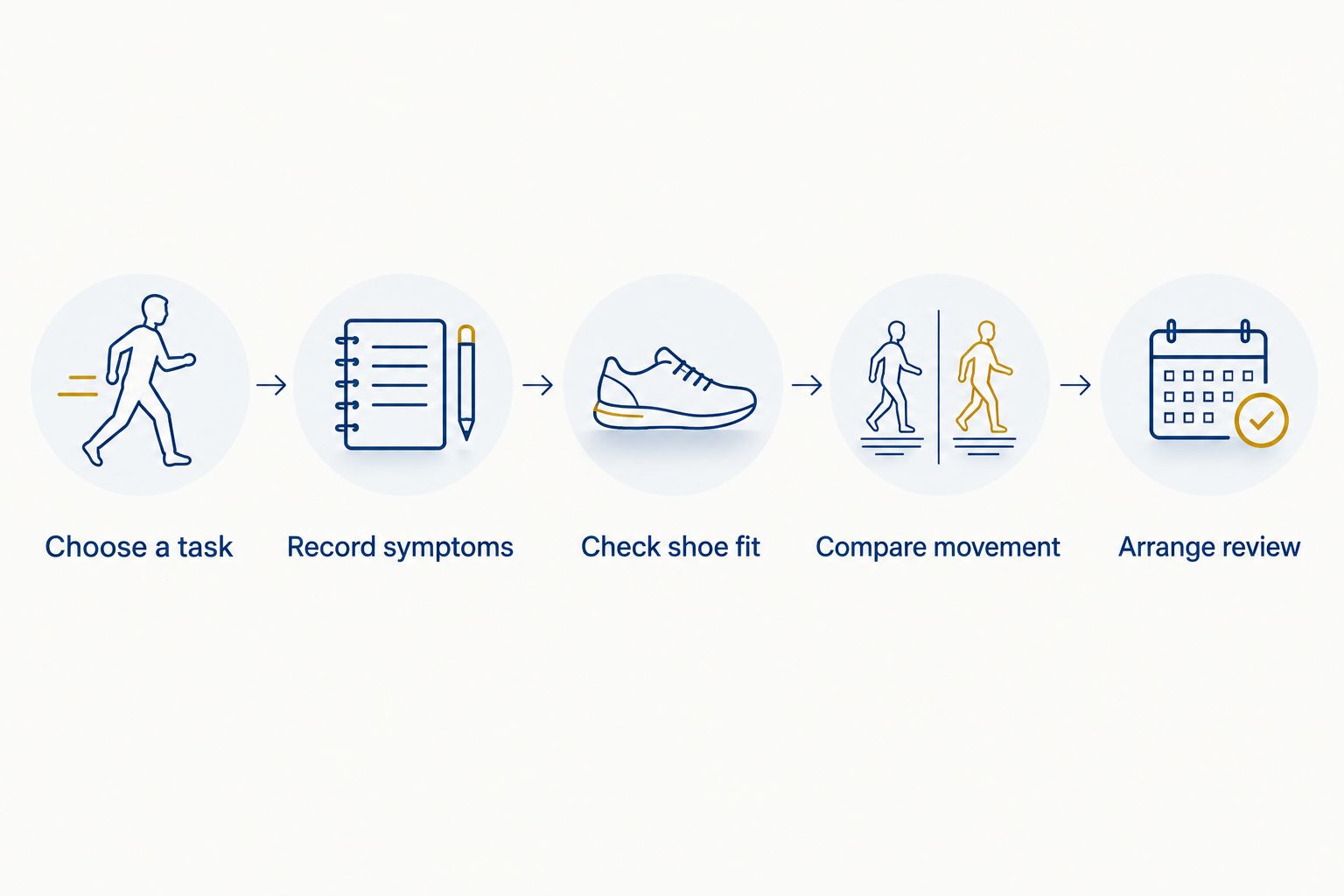
Use a repeatable activity rather than relying only on how the insert feels while standing. Your clinician can help select a task that is safe for your knee.
- Choose a task. Identify an everyday movement that reliably brings on symptoms, such as walking or using stairs. Do not repeatedly provoke severe pain to test an insert.
- Record symptoms. Use a 0–10 pain scale, with 0 meaning no pain and 10 meaning the worst pain imaginable. Note where the pain occurs, not just its intensity.
- Check shoe fit. Make sure the insert lies as intended and does not crowd the foot. Bring the shoes you actually wear to the appointment.
- Compare movement. Check whether the selected activity becomes more comfortable without creating foot, ankle, hip, or back symptoms.
- Arrange review. Agree on a follow-up plan and what should prompt an earlier call. A device that increases pain needs review rather than forced wear.
Keep the comparison fair. If you change your shoes, activity level, exercise program, and insert together, it becomes harder to identify what helped or irritated your knee.
An immediate improvement is useful information, not proof of a diagnosis. Lasting benefit means you can do the relevant activity more comfortably without developing a different problem.
Should you keep exercising while using orthotics?
Orthotics should support an appropriate activity plan, not give you permission to push through increasing pain. For patellofemoral pain, hip- and knee-targeted exercise remains an important part of treatment.
A physical therapist or treating clinician can adjust exercises to your symptoms and ability. Older adults, runners, and people returning to pickleball need different starting points; a generic exercise list does not account for balance problems, arthritis, or a recent injury.
In your 2026 activity plan, build around movements you can perform without worsening symptoms. If your knee hurts more after adding court time or longer walks, discuss the activity increase rather than assuming the orthotic needs more arch support.
When should knee pain be examined instead of treated with inserts?
Seek urgent medical assessment for a hot, swollen knee with fever, a visibly deformed knee, or inability to bear weight after an injury. These symptoms need an examination, not an insert trial.
A knee that locks, repeatedly gives way, or develops substantial swelling also needs evaluation. New calf swelling or pain requires prompt medical assessment; chest pain or shortness of breath with those symptoms is an emergency.
For persistent knee pain without those warning signs, start with a clinician who can assess the knee and coordinate care. A podiatrist contributes when foot pain, changing arches, ankle restriction, or footwear problems are part of the picture.
Naples Podiatrist is best suited to patients who need foot and ankle assessment alongside questions about knee pain. A foot-focused visit does not replace orthopedic, primary care, or rehabilitation assessment when the knee is the main concern.
What should you bring to an orthotics appointment?
Bring your current inserts and 2 shoes from the same pair, including the shoes used during the activity that hurts. A device needs to work inside your footwear, not just look suitable outside it.
Describe whether pain starts during movement, appears afterward, or occurs at rest. Mention swelling, previous knee surgery, falls, diabetes, numbness, and any change in walking.
Useful questions for a 2026 appointment include:
- What findings suggest my foot contributes to my knee symptoms?
- What benefit should this orthotic provide?
- Why is this device preferable to another approach for me?
- Which exercises or activity changes belong in the plan?
- What should happen if my knee does not improve?
Naples Podiatrist's foot and ankle care is relevant when those questions involve foot mechanics or a diagnosed foot condition. The next move is an examination that connects the recommendation to your symptoms.
FAQ
Can orthotics help with knee pain if I have flat feet?
Orthotics can help some people with knee pain and flat feet, but flat feet alone do not establish the cause. An examination should assess the knee, foot movement, shoes, and response to support.
Are custom orthotics better than store-bought inserts for knee pain?
Custom orthotics are not automatically better for patellofemoral knee pain. Prefabricated devices have guideline support for selected patients, while custom devices require an individual clinical reason.
How long should I try orthotics for kneecap pain?
Up to 6 weeks is the short-term period described in the 2019 patellofemoral pain guideline for selected patients using prefabricated orthoses alongside exercise. Your clinician should set your review plan; worsening symptoms need earlier reassessment.
Can orthotics make my knees hurt more?
Orthotics can cause discomfort or worsen symptoms if the support, fit, or shoe combination does not suit you. Contact the prescribing clinician rather than continuing to wear a device that increases pain.
Will orthotics cure knee arthritis?
Orthotics do not cure knee arthritis or rebuild cartilage. An arthritis treatment plan needs a knee assessment; a foot orthotic requires a specific reason rather than a general arthritis claim.
Should I stop my knee exercises when I get orthotics?
Orthotics do not replace prescribed knee exercises. For patellofemoral pain, foot support is an addition to appropriate hip and knee exercise, not a substitute.
Can I wear orthotics for pickleball, golf, or running?
Orthotics can be used in activity shoes when the device fits and your clinician considers it appropriate. Check the actual shoes and activity because comfort during walking does not guarantee comfort during lateral court movement.
One last thing
More arch pressure is not proof of better support. A useful orthotic should help you move more comfortably without creating new pressure spots, numbness, or pain elsewhere.
Before replacing an insert that is not helping, ask for the diagnosis and treatment goal to be reviewed. The right next step sometimes involves different footwear or rehabilitation—not a different orthotic.
Related guides
- Custom orthotics vs. over-the-counter insoles
- Breaking in custom orthotics
- Custom orthotics for flat feet

