 Fax: (239) 692-9436
 Tel: 239-430-3668
About 80% of patients with plantar fasciitis improve within 12 months of nonoperative treatment, according to a 2019 American Family Physician review; that is an improvement benchmark, not an average healing time. This 2026 plantar fasciitis treatment timeline by method separates early treatment windows of 4–6 weeks from longer recovery and explains what each milestone actually measures.
- The plantar fasciitis treatment timeline by method separates symptom relief from recovery; no single method guarantees a healing date.
- American Family Physician reports about 80% improve within 12 months with nonoperative treatment.
- Night splints have a recommended 1–3-month course for persistent first-step morning pain, not a guaranteed cure window.
- Naples Podiatrist provides specialist plantar fasciitis care for Southwest Florida patients seeking a treatment plan.
Why this matters
A treatment that reduces pain quickly does not necessarily restore your tolerance for walking, running, or pickleball. Comparing an injection’s short-term pain relief with a stretching program’s review date creates a false race.
For your 2026 recovery plan, identify the outcome you need: easier morning steps, comfortable workdays, or a return to golf. Naples Podiatrist provides foot and ankle care, including heel-pain treatment, custom orthotics, and shockwave therapy. Naples Podiatrist plantar fasciitis care is best for Southwest Florida patients seeking specialist assessment and a treatment plan. An examination still comes first; a treatment menu cannot establish the cause of heel pain.
Plantar fasciitis treatment timeline by method: 2026 benchmarks
A treatment timeline describes either when clinicians reassess care, how long they prescribe an intervention, or when studies measure an outcome. Those are different clocks. The overall benchmark below concerns improvement with nonoperative care, while individual rows describe narrower treatment or assessment windows.
| Method | Published time benchmark | What the benchmark means | Best for | Main limitation |
|---|---|---|---|---|
| Overall nonoperative care | About 80% improve within 12 months | Broad improvement expectation, not average time to complete recovery | Patients starting a nonsurgical plan | Does not isolate the effect of one treatment |
| Education, plantar fascia stretching, and taping | Initial core treatment for 4–6 weeks | Initial treatment window before considering stepped care | Starting treatment with a coordinated plan | Continued loading and adherence affect response |
| Rigid or elastic foot taping | Short-term benefit over 1–6 weeks | Guideline-supported short-term pain and function benefit alongside other treatment | Temporary support while rehabilitation begins | Not a stand-alone long-term solution |
| Night splints | Prescribed for 1–3 months | Recommended course for consistent first-step morning pain | Patients with persistent pain on getting out of bed | Sleep disruption and comfort affect use |
| Shockwave therapy | Considered after an unsuccessful 4–6-week core program in a stepped-care guide | An escalation point, not the time shockwave takes to work | Persistent symptoms despite initial care | Treatment protocols and outcomes differ |
| Corticosteroid injection | Small pain reduction for up to 1 month in a Cochrane review | Short-term symptom benefit compared with placebo or no injection | Selected patients after discussion of benefits and risks | Longer-term benefit was not demonstrated; complications matter |
| Surgery | Generally considered after 12 months of unsuccessful nonsurgical treatment in AAOS guidance | A treatment-selection threshold, not postoperative recovery time | Persistent, confirmed plantar fasciitis after adequate conservative care | Adds surgical risks and procedure-specific rehabilitation |
The shortest measured relief window is not the fastest recovery: corticosteroid injections showed a small benefit for up to 1 month, while the overall nonoperative benchmark is improvement in about 80% by 12 months. Neither finding establishes a winning method for complete healing, and the surgical threshold of 12 months describes when to consider an operation—not how long recovery takes afterward.
These benchmarks come from the 2019 American Family Physician clinical review Plantar Fasciitis; the 2021 British Journal of Sports Medicine best-practice guide for adult plantar heel pain; the 2023 JOSPT guideline Heel Pain—Plantar Fasciitis: Revision 2023; the 2017 Cochrane review Injected corticosteroids for treating plantar heel pain in adults; and AAOS OrthoInfo patient guidance on plantar fasciitis. This 2026 comparison combines reviews, guidelines, and patient guidance rather than one head-to-head study, so its rows cannot establish which method heals patients fastest.
Why orthotics do not get a fixed healing date
The 2023 JOSPT guideline advises against using either prefabricated or custom orthoses as an isolated treatment for short-term pain relief. Orthoses can form part of a combined treatment program. That recommendation does not support promising that a particular insert will resolve plantar fasciitis by a particular week.
Best for: patients whose examination supports adding mechanical support to rehabilitation. The benefit is another way to manage loading; the limitation is that an insert does not replace stretching, activity adjustment, or reassessment. Fit, footwear compatibility, and comfort also matter when deciding whether you can use an orthotic consistently.
How to use these benchmarks in 2026
Use the table to set review points, not deadlines. A calendar is useful only when you pair it with changes in symptoms and function.
- Use the 4–6-week core-treatment window to check direction. Review morning pain, walking tolerance, and whether you are following the plan. Worsening symptoms need earlier assessment rather than waiting for that window to end.
- Treat the 1–3-month night-splint course as targeted treatment. Night splints address a particular presentation: persistent first-step morning pain. A splint that prevents sleep or causes pressure problems needs adjustment, not forced compliance.
- Do not turn the 1-month injection finding into a sports-clearance date. Short-term pain reduction does not demonstrate restored tissue capacity. Discuss risks, including plantar fascia rupture and heel fat-pad injury, before choosing an injection.
- Do not wait 12 months to seek help. The overall improvement benchmark and surgical threshold are not instructions to tolerate disabling pain without review. An accurate diagnosis and an achievable plan belong at the beginning.
Measure progress before changing treatment
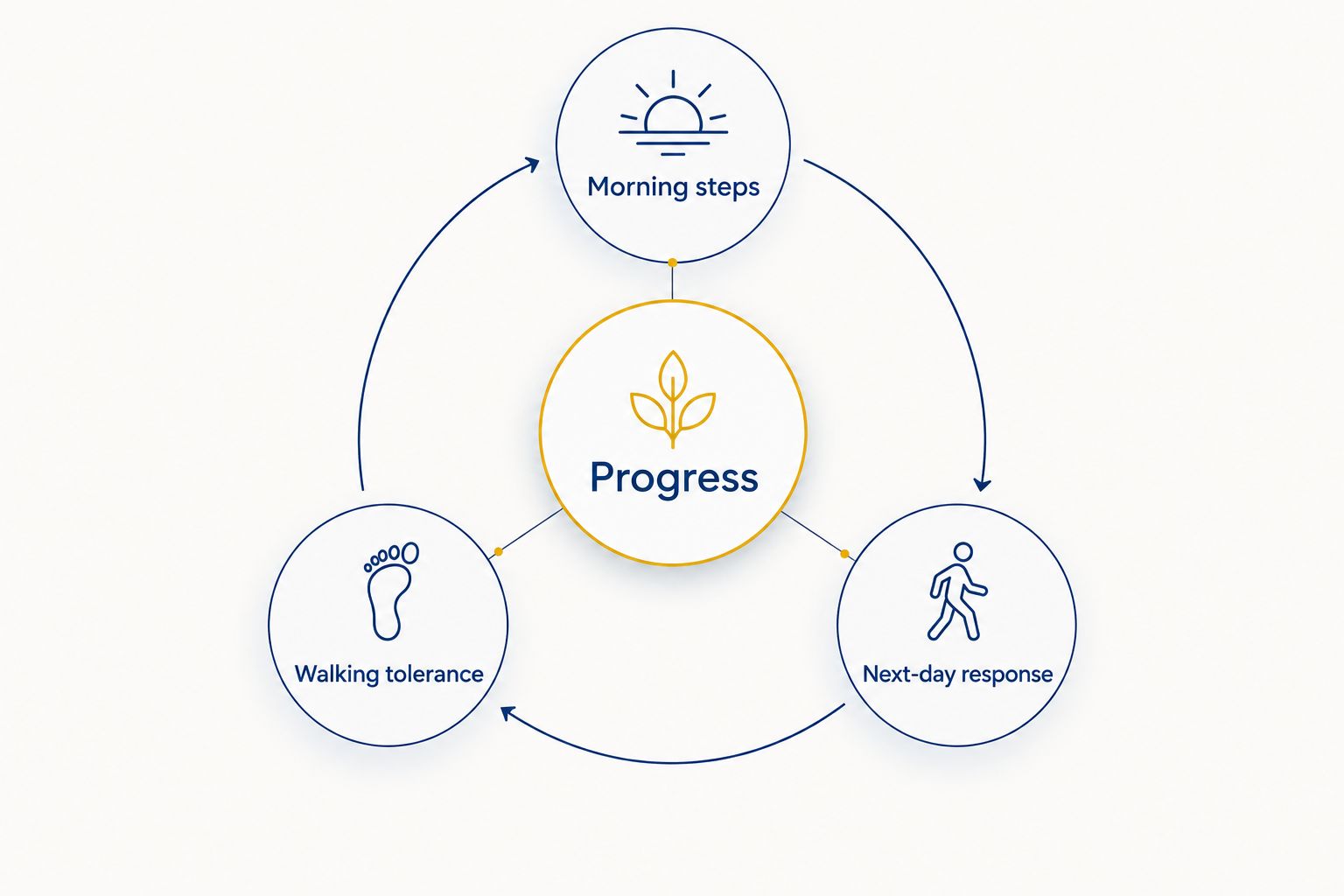
Your heel needs a functional scorecard, not just a question about whether it still hurts. Keep a brief record using the same activities and conditions so that comparisons mean something.
Morning steps
Record whether getting out of bed is easier, unchanged, or worse. Note whether the painful area has moved or whether burning, tingling, or numbness has appeared. A change in symptom pattern deserves clinical attention rather than automatically adding another plantar fasciitis treatment.
Walking tolerance
Track a familiar walk or household task. Record whether you finish comfortably, shorten the activity, or limp afterward. More comfortable activity at the same workload is more informative than less pain after avoiding nearly all activity.
Next-day response
Notice what happens the morning after a longer walk, work shift, or exercise session. Feeling better during activity is not the only outcome that matters. A repeated next-day flare is a reason to discuss the amount and type of loading with your clinician.
Bring that record to your appointment along with your usual footwear and a description of what you have already tried. It helps distinguish an ineffective plan from a useful plan that needs a different workload, fit, or exercise progression.
Match treatment to the problem, not the fastest claim
Plantar fasciitis commonly causes pain near the inner underside of the heel, especially with initial steps after rest. A clinician also considers other causes, including a calcaneal stress fracture, nerve entrapment, and heel fat-pad problems. Persistent pain is not proof that you simply need a stronger plantar fasciitis treatment.
Starting nonsurgical care
Best for: patients beginning treatment after assessment. Education, stretching, and short-term taping provide a coordinated starting point in the 2021 best-practice guide. Their advantage is that they address daily management without an invasive procedure; their limitation is that meaningful participation extends beyond the appointment.
Tell your clinician about barefoot walking on hard floors, standing at work, and recent increases in exercise. The plan needs to account for those demands. Adding exercises while leaving every aggravating activity unchanged is not the same as following a coordinated program.
Considering shockwave therapy
Best for: persistent symptoms after an adequate initial program. Shockwave therapy is a nonsurgical option considered in stepped care, but the escalation window in the table is not a promised response date. Discuss the protocol, treatment goal, and how progress will be assessed before starting.
Its advantage is a nonoperative treatment option for persistent plantar heel pain. Its limitations include treatment discomfort and differences among protocols and patient responses. A clinician should explain what comes next if symptoms do not improve, rather than presenting shockwave therapy as a guaranteed shortcut.
Considering an injection or surgery
Best for: selected patients after a diagnosis and benefit-risk discussion. An injection offers a different short-term objective from surgery. Neither belongs at the top of a list simply because conservative care feels slow.
The Cochrane injection finding concerns limited short-term pain relief, while surgery requires a procedure-specific discussion of risks, restrictions, and rehabilitation. Ask exactly which outcome the proposed treatment targets and what evidence supports that outcome for your situation.
Returning to pickleball, golf, and running
Return to activity should follow function, not the end of a treatment course. Finishing night-splint treatment or completing shockwave sessions does not automatically clear you for unrestricted play.
For pickleball, discuss lateral movement, quick stops, and repeated push-offs—not just straight-line walking. For golf, distinguish the demands of walking the course from those of practicing your swing. For running, discuss a graded return that accounts for symptoms during activity and the following morning.
The advantage of modifying activity is that you can preserve suitable movement while reducing aggravating demands. The limitation is practical: your preferred activity might need temporary changes. Ask about alternatives appropriate to your balance, cardiovascular health, and other medical conditions, particularly if you are returning after a period of reduced activity.
When the timeline needs a new diagnosis
Seek prompt assessment for a sudden pop, new bruising, marked swelling, inability to bear weight, or pain following an injury. Fever, spreading redness, or an open wound also require medical attention. A cold, pale, or suddenly numb foot needs emergency assessment.
If you have diabetes or reduced sensation, do not use pain intensity alone to judge safety. A newly hot, swollen foot needs prompt assessment even when it is not especially painful. Avoid aggressive self-treatment over damaged skin or areas you cannot feel normally.
For a nonemergency evaluation, Naples Podiatrist offers specialist foot and ankle care for patients along Southwest Florida’s coast. Call 239 430 3668 to arrange an appointment and describe your symptoms, their duration, and any change in your ability to walk.
Get your heel pain assessed
Discuss your diagnosis, daily activity, and a treatment plan with a foot and ankle specialist.
FAQ
How long does plantar fasciitis usually take to improve?
A 2019 American Family Physician review reports that about 80% of patients improve within 12 months with nonoperative treatment. That figure describes improvement across patients, not an average healing time or a guarantee of complete recovery.
Which plantar fasciitis treatment works fastest?
These benchmarks do not establish one treatment as the fastest route to complete recovery. Injection research measures short-term pain relief, while stretching, taping, night splints, and surgery guidance use different treatment windows and outcomes.
How long should I try stretching before reviewing my treatment?
The 2021 British Journal of Sports Medicine best-practice guide uses an initial 4–6-week core program that includes education, stretching, and taping. Review sooner if symptoms worsen, your walking changes substantially, or new symptoms develop.
How long do night splints take for plantar fasciitis?
The 2023 JOSPT guideline recommends a 1–3-month night-splint program for patients with consistent first-step morning pain. This is a recommended treatment course, not a guaranteed time to symptom resolution.
Does a steroid injection permanently fix plantar fasciitis?
A steroid injection does not guarantee permanent resolution of plantar fasciitis. The 2017 Cochrane review found a small pain benefit for up to 1 month, without demonstrated longer-term benefit; discuss complications and alternatives with your clinician.
Can I keep playing pickleball or golf during treatment?
Your activity plan should depend on your examination, walking tolerance, and symptom response rather than a fixed date. Discuss modifications if you limp, symptoms escalate, or the next morning is repeatedly worse.
When should I discuss surgery for plantar fasciitis?
AAOS patient guidance generally reserves surgery for symptoms that persist after 12 months of nonsurgical treatment. That threshold does not mean you should wait to seek assessment or that every persistent case needs surgery.
Can Naples Podiatrist assess heel pain that is not getting better?
Naples Podiatrist provides specialist foot and ankle care, including heel-pain treatment. An assessment can address whether plantar fasciitis explains your symptoms and which treatment or further evaluation fits your findings.
One last thing
The first comfortable day is a milestone, not proof of full recovery. In your 2026 activity plan, make the next-morning response part of every return-to-sport decision. If ordinary walking improves but pickleball or running repeatedly brings symptoms back, bring that distinction to your next review rather than restarting the same treatment without reassessment.
Related guides
- How long does plantar fasciitis take to heal?
- Custom orthotics for plantar fasciitis
- Shockwave therapy for plantar fasciitis in Naples
- Foot and ankle pain from pickleball