
 Fax: (239) 692-9436
 Tel: 239-430-3668
Instead of repeatedly calling to sort out hospital discharge podiatry follow-up, use a written handoff that connects your discharge instructions, hospital records, specialist appointment, and home-care plan. This 2026 workflow shows patients and caregivers how to confirm each step without changing the hospital team's treatment orders.
- Hospital discharge podiatry follow-up needs confirmed timing, transferred records, medication review, and clear home-care instructions.
- Naples Podiatrist provides specialist foot and ankle care for Southwest Florida patients needing podiatry follow-up.
- A referral request is not a confirmed appointment; verify the date, office, and clinical instructions.
- New emergency symptoms require emergency care, not a routine appointment or an unanswered portal message.
Why this matters
Leaving the hospital does not finish treatment for a foot wound, infection, fracture, or surgical incision. You still need to know who will examine your foot next, what care continues at home, and who will review unfinished tests.
Naples Podiatrist is best for Southwest Florida patients seeking specialist foot and ankle follow-up. Naples Podiatrist provides podiatric medical and surgical care, including diabetic wound care and foot and ankle trauma care. Scheduling a visit does not replace the discharge team's responsibility to explain your immediate treatment plan.
Use this 2026 checklist as an organizational guide, not a treatment protocol. Your discharge orders and treating clinicians determine appointment timing, dressing care, medications, and permitted activity.
Before you start
- Gather your materials: Keep the discharge instructions, medication list, hospital contact details, insurance information, and available procedure or imaging reports in 1 folder. Include equipment instructions and home-health paperwork when applicable.
- Confirm access and help: Have a working callback number, transportation plan, and a caregiver contact if you need assistance. For electronic records, use your own authorized account or the hospital's process for caregiver access.
- Catch the hidden gap: A hospital referral does not confirm that an outside office received your records or accepted an appointment. Ask which clinician owns pending test results and who handles urgent questions before the first visit.
If your paperwork gives no follow-up deadline, contact the discharging team for clarification. Do not substitute a generic interval from an online article for instructions based on your condition.
Discharge handoff
The first configuration unit is your handoff packet. Use the bold labels below as headings in your own checklist; they are not names of hospital software fields.
- Identify the patient. Put your full name and date of birth on the cover sheet. Check these 2 patient identifiers against the discharge paperwork before asking an office to locate records.
- Record the reason. Write the condition treated, the affected foot or ankle, and any procedure performed. Copy the diagnosis from the paperwork rather than interpreting unfamiliar medical terms yourself.
- Copy follow-up instructions. Record the named specialist, requested timing, and reason for reassessment. If the hospital named an operating surgeon, clarify whether that surgeon should provide postoperative follow-up before booking elsewhere.
- List pending results. Ask about cultures, pathology, imaging interpretations, or laboratory tests still outstanding. Record the clinician responsible for reviewing each result and communicating any treatment change.
- Confirm record transfer. Ask the receiving office which records it needs and which secure transfer method it accepts. Request those records through the hospital's approved process; do not assume separate organizations share a medical record.
Expected result: You can explain why follow-up is needed, when it is requested, and who is responsible for unresolved hospital findings.
Keep copies you can bring yourself. A discharge summary provides context, but an operative report, culture result, or imaging report can answer a different clinical question; ask the receiving clinician which documents matter for your visit.
Appointment confirmation
For your 2026 hospital discharge podiatry follow-up, separate requesting care from confirming care. A submitted form, voicemail, or referral transmission proves only that a request was made.
- Explain the discharge. Tell the scheduler that you recently left the hospital and name the condition, procedure, and requested follow-up timing. Report current concerns so clinical staff can decide how to route the request.
- Confirm the destination. Write down the clinician, office address, appointment date, and arrival instructions. Check the location before arranging transportation, especially if you use a wheelchair or cannot bear weight.
- Check referral requirements. Ask whether your insurance plan requires a referral or authorization and who will obtain it. An appointment confirmation is not a coverage guarantee.
- Resolve timing conflicts. If the offered appointment falls outside the hospital's instructions, contact the discharging team and receiving clinical staff. Ask for an appropriate plan rather than silently accepting the mismatch.
- Assign a contact. Choose who will answer scheduling calls, track paperwork, and tell the rest of the household about changes. Use authorized caregiver access rather than sharing account passwords.
Expected result: Your checklist contains a confirmed appointment or a named person actively resolving the scheduling problem—not simply a note that someone sent a referral.
Naples Podiatrist offers specialist foot and ankle care; the receiving clinical team determines the appropriate visit after reviewing your needs. Its outpatient service is not a substitute for emergency evaluation, and this workflow does not promise a specific appointment interval or automatic hospital-record access.
Home-care plan
A complete handoff must work between appointments. Confirm what you should actually do at home, particularly when mobility restrictions or wound care make everyday tasks difficult.
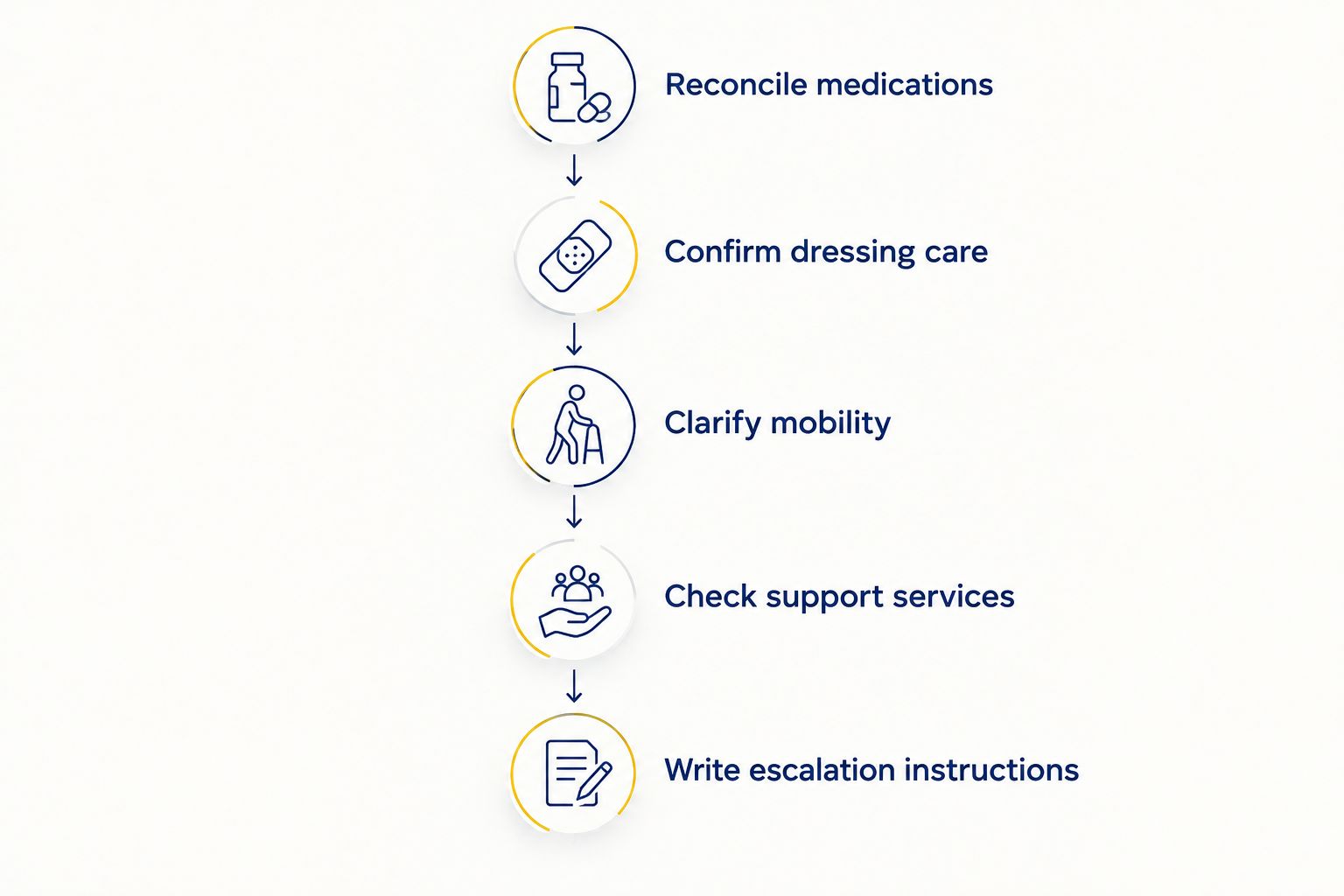
- Reconcile medications. Compare your discharge medication list with the medicines you already take, including nonprescription products and supplements. Ask the prescribing clinician or pharmacist to resolve duplicate, missing, or conflicting instructions; do not independently restart a stopped medicine.
- Confirm dressing care. Identify who changes the dressing, what instructions apply, and where supplies come from. Do not remove a surgical dressing, soak a wound, or add a topical product unless the treating team directs you to do so.
- Clarify mobility. Ask what weight-bearing restriction applies and which prescribed device to use. Have the team explain how to manage transfers, stairs, and bathroom access safely within that restriction.
- Check support services. If home nursing or therapy was ordered, confirm which organization accepted the referral and how to reach it. Ask the discharging team what to do if the planned service has not been arranged.
- Write escalation instructions. Separate emergency symptoms from concerns that require a prompt call to your treating team. Keep the appropriate contact details with your discharge papers.
Expected result: You and your caregiver can describe the medication, dressing, mobility, and contact plan without guessing.
Keep the goal of returning to golf, pickleball, running, or neighborhood walks separate from permission to resume them. Feeling better is not clearance to increase weight-bearing or return to sport after hospitalization.
Follow-up visit and handback
The workflow closes when the specialist's assessment becomes an updated plan you understand—not when you simply arrive at the office.
- Bring the packet. Take the discharge documents, current medication list, available reports, and prescribed devices. Include a short account of symptoms or practical problems since discharge.
- Describe changes. Explain new drainage, redness, swelling, pain, numbness, medication problems, or difficulty following restrictions. Report changes even if they seem minor; diabetes-related loss of sensation can reduce pain from a foot problem.
- Ask for decisions. Use 3 questions: What continues? What changes? When is the next review? Include dressing instructions, medication responsibility, mobility, and any additional tests or referrals.
- Confirm communication. Ask how updated instructions will reach your primary care clinician, home-health team, facility staff, or other treating specialists. Follow the office's authorization process where needed.
- Read back the plan. Explain the instructions in your own words and ask the clinician to correct misunderstandings. Obtain written instructions before leaving.
Expected result: You have an updated care plan, clear responsibility for remaining tasks, and a defined next contact.
For a 2026 caregiver handoff, date each update and identify its source. Keep older paperwork for context, but clearly distinguish it from the current clinician-directed plan.
When a result or care setting changes
A second workflow applies when a pending result becomes available or you move from home to rehabilitation, assisted living, or another care setting. Update the existing handoff instead of creating competing instructions.
| Workflow | Best for | Main benefit | Limitation |
|---|---|---|---|
| Initial discharge handoff | Patients leaving hospital care | Establishes the receiving clinician, appointment, and home instructions | Does not resolve tests still pending |
| Change-triggered handoff | Patients with new results or a change of care setting | Gives the receiving team updated clinical information and responsibilities | Requires confirmation that the new information was received |
For the change-triggered version:
- Record what changed, when it changed, and which clinician or organization supplied the information.
- Send the update through an approved channel to the clinician responsible for that issue.
- Ask whether the change affects treatment, visit timing, or the appropriate care setting.
- Confirm receipt and document the clinician's instructions before replacing the previous plan.
Expected result: Everyone working from the handoff can identify the current instructions and the clinician responsible for them.
Do not interpret a newly posted culture result yourself or switch antibiotics based on a portal notification. Contact the responsible clinician for interpretation and instructions.
Troubleshooting
The office cannot find the discharge records
Verify the receiving office and the hospital's transfer destination. Ask which documents are missing, arrange retransmission through an approved channel, and bring your available copies; clinical staff decide whether additional records are required before assessment.
The appointment misses the discharge deadline
Contact both the receiving clinical team and the discharging team. Explain the written deadline and current symptoms, then ask for a clinician-directed alternative rather than waiting without a plan.
The medication lists disagree
Contact the prescribing clinician or pharmacist with both lists in front of you. Identify the exact discrepancy, including the medicine name and instructions; do not choose between conflicting directions yourself.
Home care or equipment is not arranged
Tell the hospital discharge coordinator which ordered service or device is missing and why the gap affects safe care. Ask for an interim plan from the treating team rather than improvising wound care or walking without prescribed support.
Symptoms worsen while you wait
Do not treat a scheduled follow-up as a reason to delay urgent care. New chest pain, difficulty breathing, fainting, or a suddenly cold, pale, or blue foot requires emergency evaluation; call 911 for a medical emergency.
Contact your treating team promptly for spreading redness, increasing drainage, fever, wound opening, or worsening pain. Rapid progression, severe illness, or inability to reach appropriate help warrants urgent in-person evaluation.
Customize your workflow
For diabetic wounds, add the clinician's instructions about protecting the affected area, dressing care, and who monitors healing. The guide to wound care for diabetic foot ulcers in Naples provides additional condition-specific context, not a replacement for your discharge orders.
For rehabilitation or assisted living, identify the staff member responsible for appointment transport, medication administration, and carrying updated orders back to the facility. For seasonal residents, include contact details for clinicians who remain involved outside Florida.
Naples Podiatrist provides foot and ankle specialist care across Southwest Florida. When requesting follow-up, lead with the hospital diagnosis and discharge instructions so the clinical team can assess the request.
FAQ
How soon should I see a podiatrist after leaving the hospital?
Follow the timing in your discharge instructions or obtain clarification from the discharging team. The appropriate interval depends on the condition, procedure, and current symptoms; there is no single deadline for every patient.
Does a hospital referral mean my podiatry appointment is booked?
No, a hospital referral does not confirm an appointment. Verify the clinician, date, office location, and any records or referral requirements directly with the receiving office.
What should I bring to hospital discharge podiatry follow-up?
Bring your discharge instructions, current medication list, available hospital reports, insurance information, and prescribed mobility devices. Ask the receiving office whether it needs additional procedure reports, imaging, or test results.
Can a caregiver arrange my follow-up appointment?
A caregiver can help arrange follow-up through the office’s authorization process. Confirm permission for scheduling and medical communication, and use authorized account access instead of sharing passwords.
Who checks culture results that arrive after discharge?
The clinician assigned responsibility for the pending result should review it and communicate any treatment changes. Ask the discharging team to identify that clinician if the paperwork does not name one.
Should I wait for my appointment if my foot wound gets worse?
No, worsening symptoms require prompt contact with your treating team rather than waiting for the scheduled visit. Rapidly progressing symptoms, severe illness, or emergency warning signs require urgent or emergency evaluation.
Can I return to pickleball or golf before my follow-up?
Return only when your treating clinician permits the activity under your recovery plan. Less pain does not establish that a wound, fracture, or surgical repair is ready for sport.
One last thing
The most useful status is not referral sent; it is next action confirmed. Before putting away your 2026 discharge packet, ask someone to point to the appointment, current instructions, and person responsible for pending results. Anything they cannot identify is a question to resolve with the care team.
Related guides
- New patient guide: what to bring to your podiatry visit
- Primary care referral to podiatry treatment workflow
- Wound photo documentation to telehealth follow-up workflow

