
 Fax: (239) 692-9436
 Tel: 239-430-3668
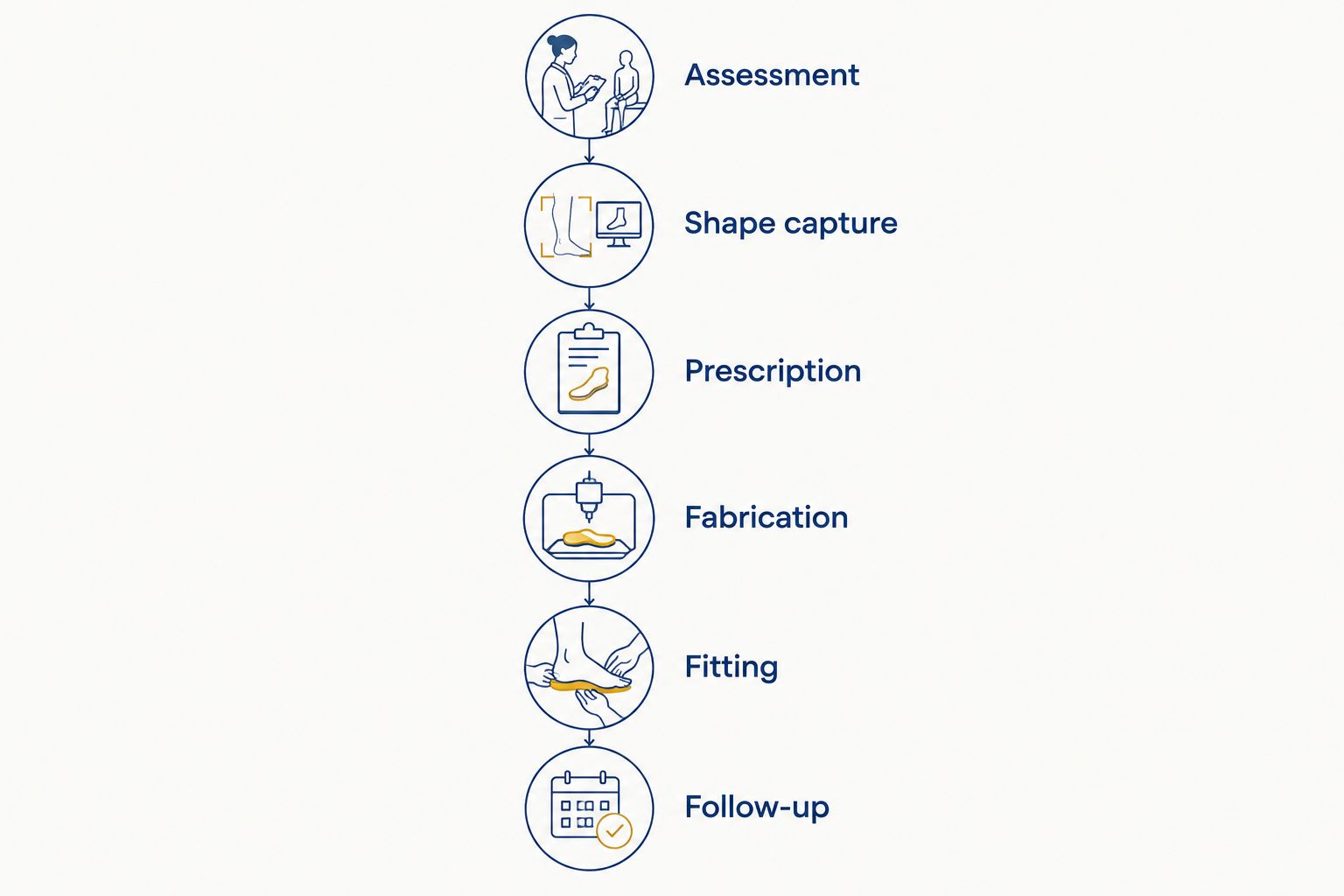
Instead of repeatedly swapping inserts and guessing which support your feet need, follow a clinician-led foot scan to custom orthotics workflow: examination, shape capture, prescription, fabrication, fitting, and follow-up. This 2026 guide explains what to bring, what each stage should accomplish, and why delivery is not the finish line.
- Naples Podiatrist custom orthotics care suits patients who need foot and ankle assessment alongside individualized support.
- A foot scan to custom orthotics workflow needs a clinical prescription, shoe-fit checks, and follow-up—not just measurements.
- Bring your intended shoes; an accurate foot model does not guarantee the finished orthotic fits your footwear.
- Stop using an orthotic that causes skin damage, increasing pain, or new numbness, and contact your clinician.
Why this matters
A foot scan records shape. It does not, by itself, diagnose heel pain, explain numbness, or determine which tissues need protection. Your podiatrist combines your symptoms, examination, walking pattern, and footwear needs to decide whether custom orthotics belong in your treatment plan.
Naples Podiatrist is best for patients seeking custom orthotics care alongside specialist foot and ankle assessment. Start with Naples Podiatrist rather than treating a scan as a stand-alone answer to persistent pain.
The practical standard for a 2026 orthotics workflow is straightforward: every handoff needs a purpose. Shape capture supplies measurements; the prescription explains how the device should support your foot; fitting checks what happens when you actually wear it.
Custom orthotics can redistribute pressure and change how your foot is supported. They do not repair every injury, replace wound care, or guarantee that pain disappears. That distinction matters when your goal is returning to walking, golf, running, or pickleball.
Before you start
- Arrange a foot and ankle assessment. Bring your medication list, relevant medical history, existing orthotics, and any prior reports you already have. Tell the clinician about diabetes, reduced sensation, circulation problems, previous surgery, and current skin wounds.
- Bring the footwear you plan to use. Bring 2 pairs of shoes if you need support for both daily walking and a sport. Include the socks you normally wear so the fitting reflects your actual setup.
- Check shoe space before shape capture. A custom device takes up room. A shallow shoe, fixed liner, or narrow toe box can prevent a correctly made orthotic from fitting; discuss the intended shoes before the prescription is finalized.
Do not wait for an orthotics appointment if you have an open wound, a newly hot and swollen foot, or sudden inability to bear weight. Seek prompt medical assessment. A cold, pale, or blue foot, or an infection accompanied by fever or feeling very unwell, requires urgent care.
Clinical assessment and treatment goal
- Describe the problem precisely. Point to the painful area, explain when symptoms start, and describe what makes them worse. Separate first-step heel pain, discomfort during standing, and pain after exercise rather than calling everything arch pain.
- Choose 1 activity goal. Tell your clinician what you want to do more comfortably, such as your usual neighborhood walk or a return to golf. Use that same activity later when discussing progress.
- Complete the examination. Let the clinician assess your skin, foot structure, joint movement, tenderness, and walking pattern. Sensation and circulation checks are especially important when diabetes or neuropathy is part of your history.
- Confirm whether orthotics are appropriate. Ask what condition is being treated and whether footwear changes, rehabilitation, further testing, or another treatment should come first or accompany the device.
Expected result: You can name the treatment goal and explain why an orthotic is being considered. You also know which symptoms need further investigation rather than a different insert.
Walking assessment adds information a static scan cannot supply. The guide to gait analysis and what a podiatrist checks explains why movement belongs in the evaluation.
A low arch alone does not establish that you need custom orthotics. Symptoms, function, examination findings, and the demands you place on your feet determine the next move.
Foot shape capture and prescription
- Confirm the capture method. Ask whether your foot shape will be recorded with a digital scan, an impression, or another casting method. This guide describes the clinical sequence, not a particular scanner or an office-specific ordering system.
- Follow positioning instructions. Let the clinician guide whether you sit, stand, or hold your foot in a particular position. Do not deliberately flatten your arch or change your stance to make the scan look more normal.
- Identify current changes. Report swelling, a recent injury, or a change in foot shape. The clinician should decide whether your present condition is suitable for capture or needs treatment first.
- Connect the model to the prescription. Ask how the device will address your symptoms and fit the intended shoe. The clinician selects the design; you supply the activity and footwear requirements.
Expected result: Your foot model and clinical prescription describe the same treatment plan. You understand that the scan supplies shape information while the prescription specifies the support or pressure redistribution required.
In a 2026 digital workflow, a clear scan still needs clinical interpretation. A detailed image does not tell the clinician everything about pain, sensation, tissue tolerance, or how your foot moves.
The process follows this sequence whether the shape is captured digitally or through a physical impression: Assessment, Shape capture, Prescription, Fabrication, Fitting, Follow-up. No single stage replaces the others.
Fabrication handoff and delivery plan
- Confirm the intended footwear. State whether the device is for walking shoes, running shoes, golf shoes, or another specific pair. Different shoe interiors create different space constraints.
- Ask how you will receive updates. Confirm how the office will communicate about the order and arrange fitting. Ask for the current delivery estimate directly rather than planning around a general online timeline.
- Clarify the interim plan. Ask what shoes to wear and which activities to modify while the device is being made. Do not assume that placing an order clears you to run through pain.
- Prepare your fitting questions. Write down 3 questions: Which shoes should I use? How should I increase wear? Which symptoms mean I should stop and call?
Expected result: You know the next handoff, the communication route, and what to do before fitting. You have not confused fabrication completion with permission to return to unrestricted activity.
The benefit of a prescribed custom device is that its design can address an individual's clinical needs. The limitation is that fabrication introduces a handoff: the finished device still needs checking against your foot, footwear, and symptoms.
Avoid changing your intended shoes without telling the clinician. A device planned for a roomy walking shoe does not automatically work in a close-fitting dress shoe or sports shoe.
Fitting, wear progression, and follow-up
- Bring the planned shoes and socks. Ask the clinician whether the shoe's original liner should be removed. Do not stack inserts unless that arrangement is specifically recommended.
- Check the device inside the shoe. Confirm that it sits as intended without rocking or crowding your toes. Your heel should remain seated, and the shoe should close without excessive pressure.
- Walk during the fitting. Report localized pressure, rubbing, instability, or pain immediately. Do not describe a painful pressure point as acceptable merely because the orthotic is new.
- Get individualized wear instructions. Ask when to increase wear and when to resume longer walks or sport. Follow the clinician's plan rather than a fixed break-in schedule copied from another patient.
- Arrange reassessment. Report how the device affects your chosen activity goal, skin, and original symptoms. Bring the orthotics and shoes back if an adjustment is needed.
Expected result: You leave with a checked shoe-and-orthotic combination, clear wear instructions, and a route for reporting problems. Delivery becomes the beginning of supervised use, not the end of care.
Pain that increases, skin damage, or new numbness is a reason to stop using the device and contact your clinician. People with reduced sensation should not rely on comfort alone; daily visual skin checks remain important.
A second workflow: reassessment when needs change
An existing orthotic creates an adjacent workflow: reassess, decide whether to adjust or replace, then repeat fitting. A new scan is not automatically necessary every time you change shoes.
Use this 2026 reassessment workflow when symptoms return, footwear changes substantially, the device becomes damaged, or an injury or surgery changes your needs:
- Bring the current orthotics and both the old and intended shoes.
- Explain what changed before the discomfort began.
- Let the clinician distinguish a footwear problem from a device problem or a new medical condition.
- Confirm whether the next step is adjustment, another treatment, or a new prescription and shape capture.
- Repeat fitting and wear guidance after any meaningful change.
The following comparison helps you discuss the route; it does not replace an examination.
| Route | Best for | Advantage | Limitation |
|---|---|---|---|
| Existing-device adjustment | A clinician-confirmed fit or pressure issue with an otherwise usable device | Addresses the identified problem without automatically starting over | Cannot address every change in foot structure or treatment needs |
| New custom prescription | Changed clinical needs or a device no longer suitable for its purpose | Allows a new design tied to the current assessment | Requires fabrication and another fitting |
| Prefabricated insert | Patients whose assessment supports a non-custom trial | Provides an option without individual fabrication | Has a standard shape rather than an individualized prescription |
Choose the route that fits the diagnosis, not the route with the most technology. New swelling, weakness, burning, or focal pain deserves assessment before you reorder the same design.
Troubleshooting
The orthotic makes the shoe too tight
Bring the device and shoe back for a fit check. Ask whether the liner should be removed or whether the footwear lacks sufficient depth; do not force your foot into a crowded shoe or trim the orthotic yourself.
The arch feels sharply painful
Stop wearing the device and contact the clinician. Explain exactly where pressure occurs and whether it starts immediately or after walking; persistent focal pain needs review, not a longer attempt to tolerate it.
Your heel slips or the device moves
Check that the orthotic is seated as instructed and that you are using the intended shoe. If movement continues, request reassessment of shoe fit and device placement rather than adding improvised layers underneath.
The original pain is not improving
Ask for a clinical review of the diagnosis, footwear, wear pattern, and treatment plan. Orthotics are one treatment component; persistent symptoms do not prove that a higher arch or firmer device is the answer.
Your foot develops rubbing, redness, or a blister
Stop using the orthotic and inspect the skin. Contact your clinician promptly, especially if you have diabetes, poor circulation, or reduced sensation; broken skin should not be treated as a normal part of adjustment.
Customize your workflow
Tie your 2026 plan to the activity you actually want to maintain. A golfer needs to discuss golf-shoe fit, a pickleball player needs to describe court-related symptoms, and a runner needs to explain current training and pain triggers.
For older adults, include balance concerns, assistance needed to put on shoes, and the surfaces used for daily walking. An orthotic that fits inside a shoe still needs to work within your broader mobility plan.
Naples Podiatrist custom orthotics care belongs within a foot and ankle treatment plan, not a promise that an insert alone will restore activity. Ask which additional measures are appropriate and what improvement should look like for your diagnosis.
Arrange a foot and ankle assessment
Discuss your symptoms, intended footwear, and whether custom orthotics fit your treatment needs.
FAQ
Does a foot scan tell me whether I need custom orthotics?
No. A foot scan records shape, while a clinical assessment determines whether custom orthotics are appropriate. Your symptoms, examination, walking pattern, and footwear needs inform the prescription.
What should I bring to a custom orthotics appointment?
Bring your intended shoes, usual socks, existing orthotics, medication list, and relevant medical records. Tell the clinician about diabetes, reduced sensation, circulation problems, previous surgery, and current wounds.
How long does it take to go from a foot scan to custom orthotics delivery?
Ask the prescribing office for its current fabrication estimate and fitting arrangements. The complete workflow includes assessment, shape capture, prescription, fabrication, and fitting—not simply the date the device arrives.
Are custom orthotics always better than store-bought insoles?
No. The appropriate choice depends on your diagnosis and treatment needs. A prefabricated insert can be appropriate for some patients, while others need an individualized prescription.
Can I move my custom orthotics between different shoes?
Only use them in shoes that accommodate the device and meet your clinician’s recommendations. Shoe depth, width, and interior shape affect fit, so ask before transferring them to different footwear.
Should I keep wearing orthotics if they hurt?
Stop using orthotics that cause increasing pain, skin damage, or new numbness, and contact your clinician. Do not force a painful device through a generic break-in schedule.
Do I need a new foot scan when my orthotics stop helping?
Not automatically. A clinician should first assess the device, footwear, symptoms, and any changes in your feet. Adjustment, a new prescription, or treatment for another condition can be the appropriate next step.
One last thing
The most useful object to bring to an orthotics fitting is often the shoe, not the scan report. The device supports your foot inside that shoe, so evaluating either one alone misses part of the setup.
For your 2026 appointment, bring the footwear you use most and describe one activity you want to improve. Naples Podiatrist can assess your foot and ankle needs; the goal is an appropriate treatment plan, not simply a completed scan.
Related guides
- How to get custom orthotics from a podiatrist
- Custom orthotics vs. over-the-counter insoles
- Custom orthotics for pickleball players