
 Fax: (239) 692-9436
 Tel: 239-430-3668
Instead of deciding each morning whether your foot can handle a regular shoe, use this 2026 workflow for transitioning to shoes after foot surgery: get your surgeon’s clearance, check shoe fit, complete the approved walking trial, and review your response before increasing activity. A comfortable shoe does not prove that a surgical repair is ready for more weight or movement.
- Transitioning to shoes after foot surgery starts with surgeon clearance, not a calendar date or pain-free morning.
- Naples Podiatrist provides specialist foot and ankle care for Southwest Florida patients seeking postoperative guidance.
- A CAM boot and a regular shoe provide different protection; weight-bearing permission does not automatically authorize shoe wear.
- Use approved footwear, track swelling and walking quality, and keep return-to-sport decisions separate from everyday walking.
Why this matters
A controlled ankle motion, or CAM, boot limits movement and protects your foot during selected stages of recovery. A regular shoe changes that protection. Bones, tendons, ligaments, and incisions have different healing requirements, so the operation—not simply the time spent in a boot—determines the transition.
Naples Podiatrist is best suited to Southwest Florida patients seeking specialist foot and ankle care. If your discharge instructions do not explain shoe progression, contact your surgical team before testing it; Naples Podiatrist provides medical and surgical care for foot and ankle conditions.
Your 2026 recovery plan should separate permission to bear weight, permission to remove the boot, and permission to exercise. These are different decisions. Full weight bearing in a boot does not necessarily mean full weight bearing in an ordinary shoe.
This guide organizes questions and observations for your care team. It does not replace your surgeon’s instructions or provide a universal rehabilitation schedule.
Before you start
- Get explicit clearance. Confirm which shoe you can use, where you can wear it, whether you still need a walking aid, and when the boot remains required. Ask for written instructions if the plan is unclear.
- Gather your materials. Have your approved shoes, usual socks, prescribed inserts or heel lifts, walking aid, and a place to record symptoms. Choose a clear indoor route without loose rugs, pets underfoot, or stairs.
- Check the hidden restriction. Permission to remove the boot for hygiene, sleep, or exercises is not permission to walk without it. After tendon repair or fusion, changing a heel lift or forcing joint movement can conflict with the surgical protocol.
Before starting a 2026 shoe transition, tell your surgeon about diabetes, reduced sensation, poor circulation, balance difficulty, or an incision that has not healed. Pain alone is an unreliable guide when sensation is reduced. Do not proceed with a shoe trial if your care team has not addressed these concerns.
Surgical clearance and recovery limits
- Identify your operation. Write down the procedure and the operated side. A bunion correction, tendon repair, and joint fusion do not share one shoe-transition schedule.
- Confirm your weight-bearing order. Ask whether you remain non-weight bearing, have restricted weight bearing, or can bear weight as tolerated. Request a demonstration if the wording is confusing.
- Confirm boot-removal rules. Ask whether the approved transition applies indoors, outdoors, or only during supervised rehabilitation. Clarify whether the boot stays on for longer outings.
- Record movement restrictions. Ask about ankle bending, toe bending, stretching, stairs, and any prescribed heel lift. Do not remove a support because it feels inconvenient.
- Agree on stop criteria. Ask what symptoms require ending a trial, contacting the office, or urgent assessment. Also confirm how to reach your surgical team outside office hours.
Expected result: You can explain exactly when you are allowed to wear a shoe and what remains restricted. If you cannot, stay with your existing instructions and request clarification rather than improvising.
Bring practical questions to the appointment. “Can I walk from my bedroom to the kitchen in this shoe?” is more useful than “Can I get back to normal?” Describe your actual needs, including stairs, grocery shopping, caregiving, and work.
Shoe fit and prescribed support
- Use the approved footwear type. Start with the shoe your surgeon or rehabilitation clinician recommends, not whichever shoe feels softest. Match any required sole stiffness, heel position, and support.
- Check both shoes. Fit the operated foot without squeezing the incision or swollen areas, and check that the other shoe is secure. Your previous size is a starting point, not proof of current fit.
- Secure the heel. Adjust the fastening so your heel does not slip while your forefoot remains comfortable. Do not tighten the shoe to force a swollen foot into it.
- Check prescribed inserts. Make sure an orthotic or heel lift sits as directed and does not crowd the shoe. Do not add extra inserts or stack supports without approval.
- Inspect the skin. Look for rubbing, pressure, drainage, or a dressing displaced by the shoe. If sensation is reduced, use visual inspection rather than comfort alone.
Expected result: The shoe stays secure without pressing on the incision, compressing your toes, or requiring you to alter prescribed supports. Fit alone does not authorize walking; clearance still comes first.
Footwear choices during the transition
These options serve different purposes. None is a substitute for a procedure-specific instruction.
| Footwear option | Best for | Advantage | Limitation |
|---|---|---|---|
| Prescribed CAM boot | Patients still requiring surgical protection | Restricts motion and provides the protection selected by the surgeon | Bulky; its height can change walking mechanics |
| Surgeon-approved walking shoe | Patients cleared for ordinary footwear during daily walking | Allows a return to shoe-based walking with a secure fit | Does not provide the same immobilization as a CAM boot |
| Prescribed postoperative shoe | Patients whose procedure requires a specific protective shoe | Provides the footwear configuration selected for recovery | Is not interchangeable with a boot or ordinary shoe |
For footwear features to discuss with your clinician, read best shoes to wear after foot surgery. The best transition shoe is the approved shoe that fits your current foot—not the shoe you hope to wear eventually.
Approved walking trial and symptom record
- Start under the conditions you were given. Use the location, walking aid, and amount of walking approved by your surgeon or physical therapist. Do not substitute an errand for a controlled trial.
- Keep the route predictable. Walk on a clear, level surface. Avoid carrying objects that prevent you from using your walking aid correctly.
- Watch your walking pattern. Notice limping, shortened steps, foot dragging, or leaning away from the operated side. Stop rather than practicing through a new or worsening limp.
- Record the response. Note shoe-wearing time in minutes, pain location, swelling, skin changes, and walking quality. Record what you actually did rather than estimating from memory.
- Review before progressing. Follow the progression your clinician prescribed. Do not increase duration, distance, and terrain difficulty together unless your plan specifically directs it.
Expected result: You have a usable record of the approved activity and your foot’s response, without overriding the surgical restrictions.
Use 3 checkpoints per trial: before walking, after walking, and the following morning. This is a recording method, not a test that proves healing. For each checkpoint, compare symptoms with your usual baseline and report meaningful changes.
A simple entry can include the date, footwear, activity, minutes in the shoe, use of a walking aid, and any change afterward. Do not set your own daily step target from a fitness watch. A high step count says nothing about whether the repair is ready for that load.
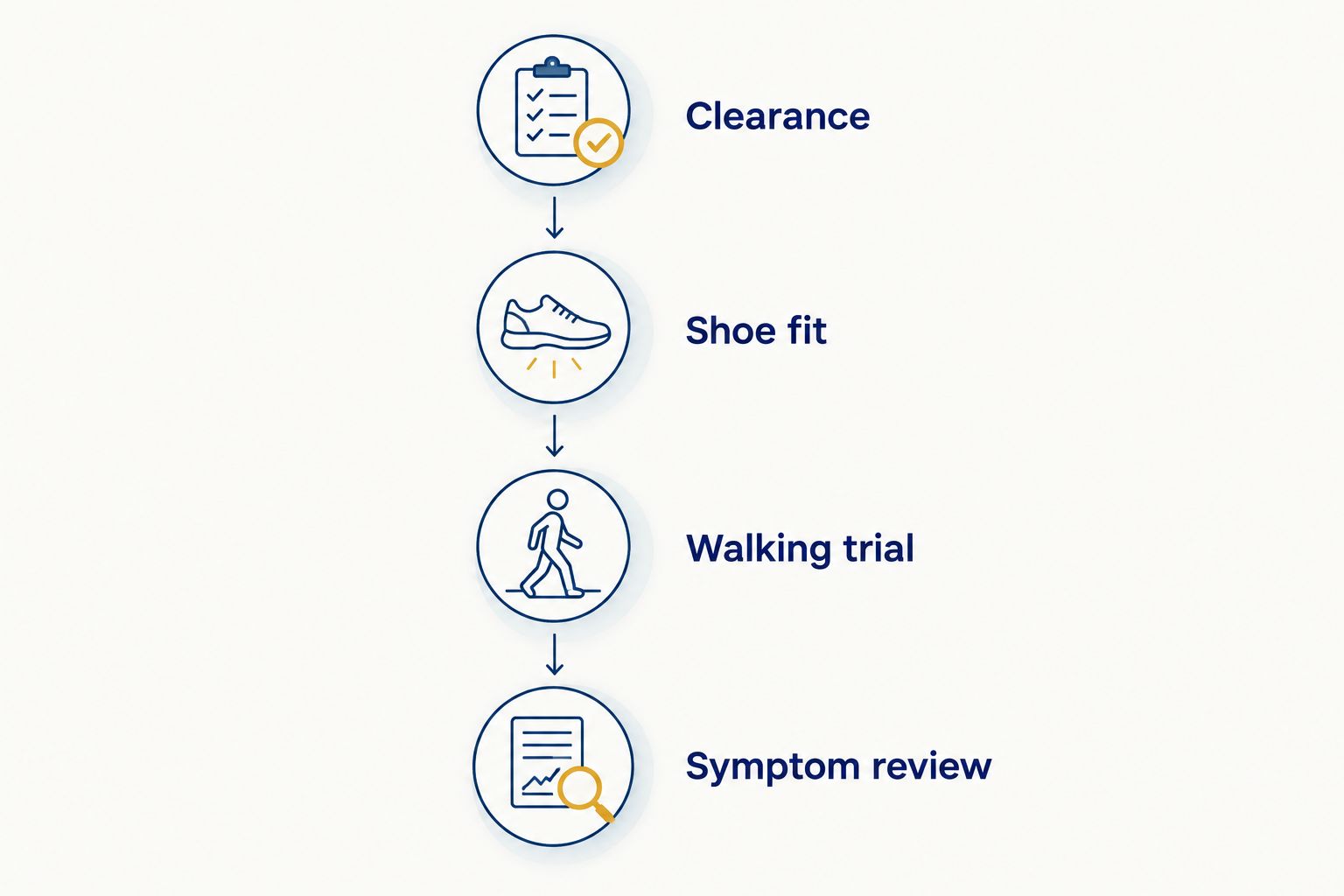
Daily activity and progression limits
- Count household activity. Standing to cook, showering, and repeated trips around the house add to your activity. A short planned walk is not your entire workload.
- Change only the approved variable. If your plan increases shoe-wearing time, keep other demands stable. Do not also add hills, shopping, or exercise.
- Preserve walking quality. Keep prescribed aids until your clinician clears you to stop. Removing a cane or crutch while you still limp is not a successful progression.
- Separate walking from sport. Ask for specific clearance before pickleball, golf, running, or uneven-ground activity. Ordinary walking does not test the same demands as pivoting or pushing off.
- Bring the record to follow-up. Show your clinician what caused symptoms and what remained comfortable. Ask whether the next change should involve footwear, activity, rehabilitation, or further assessment.
Expected result: You expand daily function within the approved plan rather than treating boot removal as the end of recovery.
For older adults, balance and fall prevention belong in this stage. Keep walking paths well lit and arrange help with tasks that require carrying items or negotiating steps. Do not practice unsupported balance exercises on the operated foot without rehabilitation clearance.
When symptoms change after an approved progression
The adjacent workflow is a reassessment loop: an authorized increase produces a new problem, so you pause further increases and contact the care team. This is not an invitation to repeatedly provoke pain until the foot adapts.
During your 2026 recovery, compare the new activity with your previous tolerated activity. Identify whether you changed time in the shoe, walking distance, standing time, terrain, or footwear. Report the change clearly.
- If the shoe begins rubbing: Stop the trial, inspect the skin, and ask about fit or dressing adjustments. Do not keep wearing it to “break it in” over an incision.
- If swelling or pain increases: Stop increasing activity and follow your postoperative instructions. Contact the team for guidance about the next trial and required protection.
- If you start limping: Use your prescribed aid and request advice. Do not force longer walks to correct the limp.
Restart only within the instructions your clinician confirms. An automatic return to the boot is not a complete plan, particularly when new symptoms need assessment.
Troubleshooting
The shoe fits in the morning but feels tight later
Activity and postoperative swelling can change fit throughout the day. Stop if the shoe becomes constricting, follow your prescribed swelling-management measures, and discuss an adjustable fit with your clinician. Do not force the foot into the shoe or start compression without approval.
You can walk, but you still limp
Walking ability and walking quality are different. Reduce the demand within your approved plan, keep your prescribed walking aid, and ask whether you need a gait or rehabilitation review. Persistent limping deserves assessment rather than reassurance from a step counter.
Your heel or ankle feels stiff
Immobilization can leave joints and muscles stiff, but the permitted movements depend on the repair. Perform only prescribed exercises. Avoid aggressive calf stretching or forcing toe motion, especially after tendon repair or joint fusion.
The incision becomes red, opens, or drains
Stop shoe pressure over the area and contact your surgical team promptly. Spreading redness, fever, increasing drainage, or worsening pain requires timely assessment. Do not soak the incision, massage it, or treat it with an unapproved cream.
New calf symptoms or breathing symptoms appear
New calf pain, tenderness, or one-sided leg swelling after surgery requires urgent medical assessment for a possible blood clot. Call 911 for sudden shortness of breath, chest pain, coughing blood, or fainting. Do not wait for a routine postoperative appointment.
Customize your workflow
Build the next stage around your actual goal. Standing at work, walking a golf course, and returning to pickleball require different decisions. Ask your clinician to specify both the permitted activity and the restriction that still applies.
Naples Podiatrist provides specialist foot and ankle care for patients across Southwest Florida. Bring your shoe, prescribed supports, and activity record when seeking guidance; these make the discussion more specific than reporting that the foot “feels better.”
Keep 2 separate decisions in your plan: everyday shoe wear and return to sport. A comfortable walk around the house does not establish readiness for running, court movement, or a golf swing.
Discuss your shoe transition
Get specialist guidance on foot and ankle care and postoperative footwear questions.
FAQ
When can I start transitioning to shoes after foot surgery?
Start when your surgeon specifically clears shoe wear for your procedure. Permission to bear weight in a boot or remove it for hygiene does not automatically authorize walking in regular shoes.
Can I stop wearing my CAM boot if my foot no longer hurts?
No—pain relief alone does not establish that the surgical repair is ready. Keep following the prescribed protection and weight-bearing instructions until your surgeon changes them.
What shoes should I wear after a CAM boot?
Wear the footwear type your surgeon approves, with a secure fit and room for the operated foot and any prescribed support. An ordinary walking shoe does not provide the same immobilization as a CAM boot.
Should I wear the boot outside and shoes inside?
Use that arrangement only if your surgical team prescribes it. Indoor walking still loads the repair, and household surfaces do not remove weight-bearing restrictions.
Is swelling normal when I start wearing shoes again?
Swelling can occur during postoperative recovery, but a new or worsening change needs review against your surgical instructions. Contact your care team if swelling increases, the shoe becomes constricting, or other symptoms develop.
What should I do if I limp after taking off the boot?
Stop increasing activity and use the walking aid prescribed for you. Ask your surgeon or physical therapist to assess the limp rather than trying to correct it with longer walks.
Can I return to pickleball, golf, or running once I can wear shoes?
Not without activity-specific clearance. Pivoting, pushing off, running impact, and uneven ground place demands on the foot that ordinary household walking does not.
Can Naples Podiatrist help with foot and ankle recovery questions?
Naples Podiatrist provides specialist medical and surgical foot and ankle care in Southwest Florida. For changes to an existing postoperative plan, contact your operating surgeon so advice stays consistent with the repair.
One last thing
Your non-operated shoe matters, too. While you still use a CAM boot for prescribed activities, a difference in footwear height can affect walking mechanics. Ask your clinician whether the opposite shoe needs adjustment; do not improvise a lift.
For your next 2026 follow-up, bring both shoes—not just the operated-side shoe—and your symptom record. That gives your clinician a clearer view of fit, support, and how you are walking.
Related guides
- How a podiatrist assesses your walking pattern
- How to reduce swelling after foot or ankle surgery
- Physical therapy for foot and ankle recovery: what to expect