
 Fax: (239) 692-9436
 Tel: 239-430-3668
Film and TV production crew foot care is a routine of footwear checks, skin protection, workload adjustments, and timely medical assessment aimed at keeping you walking safely through production. This 2026 guide addresses standing between takes, carrying equipment, changing locations, and recovering before the next call time.
- Foot care for film and tv production crew starts with task-appropriate shoes, dry socks, and daily skin checks.
- Naples Podiatrist suits Southwest Florida crew members seeking specialist foot and ankle care.
- Stop equipment carrying when pain changes your walking; cushioning does not make an injury safe.
- Seek prompt assessment for wounds, persistent numbness, focal swelling, or difficulty bearing weight.
Why foot care matters for production crew
Your footwear has to match the job, not just feel comfortable at breakfast. Standing beside a monitor, pushing a cart, climbing steps, and carrying cases place different demands on your feet; outdoor locations also add uneven ground and wet surfaces.
Choose footwear around the actual hazards on your set. The guide to work boots for foot and ankle support explains a useful starting point when your assignment requires protective footwear rather than ordinary walking shoes.
Pain also affects how you work. A limp changes your balance while carrying equipment, and a painful toe can make stairs or a crouched position difficult. Treat those changes as reasons to adjust your task and seek care, not as proof that you need a softer insert.
For your 2026 production schedule, build foot care into preparation and wrap. A repeatable routine is easier to follow than a collection of remedies after symptoms become disruptive.
Build your on-set foot care routine
1. Match your shoes to the assignment
Start by checking the shoes you already own against your location and duties. Look for secure fastening, enough toe room, stable footing, and an outsole suited to the surface. Protective requirements come first; a comfortable sneaker is not a substitute for required safety footwear.
Check fit while wearing your work socks. Your heel should stay reasonably secure without squeezing your forefoot, and your toes should not hit the front during downhill walking or stair descent. Test the fit with the movements you expect to perform, without carrying a heavy load during the trial.
Compare both shoes for uneven wear or damaged soles. Replace footwear when its condition compromises fit, support, or traction rather than following an arbitrary replacement calendar.
- Review the production's footwear and protective-equipment requirements.
- Test walking, turning, stepping, and crouching before the assignment.
- Check that your toes are not compressed by the upper or toe cap.
- Inspect tread, fastening, and internal seams.
- Reserve unfamiliar shoes for a short trial, not a full location day.
2. Protect your skin before friction builds
Use a visual foot check before you put your shoes on. Look between the toes, along the heels, and under the forefoot for redness, cracks, blisters, or drainage. Check inside each shoe for grit, folded liners, and rough seams.
Pack 1 spare pair of socks per workday as a practical minimum, with additional pairs for wet locations. That is a packing recommendation, not a guarantee against blisters. Change damp socks when you have a safe opportunity, and let wet footwear dry before using it again.
For an intact blister, protect it from rubbing rather than deliberately opening it. If skin breaks, gently clean it and use a clean dressing; increasing redness, warmth, drainage, or pain needs medical assessment. Diabetes, poor circulation, and reduced sensation lower the threshold for seeking help.
- Wash your feet and dry carefully between the toes.
- Change socks when they become damp or bunch inside the shoe.
- Remove debris before it creates repeated friction.
- Cover a friction spot with an appropriate protective dressing.
- Avoid blades or acid-based corn removers on vulnerable skin.
3. Record symptoms before choosing a treatment
Write down where your foot hurts, when symptoms start, and which task brings them on. A phone note is enough. Record whether you have swelling, numbness, a recent twist, or pain that changes your walking.
This prevents a common mistake: treating every painful foot as plantar fasciitis. Heel pain, tendon pain, nerve symptoms, and bone injuries need different decisions. An insert or stretch that feels helpful does not establish a diagnosis.
Naples Podiatrist is best for Southwest Florida crew members seeking specialist foot and ankle care. The practice offers care for heel pain, neuromas, foot and ankle trauma, and custom orthotics. A Naples Podiatrist assessment provides a clinical route when symptoms persist; it does not replace workplace safety arrangements or guarantee immediate return to unrestricted duties.
- Mark the painful area on a simple foot sketch.
- Note whether symptoms occur at rest, while standing, or during walking.
- Record injuries and changes in footwear or workload.
- Bring your work shoes and existing inserts to the appointment.
- Ask which duties and activities are safe during recovery.
4. Use safe breaks to change the load
You do not need purchased equipment to stop standing motionless. When production permits, sit during a pause, change position, or take gentle steps in a clear area. Do not add movements that interfere with a take, equipment handling, or your balance.
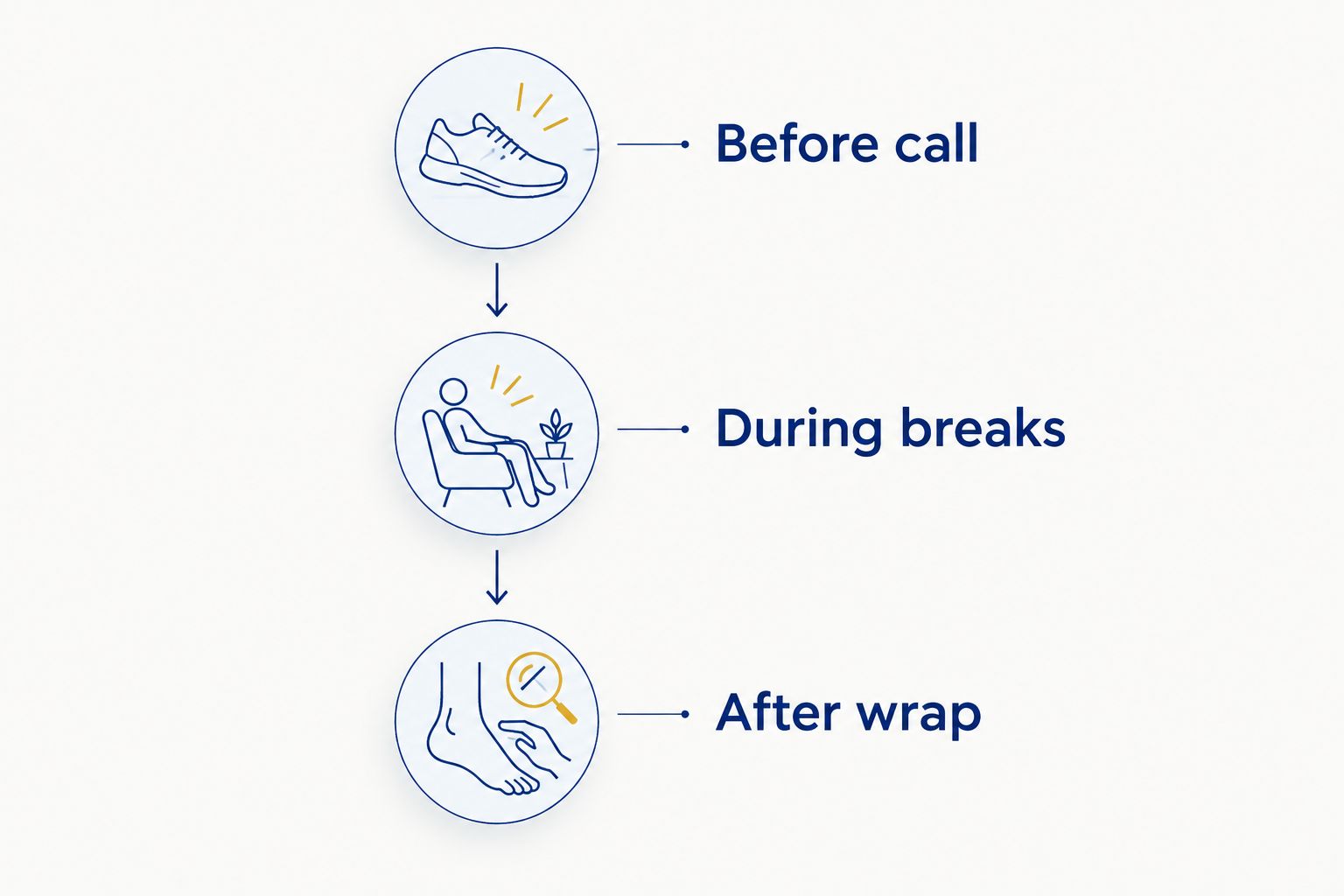
Build 3 routine checkpoints into your 2026 workday: before call, during breaks, and after wrap. These are reminders to check comfort and skin, not a medically prescribed break interval. A safety concern should interrupt the routine immediately rather than wait for the next checkpoint.
Before call, check shoes and baseline symptoms. During breaks, address damp socks and pressure spots. After wrap, inspect your feet and note whether pain has settled or remains localized.
A mat helps only when its placement is safe. Keep mats away from travel paths, rolling equipment, and cable routes unless the responsible safety lead approves the setup.
- Sit when your assignment allows a safe pause.
- Change position rather than locking your knees while standing.
- Check pressure spots before the next equipment move.
- Ask for help with loads when pain affects your footing.
- Keep rest areas and any mats clear of working routes.
5. Recover without masking an injury
After wrap, remove your shoes and compare both feet. Mild general tiredness and a sharply localized painful spot are different observations. New swelling, bruising, or a limp deserves more attention than simply feeling tired.
Rest from the task that provokes pain. If your symptoms are mild and there was no acute injury, gentle ankle movement is a reasonable comfort measure; forceful stretching through pain is not. Do not use pain medication as permission to continue unsafe lifting or walking.
Your 2026 recovery plan should include off-set activity. Running, pickleball, and golf all add work for your feet, so adjust them when symptoms affect ordinary walking. Persistent pain needs a diagnosis before you choose a return-to-sport plan.
- Inspect soles, toes, heels, and ankles after work.
- Compare swelling and skin color between both feet.
- Avoid the activity that reproduces sharp pain.
- Keep stretching gentle and stop if symptoms increase.
- Record symptoms that remain the following morning.
6. Choose support only after checking fit
Start with your existing shoe: correct fastening, a smooth liner, and sufficient internal space. Adding an insert to a shoe that already squeezes your toes creates another fit problem. More cushioning is not automatically more support.
A prefabricated insert is an option for uncomplicated discomfort when it fits properly and does not create pressure. Custom orthotics are an individualized option after clinical assessment, not a requirement for every crew member. Neither approach replaces an evaluation for an injury, a wound, or persistent numbness.
Introduce any support during ordinary, low-risk walking before using it for equipment carrying. Stop using it if it creates a new sore spot, worsens pain, or changes your stability. Keep the original liner so you can compare fit rather than stacking layers without checking space.
- Confirm that the shoe has room for the intended insert.
- Follow the insert's instructions about replacing the original liner.
- Check for heel slipping and toe compression.
- Trial the support before a demanding assignment.
- Seek assessment when symptoms recur despite footwear changes.
7. Escalate warning signs instead of working through them
Stop the provoking task when pain changes your gait or makes weight-bearing difficult. Arrange prompt assessment after a significant injury, a puncture wound, persistent numbness, spreading redness, or marked swelling. Deformity, an open injury, or a suddenly cold, pale foot requires emergency assessment.
Diabetes adds another concern: reduced sensation can hide damage. A new wound or a hot, swollen foot needs prompt evaluation even when it does not hurt much. Do not use the absence of pain as clearance to continue the shift.
After travel, new one-sided calf swelling or pain needs urgent medical advice. If you also develop chest pain or shortness of breath, call emergency services. Do not massage the leg or assume the symptoms are ordinary post-shift fatigue.
- Tell the appropriate supervisor when symptoms affect safe movement.
- Stop carrying equipment if you cannot walk steadily.
- Protect an open wound with a clean dressing.
- Seek prompt care for diabetic foot changes.
- Use emergency services for emergency warning signs.
Compare foot care options for production work
Choose an option by the problem it addresses. Footwear manages the work environment, inserts alter support within a shoe, and clinical care identifies conditions that self-care cannot diagnose.
| Option | Best for | Main benefit | Key limitation |
|---|---|---|---|
| Daily checks and task adjustments | Crew without injury warning signs | Identifies rubbing and reduces avoidable strain | Cannot diagnose persistent pain or make unsafe duties safe |
| Task-appropriate footwear | Crew moving between different surfaces and hazards | Matches fit, traction, and protection to the assignment | No single shoe fits every location or safety requirement |
| Prefabricated inserts | Crew with uncomplicated discomfort and adequate shoe space | Provides a trial of additional cushioning or support | Fit varies; inserts can create pressure or crowd toes |
| Custom orthotics | Crew with an assessed need for individualized support | Addresses support needs identified during examination | Requires assessment and compatible footwear; not a universal solution |
| Naples Podiatrist foot and ankle care | Southwest Florida crew with persistent symptoms or foot conditions | Provides specialist assessment and condition-specific treatment | An appointment does not guarantee unrestricted work or eliminate recovery time |
| Emergency assessment | Crew with severe injury or emergency warning signs | Addresses conditions that need immediate evaluation | Not a substitute for ongoing preventive or follow-up care |
For your 2026 plan, start with the lowest-intensity option that is safe for your symptoms, not the newest accessory. Warning signs bypass the self-care trial.
Arrange specialist foot and ankle care
Discuss recurring pain, work footwear, and the duties that trigger your symptoms.
Common mistakes production crew make
Saving new shoes for the hardest location day
A shoe that feels fine indoors can rub during stairs, repeated turns, or equipment moves. Test it beforehand under safe conditions, and do not assume discomfort will disappear with use.
Choosing quiet footwear over required protection
Sound considerations do not cancel workplace hazards. Discuss acceptable footwear with the responsible production lead rather than switching to an unsuitable sole or removing required protection.
Treating pain relief as clearance to carry gear
Less pain does not prove that an injury has healed. If you still limp, feel unstable, or cannot bear weight normally, change the task and seek assessment.
Forgetting the feet after travel and wrap
Location travel and the next call time make it easy to skip inspection. Keep your spare socks and basic dressing supplies accessible, and check new symptoms before returning to work.
Adding sports to an already painful workday
Running, pickleball, or golf should not become a test of whether you can tolerate an injured foot. Older crew members and anyone with diabetes or reduced sensation should pay particular attention to skin changes and balance problems.
FAQ
What’s the best foot care routine for film and TV production crew?
Use task-appropriate footwear, dry socks, daily skin checks, and safe opportunities to change position. Stop the provoking task and seek assessment when pain changes your walking or warning signs appear.
Should I wear work boots or walking shoes on a film set?
Wear footwear that meets your assignment’s hazards and protective requirements. Walking shoes are not a substitute for required safety footwear, and boots still need adequate toe room and a secure fit.
Are custom orthotics better than ordinary insoles for crew members?
Custom orthotics are not automatically better for every crew member. Individualized support is appropriate when an assessment identifies a need; ordinary inserts remain an option for uncomplicated discomfort when they fit safely.
Can I keep working if my heel hurts during a shoot?
Do not continue the provoking duty if heel pain changes your gait or makes weight-bearing difficult. Persistent or localized heel pain needs assessment rather than an assumption that it is routine fatigue.
What should I do about a blister during production?
Reduce rubbing and protect an intact blister rather than deliberately opening it. Seek medical assessment for spreading redness, drainage, increasing pain, or a blister associated with diabetes or poor circulation.
When should a production crew member see Naples Podiatrist?
Seek Naples Podiatrist foot and ankle care for recurring pain, persistent numbness, footwear-related problems, or an assessed need for support. Severe injury and emergency warning signs require emergency assessment rather than waiting for a routine appointment.
Do crew members with diabetes need a different routine?
Crew members with diabetes need daily foot inspection and prompt assessment of new wounds or a hot, swollen foot. Reduced sensation can hide injury, so the absence of pain does not establish that a foot is safe.
One last thing
Bring your work shoes to the appointment, not just a description of them. Their fit, wear, and internal space help explain problems that occur only on set. Bring your inserts too, and tell Naples Podiatrist which duties you need to resume safely.
Related guides
- Gait analysis: what a podiatrist checks
- Custom orthotics vs. over-the-counter insoles
- How to check your feet daily with diabetes

