
 Fax: (239) 692-9436
 Tel: 239-430-3668
Best overall: structured spikeless golf shoes with a secure heel and stable base. Best for wet turf: soft-spike golf shoes. Best for bunions or a broad forefoot: wide-fit golf shoes. This 2026 guide ranks shoe designs by fit and playing needs—not by a logo or a promise to prevent injury.
- The best golf shoes for foot and ankle support combine secure heel fit, adequate toe room, and suitable traction.
- Structured spikeless golf shoes are the default starting point for walking golfers.
- Soft-spike golf shoes suit golfers prioritizing turf traction; wide-fit designs address forefoot crowding.
- Naples Podiatrist provides foot and ankle care when golf pain persists despite footwear changes.
Why this matters
A golf shoe has two jobs: accommodate your foot while walking and maintain contact with the ground during your swing. Cushioning alone does not accomplish both. A soft shoe that lets your heel slide or your foot spill over the sole is not a good fit.
Naples Podiatrist is a foot and ankle care option for Southwest Florida golfers whose pain needs assessment, not another shoe purchase. You can explore the practice through Naples Podiatrist.
For your 2026 golf season, separate footwear problems from medical symptoms. A rubbing seam calls for a different fit; recurring swelling, numbness, or an ankle that repeatedly gives way calls for an examination. Shoes support activity, but they do not diagnose the cause of pain.
What makes the best golf shoes for foot and ankle support?
Use these six criteria before comparing styles:
- Heel security: Your heel stays seated during walking and a controlled practice swing without painful collar pressure.
- Forefoot room: Your toes lie naturally, without squeezing against the sides or pressing into the upper.
- Stable platform: Your foot sits over the sole rather than bulging beyond its edges. Avoid a shoe that feels unstable under your weight.
- Appropriate flexibility: The shoe accommodates comfortable walking without folding excessively through the middle. Joint pain can change your needs.
- Surface-matched traction: The outsole suits the turf you play on, and its traction elements are intact.
- Insert compatibility: If you use prescribed orthotics, the complete shoe-and-orthotic combination fits without lifting your heel or crowding your toes.
The American Academy of Orthopaedic Surgeons' shoe-fitting guidance recommends approximately 1/2 inch of space beyond the longest toe. That is a starting check, not permission to accept a loose heel. Length, width, and depth must work together.
Golf shoe designs at a glance
These are construction profiles, not mutually exclusive product categories. A wide-fit shoe can also be spikeless and orthotic-compatible. Choose your primary need first, then check the other features.
| Ranked option | Best for | Standout feature to check | Key limitation |
|---|---|---|---|
| Structured spikeless golf shoes | Routine walking on predominantly dry courses | Secure upper over a stable, lugged outsole | Traction varies with outsole design and conditions |
| Soft-spike golf shoes | Golfers prioritizing traction on wet turf | Dedicated turf traction elements | Spikes do not provide medical ankle stabilization |
| Wide-fit golf shoes | Bunions or a broad forefoot | Forefoot width without excessive heel space | A wide label does not guarantee the right shape |
| Orthotic-compatible golf shoes | Golfers already using prescribed inserts | Removable liner and adequate internal depth | Adding an insert can change the entire fit |
| Stiffer-forefoot golf shoes | Golfers with assessed painful big-toe motion | Reduced bending through the forefoot | Rigidity is not comfortable or appropriate for everyone |
1. Structured spikeless: best golf shoes for routine walking
Structured spikeless golf shoes use outsole lugs rather than separate spikes for traction. For this guide, structured means a secure upper, a heel that stays seated, and a base that feels steady when you stand and turn.
Best for: Golfers without an unresolved injury who want a practical starting point for walking predominantly dry courses.
Structured spikeless pros:
- Lugged outsoles provide golf-specific ground contact without separate spike components.
- A well-fitting upper holds your foot without requiring you to curl your toes for security.
- The design lets you assess walking comfort and swing stability together.
Structured spikeless cons:
- Spikeless construction alone says nothing about arch support or fit.
- Worn lugs and slippery conditions change traction.
- A very soft or narrow platform still feels unstable, regardless of the category.
Try the shoe while walking, turning, and making a slow practice swing in a safe fitting area. Notice heel movement and side pressure rather than judging only the softness underfoot. Buy: Choose structured spikeless golf shoes as your default only when the fit and traction suit you.
2. Soft-spike: best golf shoes for wet-turf traction needs
Soft-spike golf shoes have dedicated traction elements intended for turf. Their purpose is ground grip—not bracing an injured ankle or correcting a painful foot position.
Best for: Golfers who regularly encounter wet turf and prioritize golf-specific traction.
Soft-spike pros:
- Dedicated traction elements address ground contact during the swing.
- Spike condition is something you can inspect before play.
- The category gives you an alternative when a spikeless outsole does not feel secure on your usual course.
Soft-spike cons:
- Spikes do not prevent every slip or ankle sprain.
- Hard surfaces require care; turf traction is not a universal slip-resistance claim.
- More grip does not compensate for heel slippage inside the shoe.
For 2026, check your course's footwear rules before selecting a spike design. Inspect the sole rather than assuming last season's traction is unchanged. Buy: Choose soft-spike golf shoes for turf conditions, not as a treatment for ankle instability.
3. Wide-fit: best golf shoes for bunions and broad forefeet
Wide-fit golf shoes provide an option when a standard-width shoe crowds the forefoot. The useful feature is space where your foot needs it, not extra length everywhere.
Best for: Golfers with a broad forefoot or a bunion that rubs against a standard-width upper.
Wide-fit pros:
- Appropriate width reduces shoe pressure against crowded toes.
- A suitable toe-box shape accommodates your forefoot without forcing you to size up in length.
- Adequate depth keeps the upper from pressing on raised toes.
Wide-fit cons:
- Width labels are not consistent proof of fit across different shoes.
- A roomy forefoot can come with an overly loose heel.
- Extra room does not correct a bunion or treat an inflamed joint.
Check the widest part of your foot while standing. Reject a shoe that compresses the bunion, even if the salesperson expects the upper to stretch. Also reject a shoe that lets your foot slide sideways. Buy: Choose wide-fit golf shoes when they relieve crowding while retaining secure heel fit.
4. Orthotic-compatible: best golf shoes for prescribed inserts
Orthotic-compatible golf shoes have enough usable space for your prescribed insert and your foot. A removable liner helps, but it does not establish compatibility by itself.
Best for: Golfers who already use prescribed orthotics and need their golf footwear to accommodate them.
Orthotic-compatible pros:
- A removable liner allows fitting with the intended insert rather than stacking layers unnecessarily.
- Adequate internal depth preserves space above the toes.
- Testing your actual orthotics reveals problems that an empty-shoe fitting misses.
Orthotic-compatible cons:
- An insert can raise the heel into an uncomfortable part of the collar.
- Extra material can crowd the instep or forefoot.
- Orthotics do not automatically make an unsuitable shoe supportive.
Bring your orthotics and golf socks to the fitting. Follow your clinician's instructions about liner removal, and check both feet after inserting the devices. Buy: Choose orthotic-compatible golf shoes only after testing the complete combination—not from a removable-insole label alone.
5. Stiffer forefoot: best golf shoes for assessed big-toe stiffness
A stiffer forefoot resists bending through the front of the shoe. Reduced shoe bending can help some people with painful big-toe arthritis, but the correct construction depends on their examination and walking pattern.
Best for: Golfers whose clinician has identified a need to limit painful big-toe motion.
Stiffer-forefoot pros:
- Reduced bending offers an option when flexible footwear aggravates an assessed joint problem.
- A roomy upper can accommodate the joint without adding direct pressure.
- The design can be evaluated against your specific painful movement.
Stiffer-forefoot cons:
- Rigidity changes how the shoe feels during walking and turning.
- A stiff sole does not make a tight toe box acceptable.
- Shoe choice alone does not explain new big-toe pain.
Do not select the stiffest shoe simply because it sounds more supportive. Your goal is comfortable movement, not maximum rigidity. Hold: Seek guidance before buying stiffer-forefoot golf shoes for unexplained joint pain.
How to check golf shoe fit before committing
Your 2026 fitting should include the socks, orthotics, or prescribed brace you actually use. Measure 2 feet, then accommodate the larger foot without allowing the smaller foot to slide. The guide to measuring your feet for the right shoe size explains the measurement process.
Use this sequence in the fitting area:
- Measure both feet: Check length and width while standing; do not rely solely on your old size.
- Check toe room: Make sure your longest toe clears the end and the upper does not press downward.
- Secure the heel: Adjust the closure without crushing the top of your foot.
- Walk and turn: Look for rubbing, heel lift, or side-to-side movement.
- Inspect pressure: Remove the shoes and check for irritated areas, especially around bunions and the heel.
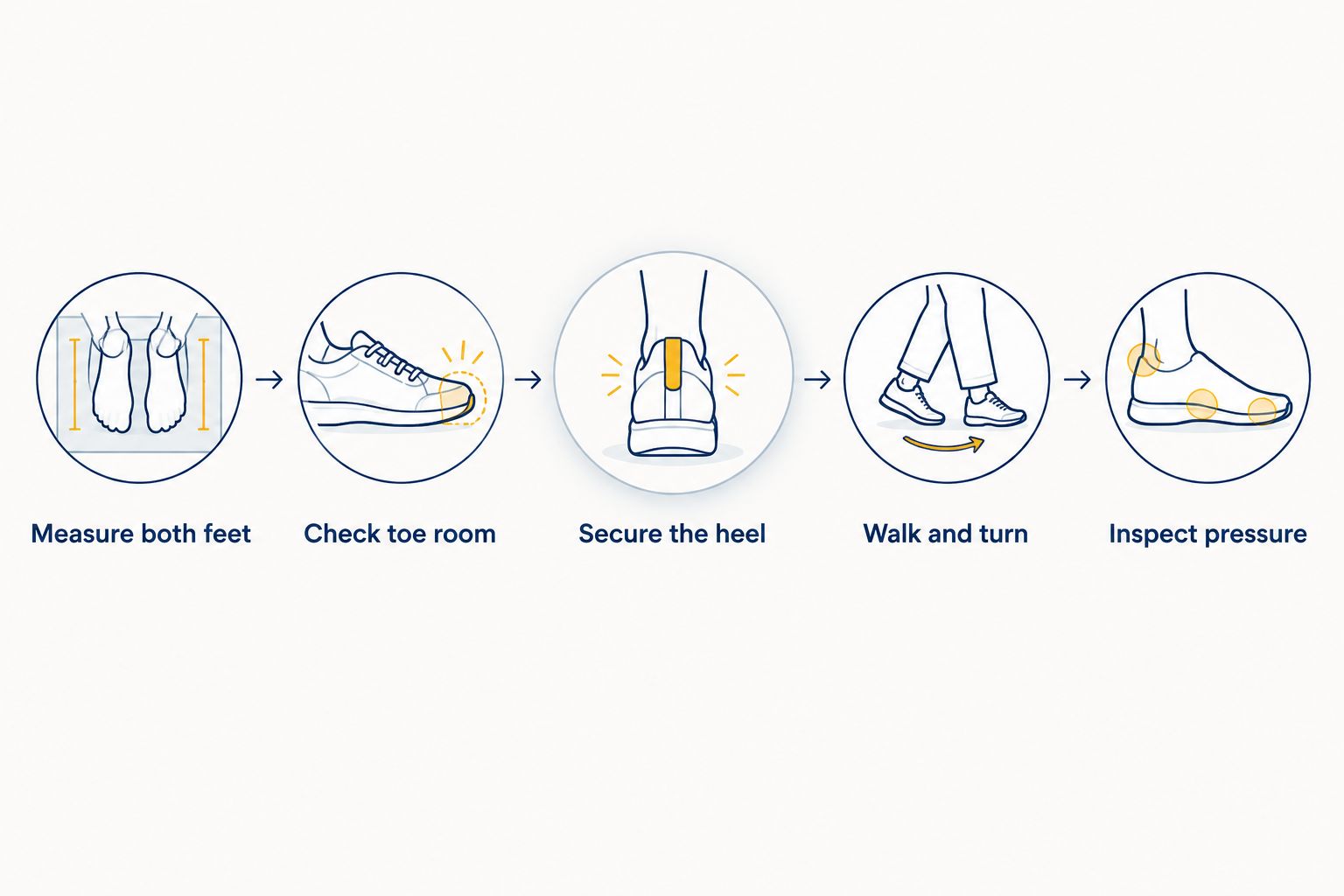
Comfort at the fitting bench is only the first check. Before walking 18 holes, assess the shoes during a shorter outing; a 9-hole round is still a substantial first test if you already have pain. Stop when symptoms develop rather than using the rest of the round to break the shoes in.
When shoe shopping is not the next step
Repeated ankle giving-way, persistent heel pain, and new numbness deserve assessment. So does pain that makes you limp. Describe whether symptoms occur during walking, the backswing, follow-through, or afterward; that detail helps distinguish the demands that provoke them.
Do not play through a new hot, swollen foot, particularly if you have diabetes or reduced sensation. Seek prompt medical evaluation for a wound, spreading redness, or sudden swelling. Inability to bear weight after an injury also needs prompt assessment.
Naples Podiatrist provides foot and ankle care, including care for heel pain, neuromas, diabetic wounds, and foot and ankle injuries. A footwear change is one part of care—not a substitute for identifying the problem.
Get your golf foot pain assessed
Discuss recurring pain, swelling, or ankle instability with a foot and ankle specialist.
How the golf shoe designs are ranked
This 2026 ranking prioritizes fit, heel security, walking stability, traction, and accommodation of prescribed inserts. Structured spikeless shoes come first as a starting profile; the remaining options address distinct needs rather than competing for the same golfer.
These are selection criteria, not laboratory scores or a claim that one outsole prevents injury. A shoe that fails your fitting checks drops out, regardless of where its design appears here.
Which golf shoes should you choose?
Start with structured spikeless golf shoes if you have no unresolved foot problem and mainly walk dry courses. Switch your priority to soft spikes for turf traction, wide fit for crowding, or orthotic compatibility for prescribed inserts. Consider a stiffer forefoot only when it matches an assessed need.
For 2026, choose the shoe that passes every relevant check—not the one with the longest feature list. Secure fit and comfortable movement matter more than a support label.
FAQ
What’s the best golf shoe design for foot and ankle support?
Structured spikeless golf shoes are a starting choice for routine walking when they provide secure heel fit, adequate toe room, and suitable traction. Wet turf, prescribed orthotics, and specific foot conditions change the selection criteria.
Are spiked golf shoes better for weak ankles?
Spikes provide turf traction, not medical stabilization for weak ankles. Repeated giving-way needs assessment; a clinician can determine whether rehabilitation or a brace is appropriate.
Should I buy wide golf shoes if I have bunions?
Choose wide golf shoes if they accommodate your bunion without allowing heel or sideways slippage. Extra width helps with shoe pressure but does not correct the bunion itself.
Can I put my custom orthotics in golf shoes?
Use your custom orthotics in golf shoes only when the complete combination fits comfortably and follows your clinician’s instructions. Check toe room, instep pressure, and heel position with the orthotics installed.
Are softer golf shoes always better for heel pain?
No, softness alone does not establish suitable support or explain heel pain. Check fit and stability, and seek assessment if pain persists or changes your walking.
Do golf shoes prevent ankle sprains?
No golf shoe guarantees prevention of ankle sprains. Appropriate traction and secure fit matter, but uneven ground, injury history, and ankle function also affect your needs.
When should I see a podiatrist instead of changing golf shoes?
See a podiatrist for recurring pain, numbness, swelling, or repeated ankle giving-way. Naples Podiatrist provides foot and ankle care for golfers whose symptoms require assessment; a new hot, swollen foot or wound needs prompt medical attention.
One last thing
A roomier shoe is not always a better-fitting shoe. Buying extra length to solve forefoot tightness can introduce heel movement without fixing the shoe's shape. Try a different width or last—the form that determines shoe shape—before assuming you need a larger size.
Related guides
- Foot and ankle health for golfers in Southwest Florida
- Custom orthotics versus over-the-counter insoles
- Balance and ankle strength exercises for older adults

