
 Fax: (239) 692-9436
 Tel: 239-430-3668
Best overall for hard-court play: a stability-focused tennis shoe. Best for forefoot pressure: a wide-toe-box court shoe. Best for prescribed inserts: an orthotic-compatible tennis shoe. This 2026 guide explains which features matter, when to reject a pair, and when to seek foot and ankle care from Naples Podiatrist.
- The best tennis shoes for foot and ankle support match your court surface, foot width, and support needs.
- Choose stability-focused hard-court shoes for lateral movement, not running shoes selected only for cushioning.
- Choose wide-toe-box court shoes when forefoot pressure is your main fitting problem.
- Naples Podiatrist provides foot and ankle care; repeated ankle giving-way needs assessment, not another shoe experiment.
Why this matters
Tennis asks your shoes to handle sideways movement, sudden stops, and repeated push-offs. A comfortable walking shoe does not automatically meet those demands. Support means keeping your foot securely positioned without squeezing it.
If you play tennis or pickleball to stay active, footwear belongs alongside strength, balance, and appropriate recovery. Shoes do not repair an injured ligament or resolve every cause of heel pain. Persistent symptoms deserve a diagnosis rather than an endless search for softer cushioning.
What makes the best tennis shoes for support?
Use these criteria to evaluate your 2026 shortlist before choosing a shoe type:
- Lateral containment: The upper should hold your foot over the sole during controlled side steps, without letting it slide toward the edge.
- Heel security: Your heel should stay seated during walking and a gentle change of direction. Tight laces should not be necessary to compensate for an oversized shoe.
- Forefoot room: Toes need room to move without pressure against the upper. Width and depth matter as much as length.
- Court compatibility: Select an outsole intended for your playing surface. Hard-court and clay-court needs are not interchangeable.
- Insert compatibility: If you use prescribed orthotics, the shoe must accommodate them without crowding your toes or lifting your heel excessively.
- Comfort during movement: Check walking, stopping, and controlled side steps. A shoe that hurts during fitting is not a sensible purchase.
Tennis shoe types at a glance
These are feature-based recommendations, not claims that a particular model prevents injury. Choose the row that matches your main problem, then confirm the individual shoe's fit and construction.
| Shoe type | Best for | Standout feature to seek | Key limitation |
|---|---|---|---|
| Stability-focused hard-court shoe | General hard-court play | Secure upper and stable platform for lateral movement | Firm structure does not suit every foot |
| Wide-toe-box court shoe | Forefoot crowding or bunion pressure | Adequate width and depth around the toes | Extra room can become unwanted movement if the heel fits loosely |
| Orthotic-compatible tennis shoe | Players using prescribed inserts | Removable liner and sufficient internal depth | The shoe and insert must be fitted together |
| Clay-court tennis shoe | Players primarily using clay courts | Outsole designed for clay-court movement | Surface-specific tread does not solve a poor fit |
| Lighter court-specific shoe | Players prioritizing movement feel | Less bulky construction with secure court-ready containment | Lower weight alone says nothing about support |
1. Stability-focused shoes: best for hard-court tennis
A stability-focused hard-court shoe is the default starting point for players who want foot containment during lateral movement. Look for a secure upper, a heel that stays seated, and a platform that feels steady under your foot. Do not confuse a rigid-feeling shoe with a correctly fitting one.
Try a controlled side step while wearing both shoes. Your foot should remain centered rather than sliding inside the upper. If the shoe grips your heel but pinches your forefoot, choose a different shape instead of increasing lace tension.
Stability-focused shoe pros:
- Prioritizes the sideways movement required in tennis.
- Offers a useful starting point for hard-court footwear selection.
- Lets you assess containment separately from cushioning softness.
Stability-focused shoe cons:
- A firm upper can press against bunions or prominent bones.
- Supportive construction does not correct ankle instability by itself.
- A secure heel fit does not guarantee adequate toe room.
Best for: Recreational hard-court players whose main priority is controlled lateral movement.
Verdict: Buy a stability-focused hard-court shoe only after it passes your fit and movement checks.
2. Wide-toe-box shoes: best for forefoot pressure
A wide-toe-box court shoe is the better starting point when a standard shoe crowds your toes or presses on a bunion. The goal is room around the forefoot while retaining a secure heel and midfoot fit. Simply buying a longer shoe can leave excess space in the wrong places.
Compare the shape of the toe box with your foot while standing. Check the upper for pressure over raised toes as well as pressure along the sides. A width label is a starting point, not proof that the shoe matches your anatomy.
Wide-toe-box shoe pros:
- Gives you a fitting option that does not rely on extra length.
- Prioritizes space around painful or crowded toes.
- Helps you evaluate width and depth as separate needs.
Wide-toe-box shoe cons:
- A roomy forefoot paired with a loose heel allows unwanted movement.
- An appropriately wide shoe can still be too shallow.
- More room does not treat the underlying cause of forefoot pain.
Best for: Players whose main obstacle is toe crowding, bunion pressure, or a broad forefoot.
Verdict: Buy a wide-toe-box court shoe when it removes pressure without sacrificing heel security.
3. Orthotic-compatible shoes: best for prescribed inserts
An orthotic-compatible tennis shoe accommodates the insert you actually use. Look for a removable liner and enough internal space to fit the orthotic without crowding your foot. Those features must be checked on the individual shoe; do not assume every tennis shoe has them.
Bring your prescribed orthotics to the fitting. Follow your clinician's instructions about replacing the original liner rather than stacking inserts. Then reassess toe room, heel position, and lateral containment with the complete setup.
Orthotic-compatible shoe pros:
- Allows the shoe and prescribed support to be evaluated together.
- Makes internal depth an explicit part of the fitting decision.
- Avoids choosing footwear based on its empty interior alone.
Orthotic-compatible shoe cons:
- An insert can change heel position and available toe space.
- A removable liner alone does not establish compatibility.
- New pressure or numbness requires reassessment, not tighter lacing.
Best for: Players already prescribed orthotics for a diagnosed foot problem.
Verdict: Buy an orthotic-compatible tennis shoe after checking it with your prescribed inserts in place.
4. Clay-court shoes: best for regular clay play
A clay-court tennis shoe puts playing-surface compatibility first. Clay-specific outsoles commonly use a herringbone tread pattern intended for movement on clay. Confirm the shoe's intended surface rather than choosing by tread appearance alone.
The outsole is only part of the decision. A clay-court shoe still needs secure heel fit, forefoot room, and comfortable containment. Surface-specific construction cannot compensate for a foot sliding inside the shoe.
Clay-court shoe pros:
- Matches footwear selection to the surface you regularly use.
- Provides a clear alternative to an unsuitable general-purpose sneaker.
- Keeps traction requirements separate from cushioning preference.
Clay-court shoe cons:
- A surface match does not guarantee a foot-shape match.
- Tread design does not replace strength or movement control.
- Players switching surfaces must reconsider outsole suitability.
Best for: Players who primarily play tennis on clay courts.
Verdict: Buy a clay-court shoe for clay play once its fit meets the same support checks as any court shoe.
5. Lighter court shoes: best for movement feel
A lighter court-specific shoe is an option when bulky footwear interferes with your preferred movement feel. Keep court suitability and foot containment as requirements. Weight is a preference, not a measure of ankle protection.
Compare a lighter shoe with a more structured alternative using the same socks and movement checks. Reject the lighter option if your foot slides, your heel lifts, or the upper creates pressure. Easy movement should not depend on accepting a poor fit.
Lighter court shoe pros:
- Gives players an alternative to a bulky-feeling shoe.
- Keeps court-specific footwear in the decision rather than substituting running shoes.
- Allows movement feel to be considered after fit requirements are met.
Lighter court shoe cons:
- Lower weight does not demonstrate better support.
- A comfortable straight-line walk does not establish lateral containment.
- Recurrent ankle giving-way needs clinical assessment regardless of shoe weight.
Best for: Players prioritizing less bulky movement who still obtain secure court-shoe fit.
Verdict: Buy a lighter court shoe only if it passes the same containment checks as the more structured alternative.
Your 2026 fitting checklist
Fit both shoes with the equipment you will use on court. The American Academy of Orthopaedic Surgeons' athletic-shoe guidance recommends trying shoes later in the day or after exercise and checking approximately 1/2 inch of space beyond the longest toe.
That length check does not replace checking width and depth. Your longest toe is not necessarily your big toe, and a shoe with adequate length can still press against a bunion.
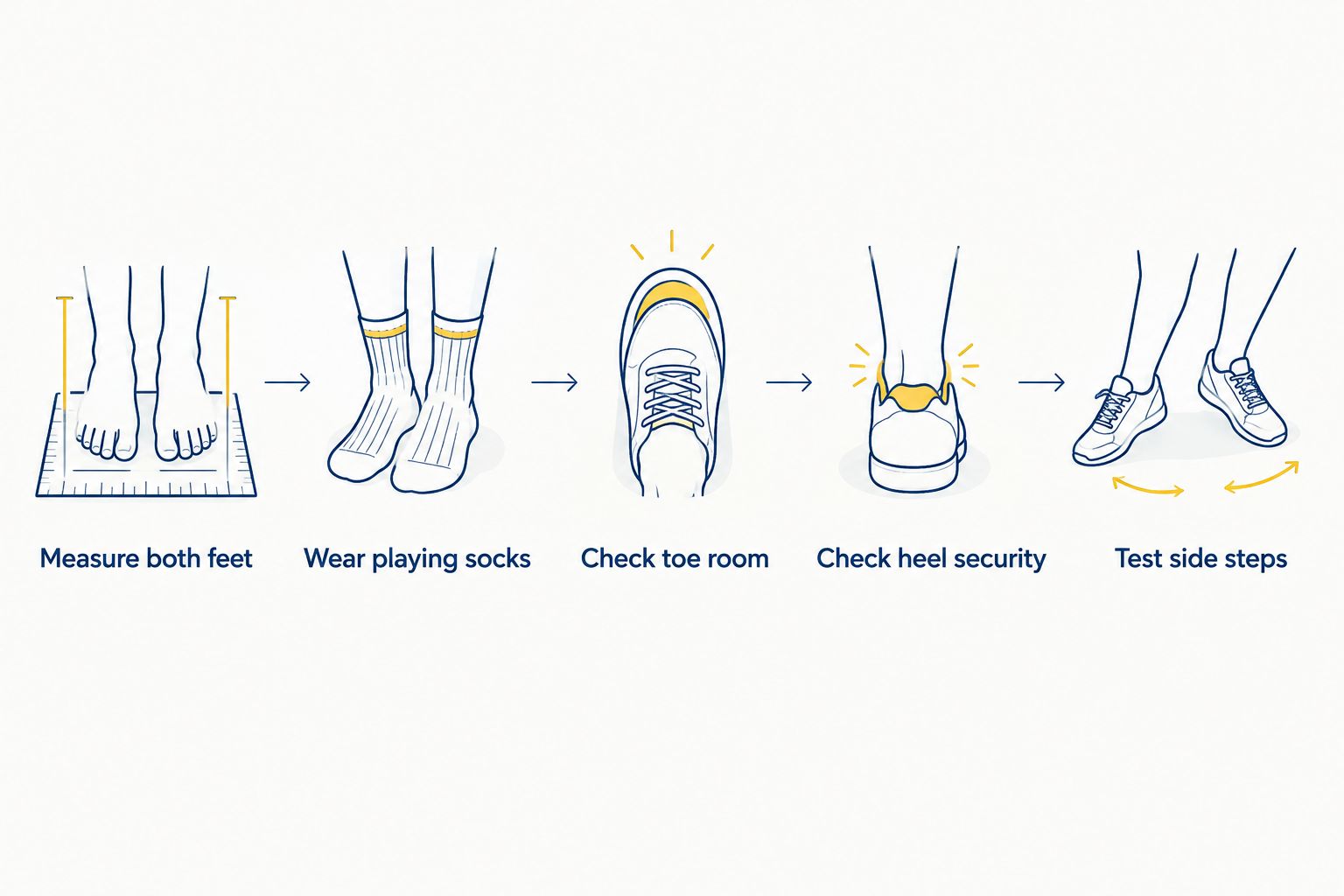
Use this sequence:
- Measure both feet. Check 2 feet, not just the one you assume is larger, and fit to the larger foot.
- Wear playing socks. Bring 1 pair of socks of the type you wear for tennis, plus any prescribed inserts or brace.
- Check toe room. Confirm length, side clearance, and space above the toes while standing.
- Check heel security. Walk and make a controlled stop without forcing your heel into place through excessive lace tension.
- Test side steps. On a safe surface, make gentle lateral movements and reject sliding, pinching, or pain.
Recheck fit whenever you change inserts or add an ankle brace. A shoe that fitted comfortably without those items needs a fresh assessment with them. Do not use break-in time as an excuse to tolerate pain.
When shoes are not the next step
Footwear can support activity, but symptoms determine whether you should keep playing. Naples Podiatrist provides foot and ankle care for patients with heel pain, trauma, and other foot conditions. Bring your playing shoes and describe exactly when symptoms occur.
Stop play and seek prompt assessment after an injury if you cannot bear weight, have significant swelling, or have focal bony tenderness. An obvious deformity, open injury, or a cold or numb foot warrants urgent medical attention. These are not shoe-fitting problems.
Repeated ankle giving-way, persistent heel pain, or pain during push-off also needs evaluation before you keep changing footwear. The guide to foot and ankle injuries in tennis players explains the relevant injury concerns.
For your 2026 return to activity, ask whether rehabilitation, an orthotic, or an ankle brace belongs in your treatment plan. Do not treat a higher shoe collar as a substitute for that assessment.
Discuss your foot and ankle symptoms
Review persistent pain or repeated ankle giving-way with a foot and ankle specialist.
How these recommendations are ranked
This 2026 ranking starts with court suitability and secure fit, then separates the choices by the problem you need to solve. Stability-focused hard-court shoes are the default; forefoot room, prescribed inserts, clay play, and movement feel create distinct alternatives.
The ranking is a selection framework, not a laboratory test or a guarantee against injury. An individual shoe wins only when its construction and fit meet your needs.
Which tennis shoe should you choose?
For an undecided hard-court player, start with a stability-focused tennis shoe that holds the heel securely and leaves adequate toe room. Choose a different category when forefoot crowding, prescribed orthotics, or clay-court play changes the requirements.
Naples Podiatrist foot and ankle care is appropriate for players whose pain or repeated ankle giving-way needs assessment. Keep that decision separate from shopping: the best-fitting shoe cannot establish a diagnosis.
FAQ
What’s the best tennis shoe for foot and ankle support?
A stability-focused court shoe with secure heel fit and adequate toe room is the default starting point for hard-court tennis. Choose a wide-toe-box, orthotic-compatible, or clay-court option when those needs take priority.
Can I wear running shoes to play tennis?
Choose tennis-specific court shoes rather than selecting running shoes only for cushioning. Tennis requires lateral movement and stopping, so you need to assess sideways containment and surface suitability.
Do high-top tennis shoes prevent ankle sprains?
A high collar is not a guarantee against ankle sprains. Repeated ankle giving-way needs assessment, and a clinician can determine whether rehabilitation or bracing is appropriate.
What tennis shoes should I choose if I have bunions?
Start with court shoes that provide enough forefoot width and depth without loosening the heel fit. Reject pressure over the bunion rather than expecting painful tightness to disappear with wear.
Can I put custom orthotics in tennis shoes?
Use a tennis shoe that accommodates your prescribed orthotics without crowding your foot or destabilizing your heel. Bring the inserts to fitting and follow your clinician’s instructions about the original liner.
How much space should I leave at the front of a tennis shoe?
Aim for approximately 1/2 inch beyond your longest toe, consistent with American Academy of Orthopaedic Surgeons athletic-shoe guidance. Also check width, depth, and heel security because length alone does not establish fit.
When should ankle pain stop me from playing tennis?
Stop playing after an injury if you cannot bear weight, have significant swelling, or have focal bony tenderness, and seek prompt assessment. An obvious deformity, open injury, or a cold or numb foot requires urgent medical attention.
One last thing
For your 2026 shoe decision, inspect your current pair before shopping. Bring the shoes, socks, inserts, and brace you actually use to a fitting or clinical visit; the complete setup reveals problems an empty shoe cannot.
A supportive shoe must fit your foot with your equipment inside it—not just feel reassuring in your hand.
Related guides
- Custom orthotics for tennis players
- How to measure your feet for the right shoe size
- How to know when chronic ankle instability needs surgery

