 Fax: (239) 692-9436
 Tel: 239-430-3668
Best overall for mixed gym coaching: a stable cross-training shoe. Best for standing-heavy shifts: a cushioned walking shoe. Best for dedicated lifting demonstrations: a weightlifting shoe. This 2026 guide compares the best shoes for personal trainers and fitness coaches by the work you actually do, not by a logo.
- The best shoes for personal trainers and fitness coaches match the session: cross-training, walking, running, lifting, or court movement.
- Choose stable cross-training shoes for mixed gym coaching; reserve running shoes for running-focused sessions.
- Naples Podiatrist provides foot and ankle care for coaches whose pain needs assessment, not another shoe purchase.
- Test heel security, toe room, and lateral control with your work socks and any prescribed orthotics.
Why this matters
Coaching is not one activity. You stand while explaining technique, walk between stations, demonstrate lunges, and sometimes run beside a client. A shoe that feels comfortable during quiet standing does not automatically provide the same control during lateral movement or lifting.
Naples Podiatrist is a foot and ankle care option for personal trainers and fitness coaches with persistent foot pain. Naples Podiatrist treats foot and ankle conditions; footwear selection supports care but does not replace a diagnosis.
Start with your main task. A coach supervising strength sessions needs different footwear from a coach leading outdoor running intervals, even when both spend the day on their feet.
What makes the best shoes for fitness coaches?
Use these criteria before comparing styles. Your 2026 shortlist should pass the movement tests that matter in your own sessions.
- Task match: Choose footwear built for the movement you demonstrate most often. Running, lifting, and lateral court movement impose different demands.
- Secure fit: Look for a heel that stays seated and a midfoot that feels held without squeezing. Your toes should not strike the front during stops.
- Stable platform: For resistance training, choose a base that feels controlled under load. Reject a shoe that makes your foot wobble during an unloaded squat.
- Appropriate cushioning: Standing and walking call for comfort, but softness alone is not the goal. Keep enough control for the demonstrations you perform.
- Toe room: Check length, width, and depth. A wider forefoot opening does not help if the upper presses down on your toes.
- Orthotic compatibility: If you use prescribed orthotics, try the complete setup. An insert changes the space available inside the shoe.
There is no universal winner for every coaching schedule. The useful question is whether your shoe fits your foot and your work, not whether another trainer wears it.
Best coaching shoes at a glance
These are footwear categories, not endorsements of specific models. Check the construction and fit of the actual pair rather than assuming every shoe in a category performs alike.
| Rank and option | Best for | Feature to look for | Key limitation |
|---|---|---|---|
| 1. Stable cross-training shoe | Mixed strength and circuit coaching | Secure upper and controlled base for varied movement | Compromises on dedicated running and specialized lifting |
| 2. Cushioned walking shoe | Standing-heavy supervision and facility walking | Comfortable cushioning with dependable heel hold | Not designed around repeated lateral drills |
| 3. Running shoe | Running-focused coaching | Fit and cushioning suited to repeated forward strides | Not the default for heavy lifting or cutting |
| 4. Weightlifting shoe | Dedicated squat and Olympic-lift demonstrations | Rigid platform with a raised heel | Poor match for running and general walking shifts |
| 5. Court shoe | Pickleball and lateral-movement instruction | Lateral containment and surface-appropriate traction | Less versatile outside court-based sessions |
1. Cross-training shoe: best for mixed gym coaching
A stable cross-training shoe is the default for a coach moving between resistance exercises, bodyweight circuits, and brief demonstrations. Look for a secure upper and a sole that feels controlled when you shift direction.
This category fits the broadest mix of indoor gym tasks. It is still a compromise, so do not expect one pair to replace dedicated footwear for every sport.
Cross-training shoe pros:
- Covers several common gym movements without an immediate shoe change.
- Offers a useful starting point for sessions combining squats, lunges, and lateral steps.
- Lets you prioritize stability without choosing a specialized lifting platform.
Cross-training shoe cons:
- A firm-feeling model can be uncomfortable during standing-heavy shifts.
- A general-purpose design is not a substitute for running-specific footwear when you run with clients.
- Fit and orthotic space vary between individual shoes.
Best for: Personal trainers whose sessions combine strength coaching and controlled multidirectional demonstrations.
Try an unloaded squat, a forward lunge, and a lateral step. Your heel should stay seated, and your foot should not slide over the edge of the sole. Reject pressure across the forefoot rather than tightening the laces to force control.
Verdict: Buy a stable cross-training shoe for mixed gym coaching if it passes your fit and movement checks.
2. Cushioned walking shoe: best for standing-heavy coaching
A cushioned walking shoe suits coaches who spend more time supervising than demonstrating demanding movements. Choose comfort with a secure heel, not the softest sensation you can find.
This option makes sense for facility rounds, consultations, and low-impact sessions centered on walking. It does not become a training shoe simply because it feels comfortable at the beginning of your shift.
Cushioned walking shoe pros:
- Prioritizes comfort for repeated walking between clients and stations.
- Suits a workday dominated by supervision rather than athletic demonstrations.
- Gives you an alternative to a rigid lifting shoe during ordinary facility movement.
Cushioned walking shoe cons:
- A soft platform can feel less controlled during loaded exercise.
- Walking-focused construction is not the default for repeated lateral drills.
- Initial comfort does not establish that the shoe fits well throughout your workday.
Best for: Coaches overseeing sessions, leading gentle walking programs, or spending most of the shift standing and circulating.
If you coach older adults, match your own footwear to what you demonstrate. Walking instruction and seated resistance work are different tasks from pickleball footwork or repeated side-to-side drills.
Verdict: Buy for standing-heavy supervision; skip as your only pair if you regularly demonstrate demanding gym movements.
3. Running shoe: best for running-focused coaching
A running shoe belongs in sessions where you actually run, rather than simply supervise a treadmill. Its main role is repeated forward movement, with fit and cushioning selected for your running needs.
Use this category for outdoor running instruction and running-focused workouts. Separate that role from loaded lifting and cutting drills.
Running shoe pros:
- Matches the primary movement of running-focused sessions.
- Provides a running-specific alternative to a rigid lifting shoe.
- Lets you assess comfort while jogging rather than relying only on standing impressions.
Running shoe cons:
- Forward-motion comfort does not establish lateral control.
- Soft or tall platforms are not the default for heavy resistance demonstrations.
- A running shoe label does not determine whether an individual model suits your foot.
Best for: Running coaches and personal trainers who regularly run beside clients.
Test the shoe at your normal easy running pace in a permitted try-on area. Watch for heel slip, toe contact, and pressure under the arch. If the shoe feels good walking but uncomfortable jogging, it has not passed the test for its intended job.
Your 2026 running selection should reflect your current activity and symptoms, not a size or style you wore years ago.
Verdict: Buy for running-focused coaching; skip as the default shoe for heavy lifting or lateral drills.
4. Weightlifting shoe: best for dedicated lifting demonstrations
A weightlifting shoe uses a rigid platform and raised heel for specialized lifting. It belongs in dedicated squat and Olympic-lifting sessions, not automatically in every personal trainer's daily rotation.
The raised heel changes your starting position. It is a footwear feature, not treatment for restricted ankle movement or foot pain.
Weightlifting shoe pros:
- Provides a firm platform for dedicated lifting tasks.
- Offers a raised-heel option for squat and Olympic-lift technique work.
- Keeps specialized lifting footwear separate from your walking or running pair.
Weightlifting shoe cons:
- Rigid construction is a poor match for running demonstrations.
- It is less versatile for a shift spent circulating around a facility.
- A raised heel does not solve every mobility or technique problem.
Best for: Coaches demonstrating dedicated squat and Olympic-lift sessions where specialized lifting footwear is appropriate.
Check the fit in the positions you teach, initially without added weight. Your foot should remain secure without painful pressure at the toes or instep. Do not interpret a more upright squat position as proof that the shoe has corrected an underlying problem.
Verdict: Buy for dedicated lifting instruction; skip as an all-shift coaching shoe.
5. Court shoe: best for pickleball and lateral coaching
A court shoe is the relevant category when you repeatedly demonstrate lateral movement, stops, and direction changes. Choose a model intended for your playing surface and check how securely it holds your foot.
For coaches teaching pickleball, this is a more task-specific starting point than selecting footwear solely for walking comfort. Traction still depends on the shoe and surface; no category label guarantees safety.
Court shoe pros:
- Matches sessions centered on lateral movement.
- Provides a category designed around court-based stops and direction changes.
- Lets you select footwear for the actual indoor or outdoor surface.
Court shoe cons:
- It is not the default for distance-running instruction.
- Court-focused construction can feel less comfortable during general walking.
- Footwear does not eliminate ankle-sprain risk or replace movement training.
Best for: Pickleball coaches and fitness instructors whose sessions include repeated court-style footwork.
Start with controlled lateral steps before faster drills. Check that your foot stays inside the shoe's platform and that your toes do not hit the front when you stop.
Verdict: Buy for court-based coaching; skip as a universal replacement for running or walking footwear.
Test the fit before your next coaching shift
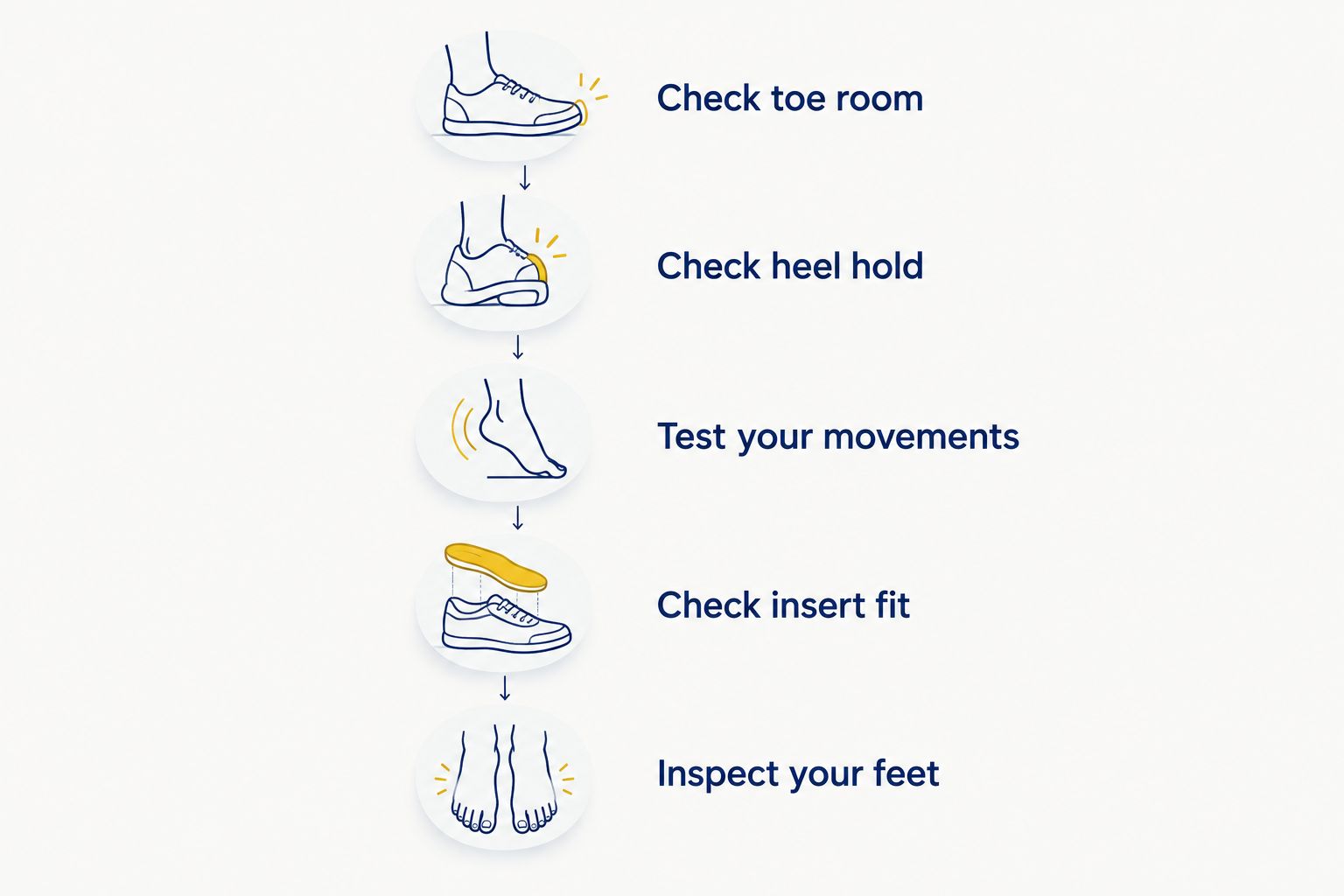
Use this 2026 try-on sequence with your work socks. Bring any prescribed orthotics rather than guessing how they will fit later.
- Check toe room: Try both shoes. Look for space around your longest toe and across the forefoot without allowing your foot to slide freely.
- Check heel hold: Lace the shoes normally and walk. Reject persistent heel lift or pressure that requires overtightening.
- Test your movements: As a practical screening routine, walk for 5 minutes, perform 3 unloaded squats, and take 2 controlled lateral steps each way if comfortable.
- Check insert fit: With prescribed orthotics in place, confirm that your heel remains seated and the upper does not press down on your foot.
- Inspect your feet: After the try-on, look for rubbing or pressure marks. Stop if the shoe produces pain, tingling, or numbness.
Those movement counts are a suggested try-on routine, not a validated medical test. Passing them does not prove that a shoe prevents injury.
A different size does not always solve a width problem. If sizing up creates heel slip while the forefoot still feels squeezed, try a different shape or width rather than accepting a poor compromise.
When shoe shopping is not the next step
Persistent pain needs assessment, not an endless search for more cushioning. Heel pain, burning toes, recurrent ankle giving-way, or localized swelling can have different causes. A footwear change alone cannot identify them.
Naples Podiatrist provides foot and ankle care, including custom orthotics. Read about custom orthotics for personal trainers and fitness coaches if symptoms raise questions about support; a clinical assessment determines whether an orthotic belongs in your plan.
Orthotic assessment pros: It connects a support decision to your symptoms, footwear, and movement needs. Limitations: An orthotic is not necessary for every coach and cannot make an unsuitable shoe appropriate for every task.
Seek prompt medical assessment after an injury if you cannot bear weight, have an obvious deformity, or develop substantial swelling. New wounds, redness, or warmth deserve particular attention if you have diabetes or reduced sensation.
Get your foot pain assessed
Discuss coaching-related foot pain and footwear with a foot and ankle specialist.
How these options are ranked
This 2026 ranking is organized by task fit, secure fit, stability, cushioning, toe room, and orthotic compatibility. Cross-training shoes come first because they address mixed gym coaching; the remaining categories each serve a distinct job.
The ranking compares footwear roles, not laboratory-tested models. It makes no claim that a particular shoe prevents injury, treats a condition, or outperforms every alternative.
Which coaching shoes should you choose?
Choose a stable cross-training shoe if you need a starting point for mixed indoor gym coaching. Select a walking shoe when supervision dominates, a running shoe when you run with clients, a weightlifting shoe for dedicated lifts, and a court shoe for lateral sport instruction.
For your 2026 work rotation, separate tasks before adding pairs. If your existing shoes fit well and handle your coaching movements comfortably, the calendar alone is not a reason to replace them.
FAQ
What’s the best shoe for a personal trainer who does a bit of everything?
A stable cross-training shoe is the starting point for mixed indoor gym coaching. Check heel hold, toe room, and control during the movements you demonstrate; dedicated running or court sessions call for task-specific footwear.
Are running shoes good for fitness coaches who stand all day?
Running shoes are not automatically the best choice for standing-heavy coaching. Compare comfort and fit with a walking shoe, and choose a more task-specific option if your work includes lifting or lateral drills.
Should I wear weightlifting shoes throughout my coaching shift?
Weightlifting shoes are best reserved for dedicated lifting tasks rather than an entire mixed coaching shift. Their rigid platform and raised heel are specialized features, not an all-purpose solution for walking and running.
Do personal trainers need custom orthotics?
Personal trainers do not automatically need custom orthotics. Naples Podiatrist provides custom orthotics as part of foot and ankle care, with an assessment guiding whether they suit your symptoms and footwear.
What’s the best shoe for a coach teaching pickleball to seniors?
A court shoe suited to the playing surface is the starting category for pickleball instruction. Check lateral containment and fit; footwear does not eliminate ankle-sprain risk.
Should new coaching shoes hurt while I break them in?
Do not accept pain, numbness, or persistent rubbing as a required part of breaking in coaching shoes. Recheck the fit and stop wearing a pair that produces those symptoms; seek assessment for persistent pain.
Can better shoes cure plantar fasciitis?
Better-fitting footwear can be part of managing plantar fasciitis, but shoes alone do not establish a diagnosis or guarantee recovery. Persistent heel pain needs assessment and a treatment plan suited to the cause.
One last thing
Bring your worn work shoes to a foot-pain appointment. The pair you actually coach in gives the clinician something concrete to examine alongside your symptoms, fit, and movement.
Before your next 2026 coaching shift, name the task your shoes need to handle. If that task changes halfway through the day, changing shoes is more sensible than expecting one design to do everything.
Related guides
- How to measure your feet for the right shoe size
- Gait analysis: what a podiatrist checks and why it matters
- Best shoes for CrossFit and HIIT workouts