
 Fax: (239) 692-9436
 Tel: 239-430-3668
Best overall: lace-up work boots matched to your job’s hazards. Best for wet irrigation work: waterproof work boots; best for dry, low-hazard maintenance: breathable work shoes. This 2026 guide to the best shoes for landscapers and lawn crews ranks footwear types by task, fit, traction, and foot protection—not by brand popularity.
- The best shoes for landscapers and lawn crews match workplace hazards before comfort preferences.
- Lace-up work boots are the default for mixed landscaping duties; protective features must match the task.
- Waterproof work boots suit wet irrigation work, but waterproofing does not prevent sweat buildup.
- Naples Podiatrist provides foot and ankle care for lawn crews with persistent pain or footwear pressure problems.
Why this matters
Landscaping puts different demands on your feet within the same shift. You walk across uneven turf, push equipment, kneel beside planting beds, and step onto pavement. A shoe that feels comfortable indoors still needs to suit those tasks.
Comfort does not establish protection. Soft cushioning does not prove slip resistance, puncture resistance, or protection against falling objects. Start with your employer’s hazard assessment and equipment instructions, then choose the footwear that fits your feet.
Naples Podiatrist offers foot and ankle care for landscapers and lawn crews when heel pain, toe pressure, or ankle symptoms interfere with work. Naples Podiatrist is best for lawn crew workers who need specialist foot and ankle assessment rather than another footwear guess.
What makes the best landscaping footwear?
Use these criteria before comparing styles for your 2026 work rotation:
- Hazard protection: Match toe protection, underfoot protection, and other required features to the work. Read the exact model’s markings; appearance proves nothing.
- Surface-specific traction: Consider wet grass, mud, loose soil, and paved walkways separately. No outsole guarantees traction on every surface.
- Toe room: Your toes need space in both length and width, including beneath a protective toe cap. Pressure against a bunion or toenail is a failed fit.
- Heel security: Your heel should stay seated without painfully tight laces. Sliding creates friction and makes footing less controlled.
- Moisture management: Choose water protection for external water exposure and breathable construction for dry tasks. Neither replaces dry socks.
- Insole compatibility: If you use an orthotic, check the complete boot-and-insole combination. Extra material inside a cramped shoe makes fit worse.
Landscaping footwear at a glance
These 2026 recommendations describe footwear categories, not tested individual models. Check the specifications of the exact pair you are considering.
| Footwear type | Best for | Standout feature to seek | Key limitation |
|---|---|---|---|
| Lace-up work boots | Mixed landscaping duties | Secure closure with task-matched protection | Weight and stiffness vary by model |
| Waterproof work boots | Wet irrigation work | Documented waterproof construction | Sweat can remain inside |
| Breathable work shoes | Dry light maintenance | Ventilated upper with secure closure | Not a substitute for required protective boots |
| Rubber work boots | Mud cleanup | Washable exterior and appropriate protective markings | Pull-on fit can allow heel movement |
| Orthotic-compatible work boots | Prescribed orthotic use | Removable footbed and adequate internal depth | An orthotic can crowd a poorly fitted boot |
Footwear categories overlap: a lace-up work boot can also be waterproof or orthotic-compatible. The ranking assigns each category a different decision point so you can start with your main task, then check the remaining requirements.
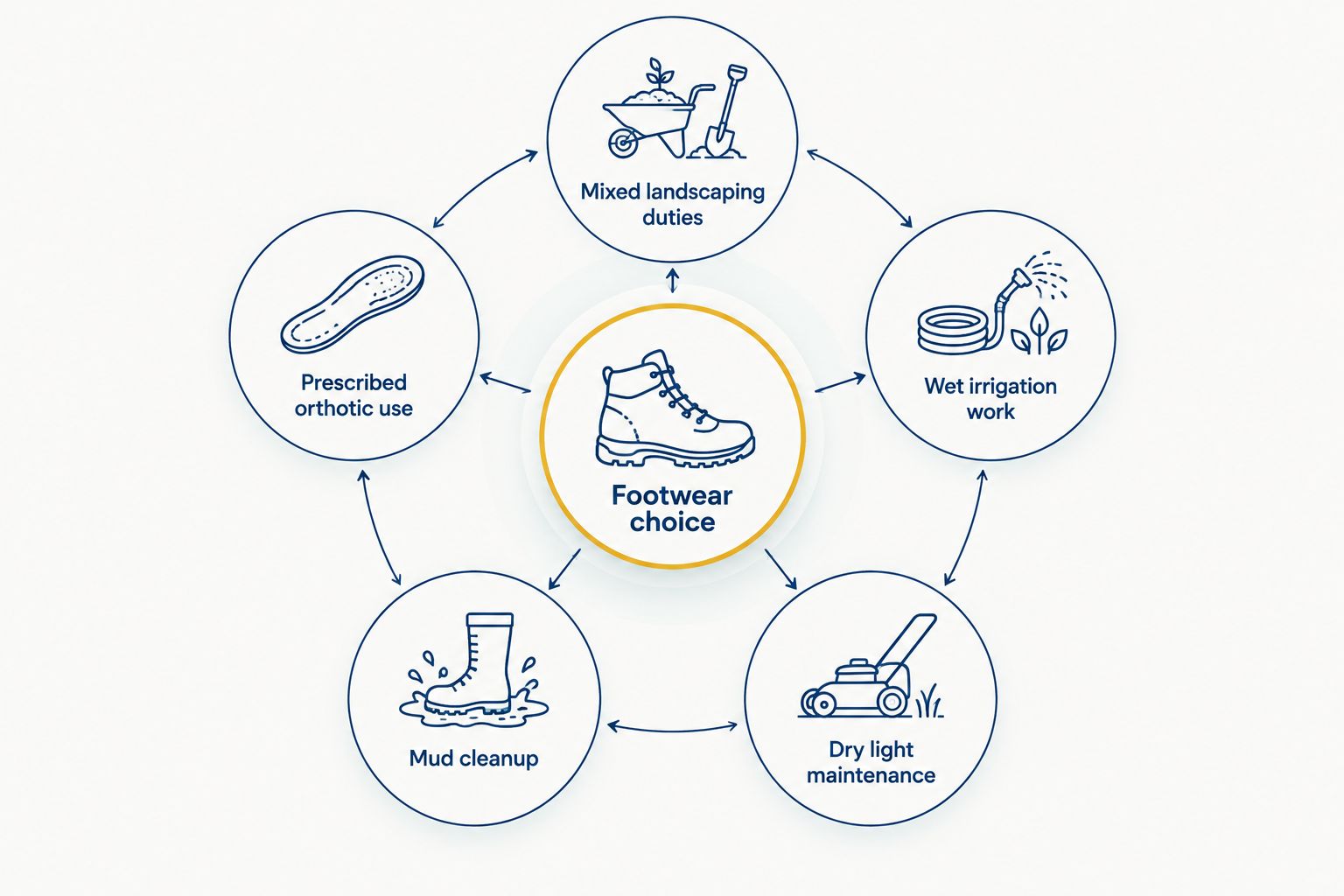
1. Lace-up work boots: best for mixed landscaping duties
Lace-up work boots are the strongest starting point when your duties change throughout the day. Adjustable closure helps you secure the foot, while model-specific protective features let you match the boot to workplace requirements.
Choose a sole that feels stable when you turn and step across uneven ground. A tall collar alone does not establish ankle protection, and a heavy boot is not automatically safer than a lighter one.
Lace-up work boots pros:
- Adjustable laces help control heel movement.
- Enclosed uppers cover the foot during routine outdoor work.
- Models with documented protective features can meet task-specific requirements.
Lace-up work boots cons:
- Stiff uppers can press against heel bumps or prominent joints.
- Weight and flexibility differ substantially between models.
Best for: Workers who alternate among mowing, planting, edging, and moving materials.
Try the boots with your work socks. Bend, squat, and walk before accepting the fit; the toe cap must not press down when you kneel. Do not rely on breaking in a boot to fix inadequate width.
Verdict: Buy lace-up work boots for mixed duties when the exact model meets your protection needs and fits without pressure.
2. Waterproof work boots: best for wet irrigation work
Waterproof work boots suit tasks where irrigation water or wet vegetation repeatedly reaches the upper. Waterproof construction addresses water entering from outside; it does not stop your feet from sweating.
Check the manufacturer’s description rather than treating water-resistant and waterproof as interchangeable. Water entering over the collar can still wet your socks, so boot height and the depth of exposure matter.
Waterproof work boots pros:
- Waterproof construction provides a barrier against external water.
- Lace-up versions let you adjust heel and midfoot fit.
- Protective versions combine water protection with task-specific safety features.
Waterproof work boots cons:
- Moisture from sweat can remain inside the boot.
- Water entering from above defeats the benefit of a waterproof upper.
Best for: Crews repairing irrigation systems or working repeatedly through wet vegetation.
Inspect the lining, seams, and outsole as part of your 2026 footwear checks. Follow the manufacturer’s care instructions rather than using heat or treatments that the boot maker does not recommend.
Verdict: Buy waterproof work boots for repeated external water exposure; skip waterproofing as your only answer to sweaty feet.
3. Breathable work shoes: best for dry light maintenance
Breathable work shoes fit a narrower role: dry, lower-hazard work where your employer permits them. Look for enclosed toes, secure laces, adequate width, and an outsole intended for the surfaces you use.
Do not treat an ordinary running shoe as protective footwear because it feels cushioned. Moving pavers, using equipment, or handling sharp debris changes the footwear requirements even when the weather stays dry.
Breathable work shoes pros:
- Ventilated uppers support moisture escape.
- Flexible construction suits walking-focused tasks.
- Secure laces help hold the heel without relying on a pull-on fit.
Breathable work shoes cons:
- Open mesh lets water and fine debris enter.
- Ordinary athletic shoes do not establish workplace protective compliance.
Best for: Dry walking inspections and light maintenance without hazards requiring protective boots.
Keep the task boundary clear. A shoe suitable for inspecting a property is not automatically suitable for loading stone, digging around debris, or operating machinery. Check those requirements before switching footwear.
Verdict: Buy breathable work shoes only for permitted low-hazard duties; skip them when protective footwear is required.
4. Rubber work boots: best for mud cleanup
Rubber work boots are useful when the main problem is muddy cleanup and a washable exterior. Their role differs from a lace-up boot: easy surface cleaning matters, but the pull-on shape still needs to hold your foot securely.
An ordinary rain boot is not automatically a safety boot. Check the exact model for required protection, and use chemical-specific guidance whenever fertilizers, pesticides, or other chemicals are involved.
Rubber work boots pros:
- The exterior is straightforward to rinse after muddy tasks.
- Tall designs cover more of the lower leg than low-cut shoes.
- Protective versions are an option when their markings match the job.
Rubber work boots cons:
- Loose pull-on construction can allow heel slipping.
- Rubber uppers provide limited ventilation.
Best for: Mud cleanup and wet tasks where washable footwear is the priority.
Walk in the boots before committing to them. If your heel lifts repeatedly or your foot slides sideways, the fit needs correction. Thick socks are not a dependable fix for a boot that is fundamentally too loose.
Verdict: Buy rubber work boots for suitable muddy tasks; skip loose rain boots for walking-intensive crew work.
5. Orthotic-compatible work boots: best for prescribed orthotic use
Orthotic-compatible work boots have enough internal room for your prescribed insert without squeezing the toes or lifting the heel out of position. A removable factory footbed helps, but removability alone does not prove that an orthotic fits.
Bring the actual orthotic to the fitting. Check the boot while standing and walking, not just by placing the insert inside an empty shoe.
Orthotic-compatible work boots pros:
- Removable footbeds allow the prescribed insert to occupy the intended space.
- Adequate depth helps avoid pressure over the top of the foot.
- A properly fitted boot keeps the orthotic seated during walking.
Orthotic-compatible work boots cons:
- Adding an insert can reduce toe room and heel security.
- An orthotic does not replace required protective features or injury treatment.
Best for: Workers already prescribed orthotics or advised to seek an assessment for recurring pain.
Naples Podiatrist provides custom orthotics for landscapers and lawn crews. The useful question is whether an insert addresses your diagnosed problem inside footwear that also suits the job—not whether every worker needs one.
Verdict: Buy orthotic-compatible work boots when you need an insert; hold off on changing orthotics without checking the cause of persistent pain.
How these recommendations are ranked
This 2026 ranking puts workplace protection first, then task suitability, fit, moisture management, and insole compatibility. Lace-up work boots take the default position because adjustable closure suits mixed duties; the other categories address more specific needs.
These are category-level recommendations, not laboratory test results or a comparison of individual shoe models. Your employer’s requirements and your foot condition take priority over the ranking.
Check the fit before the first full shift
Use the same socks and inserts you wear at work. Fit footwear later in the day if your feet swell, and check both feet rather than relying on an old size label.
- Check length: A commonly recommended fitting allowance is about 1/2 inch beyond the longest toe. Toe shape and protective caps still require an individual fit check.
- Check width: The forefoot should not bulge against the sides, and the little toe should not feel compressed.
- Check movement: Walk, turn, and bend. Reject footwear that causes rubbing, numbness, or sharp pressure.
- Check inserts: Follow fitting instructions for replacing the factory footbed; do not automatically stack insoles.
Breaking in footwear should not mean tolerating injury. Stop using a pair that produces blisters or numbness, and get persistent symptoms assessed.
Which landscaping footwear should you choose?
Choose lace-up work boots as the default, then add waterproofing, protective features, or orthotic space according to your duties. Choose breathable work shoes only when the task and employer requirements permit them. Reserve rubber work boots for work where their washable construction and fit make sense.
If foot pain follows you from the crew shift into golf, pickleball, or running, stop treating it as a shopping problem alone. Naples Podiatrist offers foot and ankle care across Southwest Florida through 9 locations, with quick access to specialist doctors. Appointment calls are answered 24 hours a day at 239 430 3668.
Seek prompt medical care for an open wound, spreading redness, new numbness, or inability to bear weight after an injury. Diabetes or reduced sensation makes a new blister or pressure mark especially important to assess.
Get your work-related foot pain assessed
Discuss heel pain, toe pressure, or ankle symptoms with a foot and ankle specialist.
FAQ
What’s the best footwear for landscapers and lawn crews in 2026?
Lace-up work boots matched to workplace hazards are the default choice for mixed landscaping duties. Choose waterproof construction for repeated water exposure and verify every required protective feature on the exact model.
Can I wear running shoes while mowing lawns?
Running shoes are not a substitute for protective footwear required by your employer or equipment instructions. Choose footwear according to the mowing task, terrain, and equipment requirements rather than cushioning alone.
Are waterproof boots better for sweaty feet?
Waterproof boots address water entering from outside, not sweat produced inside the boot. For dry tasks, consider permitted breathable footwear, dry socks, and a routine that lets footwear dry between uses.
Do all landscapers need safety-toe boots?
Safety-toe requirements depend on the workplace hazard assessment and applicable rules. Handling heavy materials or facing impact hazards requires a different assessment from light walking inspections; confirm the requirements before buying.
Should landscaping boots be tight when they are new?
Landscaping boots should hold your heel securely without squeezing your toes or causing numbness. Do not expect breaking in a boot to correct a narrow protective toe cap or inadequate length.
Do custom orthotics replace supportive work boots?
Custom orthotics do not replace properly fitted, task-appropriate work boots. The insert and boot must fit together without crowding the toes, loosening heel control, or compromising required protection.
When should I see a podiatrist about foot pain from landscaping?
Arrange an assessment when pain persists, changes your walking, or repeatedly returns during work. Seek prompt care for wounds, spreading redness, new numbness, or inability to bear weight after an injury.
One last thing
A protective toe cap does not stretch like a soft upper. If the cap presses against your toes during fitting, choose a different width or shape—not a longer break-in period. Make this your final check when selecting landscaping footwear in 2026.
Related guides
- How to measure your feet for the right shoe size
- Best work boots for foot and ankle support on the job
- Best socks to stop sweaty feet and odor

