
 Fax: (239) 692-9436
 Tel: 239-430-3668
Best overall: employer-approved safety-toe work shoes. Best for stationary concrete-floor work: cushioned safety-toe boots. Best for wet production areas: slip-resistant work footwear matched to the floor conditions. The best shoes for factory and manufacturing workers in 2026 combine required protection, secure fit, and support suited to your actual job.
- The best shoes for factory and manufacturing workers meet workplace protection requirements before comfort preferences.
- Safety-toe work shoes are the default shortlist for mixed standing and walking when your employer approves them.
- Wet floors, falling materials, and orthotics require different footwear features; one shoe type does not solve every problem.
- Naples Podiatrist provides foot and ankle care for workers with persistent pain, numbness, or pressure injuries.
Why this matters
A shoe that feels comfortable in a store can still be wrong for a production floor. Concrete, repeated turns, falling objects, and liquid contamination create different demands. Your employer's hazard assessment comes first.
Naples Podiatrist is a foot and ankle care option for factory workers with persistent pain despite properly fitting work shoes. Naples Podiatrist provides specialist medical and surgical foot and ankle care, including heel pain treatment and custom orthotics.
This 2026 guide ranks footwear types by job demands rather than declaring an unverified model the winner. Use the categories to narrow your search, then check the exact shoe's safety markings and fit. A brand name alone does not establish workplace suitability.
What makes the best factory work shoes?
Use these criteria before comparing styles. A shoe that fails a required safety criterion does not belong on your shortlist, regardless of cushioning.
- Required protection: Match toe protection, puncture protection, metatarsal protection, and electrical properties to your employer's written requirements.
- Task-specific traction: Check suitability for the liquids and surfaces in your work area. Oil resistance and slip resistance are not interchangeable claims.
- Toe-box clearance: Toes need room without contacting the protective cap. Extra length does not reliably fix insufficient width.
- Stable cushioning: Seek pressure relief without a platform that feels unstable when you turn or carry materials.
- Secure heel fit: Your heel should stay seated during walking. Tightening the laces should not create pressure across the top of your foot.
- Insert compatibility: If you use prescribed orthotics, check internal depth and whether the original footbed is removable.
For your 2026 purchase, ask the safety supervisor which markings the exact footwear must carry. OSHA's foot-protection rule, 29 CFR 1910.136, addresses protective footwear where workplace foot hazards exist. It does not make every safety-toe shoe appropriate for every manufacturing task.
Factory work shoes at a glance
These are buying categories, not individually tested products. Each category fills a different primary use case, and any option must also satisfy your site's other requirements.
| Footwear type | Best for | Standout feature to seek | Key limitation |
|---|---|---|---|
| Safety-toe work shoes | Mixed standing and walking in general production | Required toe protection with secure, low-cut fit | Low-cut construction leaves more of the ankle exposed |
| Cushioned safety-toe boots | Stationary work on concrete | Stable cushioning and a supportive fit | Bulky construction can feel cumbersome during frequent walking |
| Slip-resistant work footwear | Wet or contaminated production floors | Traction suited to the actual surface and contaminant | No outsole eliminates slipping |
| Metatarsal-protection footwear | Tasks with hazards to the top of the foot | Protection extending beyond the toe cap | Guards can restrict fit or movement |
| Extra-depth safety footwear | Workers who need orthotics or additional foot volume | Space for an insert without toe crowding | Extra volume can allow movement if the heel fit is poor |
1. Safety-toe work shoes: best for mixed production duties
Safety-toe work shoes are the first category to consider when your job combines standing, walking between stations, and routine material handling. Choose a model carrying your employer's required markings. Athletic styling does not mean the shoe has the same protection as a conventional work boot.
Fit matters more than the toe-cap material alone. Steel, composite, and other protective materials do not tell you whether the cap will accommodate your toes; the exact shape and construction do.
Safety-toe work shoe pros:
- Low-cut construction allows ankle movement.
- Secure lacing helps hold the heel during walking.
- A correctly fitted protective cap separates your toes from covered workplace hazards.
Safety-toe work shoe cons:
- A narrow cap can press on bunions or overlapping toes.
- Low-cut uppers provide less coverage against debris entering around the ankle.
- Breathable uppers are not automatically suitable for liquids, chemicals, or hot materials.
Best for: Workers moving between dry production stations where low-cut safety footwear is permitted.
Verdict: Buy an employer-approved safety-toe work shoe if mixed standing and walking define your day and the cap does not touch your toes.
2. Cushioned safety-toe boots: best for stationary concrete work
Cushioned safety-toe boots belong on the shortlist when you spend much of your shift at a fixed workstation. Look for a stable sole and cushioning that feels supportive under your heel and forefoot. The softest boot is not automatically the most comfortable under sustained loading.
A taller upper adds coverage, but boot height alone does not establish ankle-injury prevention. Check the collar for rubbing and confirm that squatting or bending does not drive it into your ankle.
Cushioned safety-toe boot pros:
- Cushioning helps distribute pressure under the foot.
- Higher uppers provide additional coverage against incidental contact and debris.
- Adjustable lacing lets you fine-tune the fit around the foot and ankle.
Cushioned safety-toe boot cons:
- Bulky boots can feel cumbersome when walking frequently.
- Thick or less breathable uppers can trap warmth.
- A poorly positioned collar can irritate the Achilles tendon area.
Best for: Assembly or machine-station workers whose main comfort problem is prolonged standing on concrete.
Verdict: Buy when the boot remains stable underfoot and comfortable through the movements your workstation requires.
3. Slip-resistant work footwear: best for wet production areas
Slip-resistant work footwear deserves priority when your floor is exposed to water, oils, or process residue. Select it for the actual conditions, not merely because the packaging says slip-resistant. Confirm any additional toe-protection requirements separately.
Traction and liquid protection are different functions. A grippy outsole does not establish that the upper protects against chemicals or keeps water out, and a waterproof upper does not establish adequate traction.
Slip-resistant work footwear pros:
- Suitable tread and outsole materials address the specific slipping hazard.
- Cleanable construction supports removal of production residue.
- Secure closures help keep your foot seated during direction changes.
Slip-resistant work footwear cons:
- Contamination and worn tread reduce grip.
- Waterproof construction can retain heat and moisture inside.
- No shoe replaces spill control, floor maintenance, or safe walking practices.
Best for: Workers in wet processing, washdown, or other areas with documented floor-contamination hazards.
Verdict: Buy only after confirming suitability for your work area's surfaces, contaminants, and required protection.
4. Metatarsal-protection footwear: best for top-of-foot hazards
Metatarsal-protection footwear adds protection over the bones behind your toes. A safety-toe cap does not cover this entire area. Jobs involving falling materials or other identified top-of-foot hazards require the protection specified by the employer.
Try the footwear while bending, kneeling, and walking. A guard that presses on your foot during these movements is a fit problem, not something to ignore until it breaks in.
Metatarsal-protection footwear pros:
- Extends protection beyond the toe-cap area.
- Addresses a different hazard than toe protection alone.
- Internal and external guard designs give you different fit options to assess.
Metatarsal-protection footwear cons:
- Guard construction can restrict movement or create pressure.
- External components can interfere with tasks in confined spaces.
- Added protective structure complicates fitting a high-volume foot.
Best for: Workers whose employer identifies impact hazards over the top of the foot.
Verdict: Buy when required by the hazard assessment; skip unnecessary added structure when that protection is not needed.
5. Extra-depth safety footwear: best for orthotic accommodation
Extra-depth safety footwear provides additional internal room for the foot or an appropriate insert. It is useful when standard shoes become cramped after an orthotic is added. Extra depth is not the same as extra width, so check both.
Bring your actual orthotics to the fitting. The combination must hold your heel securely without pushing your toes into the protective cap or raising your foot against the upper.
Extra-depth safety footwear pros:
- Additional depth helps accommodate an insert.
- A removable footbed allows fitting without stacking inserts unnecessarily.
- Suitable width and depth reduce crowding around prominent toes or bunions.
Extra-depth safety footwear cons:
- Too much internal volume allows sliding and friction.
- An orthotic can change the fit around the cap and heel.
- Additional room does not make an ordinary shoe compliant with factory safety requirements.
Best for: Workers using prescribed orthotics or needing more internal volume because of foot shape.
Verdict: Buy after assessing the shoe and insert together. Hold if either creates pressure, numbness, or heel movement.
How this ranking works
The ranking follows workplace protection, traction, fit, stable cushioning, heel security, and insert compatibility. General-production safety shoes come first because they address mixed duties; the remaining categories answer more specific needs.
This is a 2026 decision guide, not a claim of laboratory testing or model-by-model performance. Move a specialized category to the top whenever your job's hazard assessment requires it.
Check fit before committing to a full shift
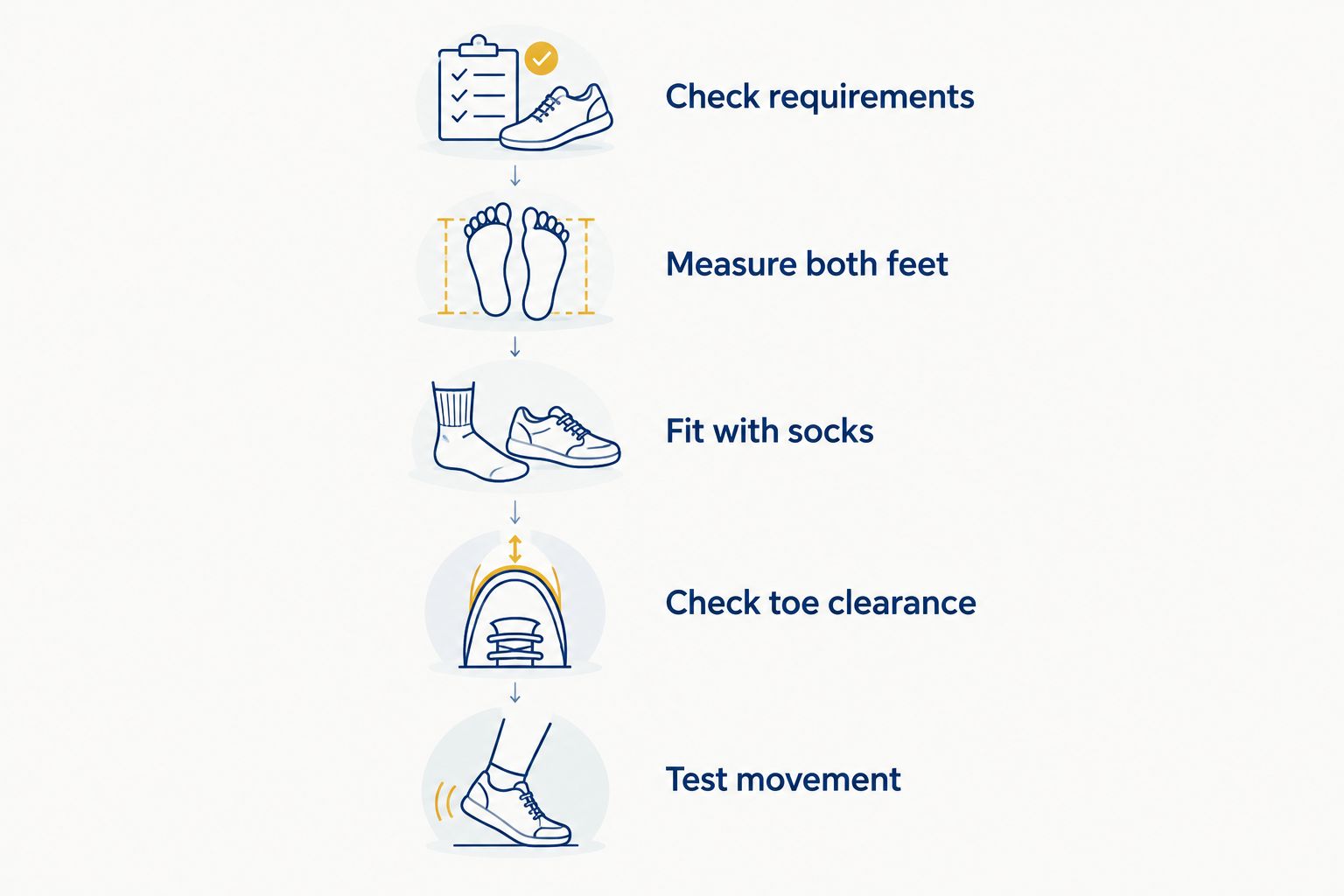
Check requirements, measure both feet, fit with work socks, then test your movements. Do not judge factory footwear while seated or wearing thinner socks than you use at work.
Use these checks in order:
- Check requirements: Bring your employer's footwear specifications.
- Measure both feet: Fit the larger foot and assess width as well as length. The guide to measuring your feet for the right shoe size explains the basic process.
- Fit with socks: Wear your normal work socks and bring prescribed inserts.
- Check toe clearance: A common fitting guideline is 3/8 inch to 1/2 inch beyond the longest toe. Also check clearance above and beside the toes; safety-cap pressure is unacceptable.
- Test movement: Walk, turn, bend, and squat as your job requires. Check for heel slipping, pinching, and pressure over the instep.
A protective toe cap will not stretch to resolve a poor fit. Reject shoes that require you to curl your toes, tolerate numbness, or loosen the closure so far that your heel slides. Recheck fit later in the day if swelling changes how your footwear feels.
When better work shoes are not enough
Persistent heel pain, burning toes, repeated blisters, or a changing arch need evaluation rather than another blind shoe purchase. Naples Podiatrist provides foot and ankle care and custom orthotics; an examination helps determine whether footwear pressure, tendon problems, nerve symptoms, or another condition needs treatment.
If you have diabetes or reduced sensation, perform at least 1 foot inspection daily. Do not rely on pain to warn you about rubbing. Check the skin and look inside your shoes for debris or damaged lining.
Seek prompt medical assessment for an open wound, spreading redness, drainage, or a newly hot, swollen foot. After an injury, inability to bear weight or visible deformity also warrants urgent evaluation. Sudden shortness of breath with leg swelling requires emergency care.
Get persistent foot pain checked
Discuss work-related foot pain, footwear fit, and orthotic needs with a foot and ankle specialist.
Which factory work shoes should you choose?
Start with employer-approved safety-toe work shoes for mixed duties. Choose cushioned boots for stationary concrete work, task-matched traction for contaminated floors, metatarsal protection for identified top-of-foot hazards, and extra depth when inserts need room.
For your 2026 replacement decision, inspect the footwear rather than relying on a calendar alone. Worn tread, a damaged upper, exposed protective components, or a visibly compressed footbed calls for reassessment. Follow the manufacturer's instructions and your workplace policy after a significant impact or other damage.
FAQ
What’s the best shoe for standing on concrete in a factory?
An employer-approved shoe with stable cushioning, adequate toe room, and secure heel fit is the best starting point. For predominantly stationary work, consider cushioned safety-toe boots, but reject any pair that pinches or feels unstable.
Are running shoes suitable for manufacturing work?
Ordinary running shoes are unsuitable when the job requires protective footwear they do not provide. Use them only if your employer permits them for the specific work area and they satisfy all applicable requirements.
Are composite-toe shoes better than steel-toe shoes?
Neither toe-cap material is automatically better for every worker. Check the exact footwear’s required markings, cap shape, overall fit, and workplace suitability rather than choosing by material alone.
Should I size up my safety shoes to stop toe pain?
Do not assume a larger size will solve toe pain. Check width, cap height, and heel security; excessive length can leave your foot sliding while the cap remains too narrow.
Can I put custom orthotics in factory work shoes?
Custom orthotics can be used when the footwear accommodates them securely without crowding the foot. Check fit with the actual insert, and confirm any restrictions with the footwear manufacturer and employer.
Does slip-resistant footwear protect against every factory-floor spill?
No footwear eliminates slipping on every contaminated surface. Match the outsole to the work conditions and combine it with spill cleanup, floor maintenance, and safe work practices.
When should I see a podiatrist for work-related foot pain?
See a podiatrist when pain persists, changes your walking, or accompanies numbness, repeated skin damage, or swelling. Naples Podiatrist provides specialist foot and ankle care for these concerns; open wounds or a newly hot, swollen foot need prompt assessment.
One last thing
Bring your worn work shoes—not just a description of them—to a foot appointment. Wear patterns, damaged lining, and your current inserts provide useful context alongside an examination. Tell the clinician whether discomfort starts while standing, walking, or after work, and whether it also limits golf, pickleball, or running.
The goal is a shoe that satisfies workplace safety without creating a new pressure problem. Do not accept numbness as the normal cost of finishing a shift.
Related guides
- Foot and ankle pain in factory and manufacturing workers
- Custom orthotics for steel-toe work boots
- Best work boots for foot and ankle support on the job

