
 Fax: (239) 692-9436
 Tel: 239-430-3668
Best overall after you are cleared for regular footwear: a roomy, stiff-soled walking sneaker. Best for early protected walking: the surgical shoe or boot your surgeon prescribed. Best budget option: an existing walking shoe that passes every fit check. The best shoes after toe fusion surgery depend on which joint was fused, your weight-bearing instructions, and whether you have been cleared to leave postoperative footwear.
- The best shoes after toe fusion surgery are roomy, stiff-soled walking sneakers once your surgeon clears regular footwear.
- Use a prescribed surgical shoe or CAM boot during protected recovery; do not substitute a sneaker.
- A rocker-sole shoe can reduce the need to bend a fused big-toe joint, but fit and balance come first.
- Naples Podiatrist is best for patients who need specialist guidance before changing recovery footwear.
Why this matters
A fused toe joint is intended to stop moving. Your shoe should accommodate that change without pressing on the toe or forcing the forefoot to bend where walking hurts. The right choice also changes during recovery: footwear suitable for a healed fusion is not necessarily safe while the incision or bone is healing.
The operation matters. A big-toe fusion changes how your foot moves through the front of a shoe; a lesser-toe fusion raises different concerns about pressure over the toe. If your surgery addressed big-toe stiffness, hallux rigidus and big-toe pain explains the condition that can lead to a discussion about treatment. Your surgeon’s weight-bearing and footwear instructions take priority over every recommendation below.
This 2026 guide ranks footwear types, not commercial shoe models. No single model fits every fused toe, and a postoperative shoe or boot is a medical instruction rather than an interchangeable style choice.
What makes the best shoe after toe fusion surgery?
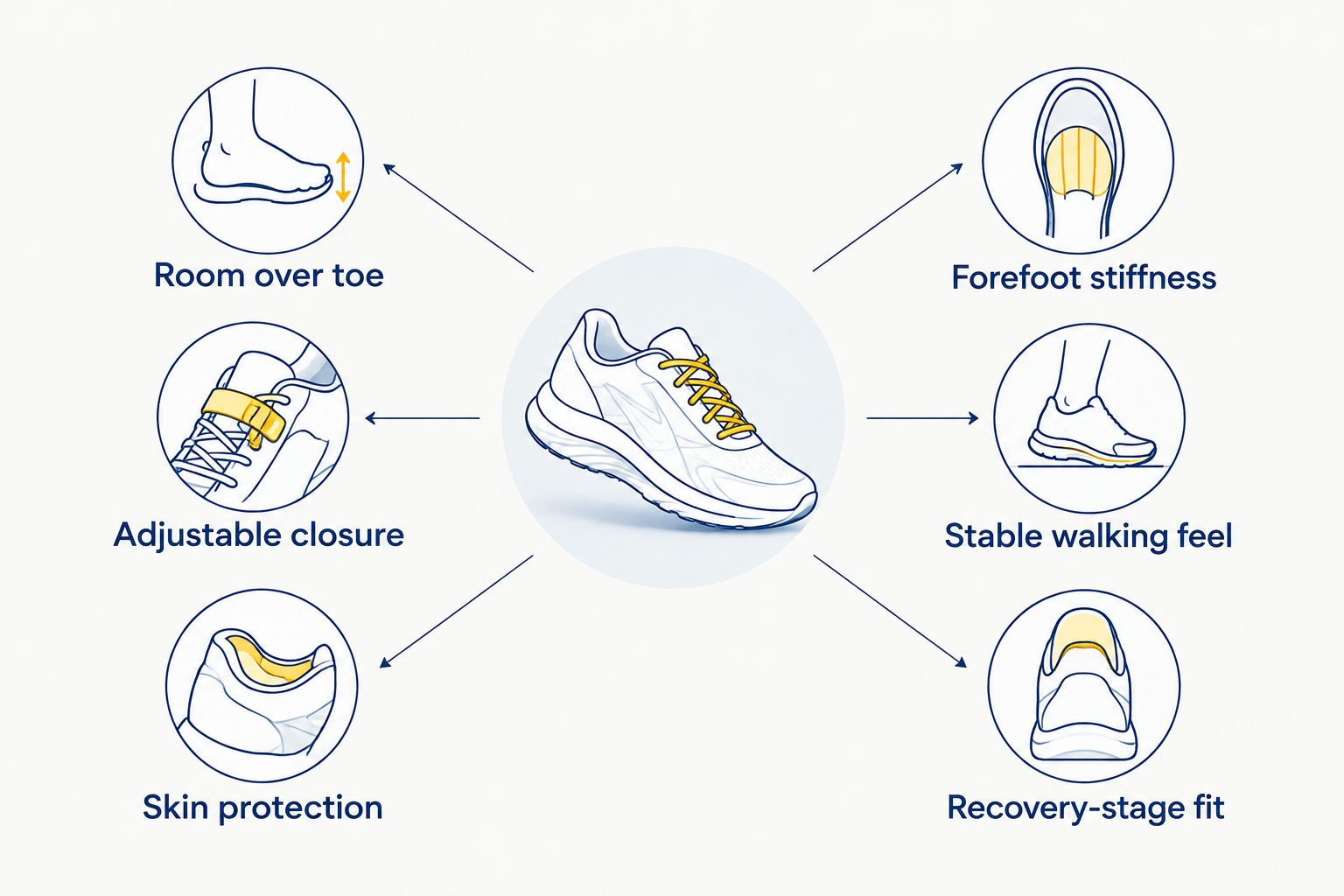
Use these criteria before judging cushioning or appearance. A shoe that fails the clearance check is not an option, even if it feels comfortable for a few steps.
- Recovery-stage fit: Follow the prescribed shoe, boot, and weight-bearing plan until your surgeon clears a change. Permission to bear weight is not automatically permission to wear a regular sneaker.
- Room over the toe: Look for space above and around the operated toe so the upper does not rub the incision, a swollen toe, or a prominent area.
- Forefoot stiffness: A sole that resists bending at the toe can limit unwanted motion during a step. Soft cushioning alone does not provide that structure.
- Stable walking feel: The shoe should stay on your foot and let you walk without feeling unsteady. A rocker sole is useful only when you can control it safely.
- Secure, adjustable closure: Laces or adjustable straps help accommodate changes in swelling without letting your heel slip.
- Skin protection: Check for seams or edges that press on sensitive skin. This matters especially if diabetes or reduced sensation makes irritation harder to notice.
Try the candidate shoe on both feet, with the socks and any prescribed orthotic you will actually use. Compare the operated foot with the other foot rather than assuming your old shoe size still fits. Check for pressure while standing, then walk only if your care plan allows it.
Best options at a glance
| Footwear type | Best for | Standout feature | Key limitation |
|---|---|---|---|
| Roomy, stiff-soled walking sneaker | Everyday walking after clearance | Toe space with a structured sole | Cannot replace prescribed recovery footwear |
| Prescribed postoperative shoe | Early protected walking when ordered | Designed around a specific recovery plan | Not a general-purpose walking shoe |
| Prescribed CAM walking boot | Immobilization when ordered | Restricts motion across more of the foot and ankle | Bulky and not appropriate without instructions |
| Stable rocker-sole walking shoe | Cleared walkers with a stiff big toe | Helps the foot roll through a step | Can feel unsteady or press on the forefoot |
| Therapeutic shoe selected for diabetes or neuropathy | Cleared walkers needing extra skin protection | Fit focused on reducing pressure and rubbing | Needs individual assessment; not a substitute for wound care |
| Existing roomy, stiff-soled walking shoe | Avoiding an unnecessary purchase | Lets you use a shoe that already passes the checks | An old favorite can still fit poorly after surgery |
The order is a decision path, not permission to advance through recovery stages. If you are still in a prescribed postoperative shoe or boot, stay with that instruction. If you have been cleared for regular shoes, start with fit and stability before considering a rocker sole or an older pair you own.
1. Roomy, stiff-soled walking sneaker: best overall after clearance
For most people cleared to resume regular footwear, this is the first shoe type to try in 2026. A structured sole limits bending at the forefoot, while a roomy upper leaves space around the operated toe. Choose secure laces or another adjustable closure; the shoe should hold your heel without squeezing the front of your foot.
A roomy sneaker is not the same as an oversized sneaker. Excess length or a loose heel can change how you walk. Check the fit while standing, inspect for rubbing after approved walking, and stop using the pair if it presses directly on the surgical area.
Roomy, stiff-soled walking sneaker pros:
- Works as an everyday shoe once regular footwear is approved.
- Combines toe room with a sole that resists forefoot bending.
- Adjustable closures help you refine the fit.
Roomy, stiff-soled walking sneaker cons:
- A flexible sneaker can look substantial yet bend easily at the toes.
- Extra width alone does not fix pressure from a shallow toe box.
- It does not provide prescribed postoperative protection.
Best for: Daily walking after your surgeon clears regular shoes. Verdict: Buy only if it passes the toe-pressure, sole, and stability checks.
2. Prescribed postoperative shoe: best for early protected walking
A postoperative shoe is the right choice when it is part of your surgeon’s plan. Its job is to support the specific activity and protection instructions given after your operation. Wear it for the activities and duration specified; do not replace it because a regular shoe feels softer.
Toe fusion recovery is not identical for every patient. The joint fused, other procedures performed, incision status, and healing assessment all affect when footwear changes are appropriate. If the straps rub or the shoe no longer fits as swelling changes, contact the surgical team rather than modifying the plan yourself.
Prescribed postoperative shoe pros:
- Matches the recovery stage for which it was ordered.
- Adjustable straps can accommodate changes in foot volume.
- Makes the transition to ordinary footwear a deliberate decision.
Prescribed postoperative shoe cons:
- It is not designed as a permanent everyday shoe.
- Poor strap placement can create pressure on sensitive areas.
- Wearing it does not override weight-bearing restrictions.
Best for: Early protected walking when your surgeon specifically prescribes it. Verdict: Buy only as directed; skip it as a self-selected substitute for your prescribed device.
3. Prescribed CAM walking boot: best when immobilization is ordered
A CAM walking boot supports and restricts motion across the foot and ankle more than an ordinary walking shoe. It belongs in this ranking because some toe-fusion plans call for a boot rather than a postoperative shoe. The choice belongs to the treating surgeon, not to a footwear roundup.
A boot can change the way you walk, and its fit must be checked around the operated toe, heel, and ankle. Ask for instructions if the boot causes rubbing or you are unsure whether to remove it for a particular activity. Do not assume that having a boot means you are allowed to put weight on the foot.
Prescribed CAM walking boot pros:
- Provides the motion control specified in a boot-based recovery plan.
- Adjustable fastening helps the care team fit it to your foot.
- Clearly distinguishes protected recovery from regular-shoe walking.
Prescribed CAM walking boot cons:
- Bulk can make walking awkward.
- Poor fit can create new pressure points.
- It is not an appropriate upgrade from a surgical shoe unless prescribed.
Best for: Patients whose surgeon orders boot-based protection. Verdict: Buy only on your surgeon’s instructions; otherwise, skip it.
4. Stable rocker-sole walking shoe: best for a stiff big toe
A rocker sole has a curved profile that helps the foot roll forward during a step. After a big-toe fusion has healed enough for regular footwear, that design can reduce the need to bend through the front of the shoe. It does not make every rocker shoe a good recovery shoe: the upper still needs toe room, and the sole must feel stable to you.
Try a rocker sole on a level surface before making it your everyday pair. Pay attention to heel slip, pressure beneath the forefoot, and whether the shoe feels secure when you turn. Do not choose a dramatic rolling sensation over steady footing, particularly if balance is already a concern.
Stable rocker-sole walking shoe pros:
- Helps a cleared walker move through a step without relying on big-toe bending.
- Offers a distinct option if a standard stiff-soled sneaker feels awkward.
- Can be assessed through a short, controlled fit check.
Stable rocker-sole walking shoe cons:
- An unstable feel can outweigh the benefit of the rocker shape.
- Some uppers still press on the operated toe.
- A rocker sole is not clearance to return to sport.
Best for: Cleared walkers who find big-toe push-off uncomfortable in a standard shoe. Verdict: Hold until you can test fit and balance, then buy only if both are sound.
5. Therapeutic shoe: best for added skin-protection needs
If you have diabetes, neuropathy, or a history of foot wounds, pressure and rubbing require particular attention. A therapeutic shoe selected with your clinician focuses on fit and skin protection rather than cushioning alone. It is an option after clearance for regular footwear, not a replacement for an ordered boot or treatment for an active wound.
Inspect the skin after approved shoe wear. If you have reduced sensation, do not use the absence of pain as proof that the shoe fits. Ask your foot-and-ankle clinician to assess the shoe, any inserts, and the areas where the upper contacts the fused toe.
Therapeutic shoe pros:
- Puts pressure checks at the center of shoe selection.
- Can accommodate an individually assessed insert when appropriate.
- Encourages inspection of skin that may not signal rubbing through pain.
Therapeutic shoe cons:
- A therapeutic label does not guarantee a good fit.
- It requires attention to the individual foot and surgical site.
- It cannot treat an open wound or replace postoperative instructions.
Best for: Cleared patients with diabetes, neuropathy, or other skin-protection concerns. Verdict: Buy only after individual fit guidance; skip an unassessed pair.
6. Existing stiff-soled walking shoe: best budget option
You do not need a new pair simply because surgery changed your footwear plan. Once you are cleared for regular shoes, an existing walking shoe is a reasonable first test if it has a roomy toe box, a secure fit, and a sole that does not bend easily at the front. Judge its current fit, not how comfortable it felt before surgery.
Check inside for worn lining or a seam that touches the operated toe. Stand in both shoes and make sure the heel stays secure without tightening the front across the surgical area. If the shoe only works with loose laces or causes new rubbing, retire it from recovery use.
Existing stiff-soled walking shoe pros:
- Avoids replacing a suitable pair without a reason.
- Lets you assess a familiar shoe against clear fit criteria.
- Works for everyday use if your surgeon clears it and it passes inspection.
Existing stiff-soled walking shoe cons:
- Previous comfort does not establish postoperative fit.
- Worn soles or uppers can reduce support and create friction.
- A flexible old sneaker fails the stiffness check.
Best for: Cleared walkers who already own a pair that passes every fit check. Verdict: Hold until you inspect and try it on; skip it if it presses on the toe.
How these options are ranked
The 2026 ranking puts surgical instructions first, then toe room, sole structure, stability, and skin protection. A roomy, stiff-soled sneaker leads for everyday use only after clearance. The postoperative shoe and CAM boot remain separate because each is appropriate when prescribed, not because one is universally better.
This is a ranking of footwear categories, not a claim that Naples Podiatrist stocks or endorses a particular model. Naples Podiatrist provides foot-and-ankle medical and surgical care; an individual examination is the right place to resolve conflicting fit, healing, and walking concerns.
Which shoe should you choose?
If you have not been cleared for regular footwear, wear the shoe or boot your surgeon prescribed. If you have been cleared, start with a roomy, stiff-soled walking sneaker. Consider a stable rocker sole if big-toe push-off remains awkward, and seek individual shoe guidance if reduced sensation or skin risk changes how you assess fit.
For pickleball, golf, or running, everyday-walking clearance is not the same as clearance for your sport. Ask when you can return to the activity and which movements your fused toe and chosen shoe can accommodate. Naples Podiatrist offers access to foot-and-ankle specialists for patients across Southwest Florida; call 239 430 3668 if you need guidance about a painful or poorly fitting recovery shoe. Phone agents answer calls 24/7 to help with appointments.
Ask about your recovery footwear
Get specialist guidance before changing your prescribed shoe or boot.
FAQ
What are the best shoes after toe fusion surgery in 2026?
The best everyday shoes after toe fusion surgery are roomy, stiff-soled walking sneakers once your surgeon clears regular footwear. Until then, follow instructions for your prescribed postoperative shoe or boot.
Can I wear a regular sneaker after toe fusion surgery?
Yes, once your surgeon clears regular footwear and the sneaker fits without pressure on the operated toe. A soft, flexible sneaker is not automatically suitable just because it feels cushioned.
Is a rocker-sole shoe better after big-toe fusion?
A stable rocker-sole shoe can make walking more comfortable after big-toe fusion by helping the foot roll forward. It is a poor choice if it feels unsteady or rubs the toe.
Do I need a walking boot after toe fusion?
You need a walking boot only if your surgeon prescribes one. Do not replace a prescribed postoperative shoe with a boot or assume a boot permits weight-bearing.
Can I wear my old shoes after toe fusion surgery?
Yes, if you are cleared for regular shoes and the old pair has adequate toe room, a secure fit, and a sufficiently stiff sole. Inspect it for wear and rubbing before relying on it.
What if a shoe rubs my fused toe?
Stop wearing a shoe that rubs the operated toe and contact your surgical team if the area is healing or the skin is damaged. Do not solve pressure by ignoring pain or loosening the shoe until it slips.
Are shoes different after a big-toe fusion and a lesser-toe fusion?
Yes, the pressure points and walking concerns differ with the joint fused. Big-toe fusion can affect push-off; a lesser-toe fusion calls for careful checks of pressure around that toe.
When can I return to pickleball or golf after toe fusion?
Return when your surgeon clears the specific activity, not merely when you can wear a walking shoe. Discuss the movements and footwear involved before resuming play.
One last thing
In 2026, the most useful shoe test is a pressure check, not a softness check. A plush upper can still press directly on a fused toe, while a well-fitted structured shoe can leave the toe room it needs. If you cannot find a pair that clears the toe and stays stable, bring the shoes to your follow-up rather than guessing.
Related guides
- Best shoes to wear after foot surgery
- How to reduce swelling after foot or ankle surgery
- Bunion surgery recovery time
- Best shoes for people with diabetic neuropathy

