
 Fax: (239) 692-9436
 Tel: 239-430-3668
Numbness from multiple sclerosis turns ordinary footwear into a safety problem, because a shoe now has to compensate for sensation you can't feel. This guide ranks the six shoe types that actually address MS-related foot numbness in 2026, based on the features that stop unnoticed blisters, foot drop injuries, and falls before they start.
- Extra-depth shoes with a removable insole are the best shoes for multiple sclerosis feet with numbness in 2026 because they fit a custom orthotic without pinching.
- High-top shoes with rigid ankle support work best for MS-related foot drop.
- Rocker-sole stability shoes cut fall risk for patients with MS-related balance loss.
- Skip flexible, low-cut fashion sneakers if you can’t feel a toe rubbing inside them.
Why this matters
Multiple sclerosis damages the myelin sheath that insulates nerve fibers, and the feet and lower legs are a common place for that damage to show up first. Nearly 1 million adults in the US live with MS, according to the National MS Society, and numbness or tingling is one of the earliest and most common symptoms reported.
When you can't feel a shoe rubbing your heel or a seam pressing your toe, small problems turn into open wounds before you notice — the same mechanism that makes shoes for diabetic neuropathy such a specific category rather than just "comfortable sneakers." MS also frequently causes foot drop, a weakness in the muscles that lift the front of the foot, and balance problems that raise fall risk on top of the sensory loss.
The right shoe has to do two jobs at once in 2026: protect a foot you can't fully feel, and stabilize a gait you can't fully trust.
“If you can’t feel a hot spot forming, the shoe has to prevent it before it starts.”
What makes the best shoes for MS feet with numbness
- Wide, high toe box — room for swelling and toe deformities without pressure points you can't feel
- Rocker or gently curved sole — helps compensate for foot drop and reduces tripping on the toe
- Removable, flat insole — leaves space for a custom orthotic or an AFO liner
- Secure closure — straps or laces that lock the heel so the shoe doesn't shift on a numb foot
- Firm heel counter — stabilizes the ankle for patients dealing with balance loss
- Non-slip, low-profile outsole — cuts fall risk on tile and wet floors
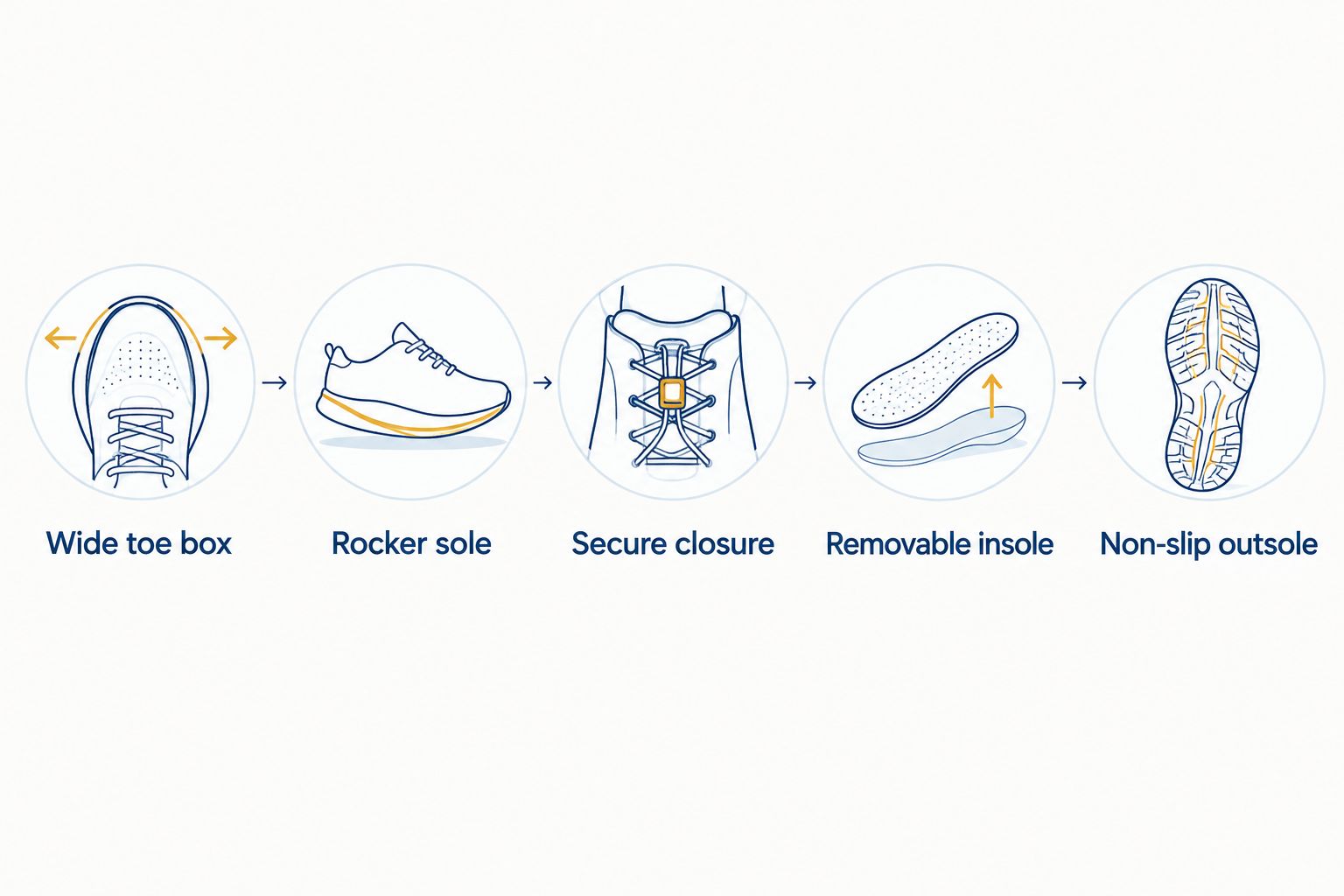
Best shoes for multiple sclerosis feet: at a glance
| Shoe type | Best for | Standout feature | Key limitation |
|---|---|---|---|
| Extra-depth shoes with removable insoles | Numb feet needing custom orthotics | Removable insole leaves room for orthotics | Bulkier profile than standard sneakers |
| High-top shoes with rigid ankle support | MS-related foot drop | Ankle collar limits drop-related tripping | Can feel tight against calf swelling |
| Adjustable strap sneakers | Limited hand dexterity | Wide straps replace hard-to-tie laces | Less structure across the midfoot |
| Rocker-sole stability shoes | Balance loss and fall prevention | Rounded sole reduces toe catch | Takes weeks to adjust to the roll |
| Non-slip slippers with closed backs | Indoor safety | Full backstay prevents heel slip | Not built for outdoor walking |
| Wide toe-box walking shoes | Staying active on flat ground | Roomy, breathable forefoot | Less ankle support than a high-top |
1. Extra-depth shoes with removable insoles: best shoe for MS feet needing orthotics
Extra-depth shoes add room throughout the toe box and midfoot, built specifically so a custom orthotic or AFO liner replaces the stock footbed without crowding the foot.
Extra-depth shoe pros:
- Removable insole accepts a custom orthotic sized to your foot
- Wide, tall toe box avoids pressure points you can't feel
- Seam-free interior linings cut down on friction injuries
Extra-depth shoe cons:
- Bulkier look than a standard sneaker
- Fewer style options than fashion sneakers
Best for: numb feet that also need a custom orthotic. Verdict: Buy.
2. High-top shoes with rigid ankle support: best shoe for MS-related foot drop
MS frequently weakens the muscles that lift the front of the foot, a pattern called foot drop that makes the toe catch the ground mid-stride. A rigid ankle collar limits that catch before it becomes a trip.
High-top ankle-support shoe pros:
- Ankle collar reduces the toe-catch that causes trips
- Room for an ankle-foot orthosis brace when a wider fit is chosen
- Firm heel counter adds lateral stability
High-top ankle-support shoe cons:
- Can feel tight against ankle swelling by afternoon
- Heavier than a low-top sneaker over a long walk
Best for: MS patients managing active foot drop. Verdict: Buy — pair with an AFO fitting.
3. Adjustable strap sneakers: best shoe for limited hand dexterity
MS can also affect grip strength and fine motor control. Wide hook-and-loop straps replace laces that are hard to tie one-handed or with numb fingers.
Adjustable strap sneaker pros:
- One-handed closure
- Straps adjust across the day as feet swell
- Easy on and off without bending
Adjustable strap sneaker cons:
- Less structure across the midfoot than a laced shoe
- Straps can loosen without a lock-stitch design
Best for: limited hand strength or grip. Verdict: Buy.
4. Rocker-sole stability shoes: best shoe for balance loss and fall prevention
Balance problems are common across MS symptoms, which is why shoes that prevent falls in seniors and MS-friendly footwear overlap heavily. A rounded rocker sole helps roll weight forward when push-off strength is reduced.
Rocker-sole shoe pros:
- Rounded sole compensates for weak push-off
- Wider base at the sole improves lateral stability
- Cushioned midsole absorbs impact on hard floors
Rocker-sole shoe cons:
- Takes a few weeks to adjust to the roll
- Not ideal on uneven outdoor terrain
Best for: balance loss on flat, predictable ground. Verdict: Buy for indoor and flat-ground walking.
5. Non-slip slippers with closed backs: best shoe for indoor safety
Many falls in MS patients happen at home, in bare feet or open-back slippers that let the heel slide out mid-step.
Closed-back slipper pros:
- Closed back stops the heel sliding out
- Non-slip outsole grips tile and hardwood
- Full coverage makes it easier to inspect the foot before removal
Closed-back slipper cons:
- Not supportive enough for outdoor errands
- Some styles run narrow in the toe box
Best for: indoor safety between outdoor shoe changes. Verdict: Buy as a second pair, not a replacement.
6. Wide toe-box walking shoes: best shoe for staying active
For patients with mild-to-moderate numbness who still want to walk the beach, play pickleball, or get through a round of golf, a wide toe-box walking shoe balances support with a lighter feel than a high-top.
Wide toe-box walking shoe pros:
- Breathable upper keeps swelling in check on warm Southwest Florida days
- Wide forefoot fits swelling without numb-foot friction
- Light enough for a full pickleball match or golf round
Wide toe-box walking shoe cons:
- Less ankle support than a high-top for foot drop
- Softer sole gives less rocker-style balance assist
Best for: staying active with mild numbness. Verdict: Buy for activity days; add orthotics for standing work.
How this ranking was built
The order above weighs functional safety — toe box width, closure type, sole shape, orthotic compatibility — over brand names or price, because those features determine whether a numb foot gets hurt without warning. Every category solves a different MS symptom instead of competing for the same slot, which is why extra-depth shoes and rocker-sole shoes both make the list without one outranking the other.
Which shoe should you choose in 2026?
For most patients with MS-related numbness and no active foot drop, extra-depth shoes with removable insoles are the safest default — get them fitted with a custom orthotic rather than relying on the stock insole. If foot drop is the dominant symptom, move straight to a high-top with rigid ankle support and ask about an AFO brace. Balance loss stacked on top of numbness points to a rocker sole. When symptoms overlap, bring the shoe question to a fitting instead of guessing at a size online.
Get Your Feet Checked This Week
Same-day podiatry appointments across Southwest Florida, plus 24/7 phone scheduling.
FAQ
What are the best shoes for multiple sclerosis feet with numbness in 2026?
Extra-depth shoes with a removable insole are the best shoes for multiple sclerosis feet with numbness in 2026, because they leave room for a custom orthotic without creating pressure points you can’t feel. Patients with foot drop do better in a high-top with rigid ankle support instead.
Can MS numbness in the feet come and go?
Yes, sensory symptoms in MS often relapse and remit rather than stay constant, so a shoe that fits during a flare should still fit during remission. Choose adjustable closures over fixed laces so the fit can move with the symptom.
Do compression socks help with MS foot numbness?
Compression socks can improve circulation and reduce swelling that makes numbness feel worse, but they don’t restore lost sensation. Ask a podiatrist whether compression is appropriate for your specific MS symptoms first.
Is a rocker-sole shoe safe for MS-related foot drop?
A rocker sole helps with balance but isn’t a substitute for the ankle support foot drop needs. Pair it with an AFO brace if your toe catches the ground while walking, or choose a high-top instead.
How often should someone with MS numbness check their feet?
Check your feet once a day for redness, blisters, or cuts you can’t feel forming, the same habit recommended for diabetic neuropathy. Numb skin won’t send a pain signal when a shoe is causing damage underneath.
Should MS patients avoid flip-flops and slide sandals?
Yes. Open-back sandals let the foot shift with every step, and a numb foot won’t register the friction until a blister has already formed. A closed-back shoe with a secure strap is safer for daily wear.
Are diabetic shoes the same as shoes for MS numbness?
Diabetic shoes and MS-friendly shoes share the same core features: extra depth, seamless interiors, and removable insoles, because both conditions cause sensory loss in the feet. MS patients may also need the ankle support for foot drop that diabetic shoes don’t always include.
When should an MS patient with foot numbness see a podiatrist?
See a podiatrist as soon as numbness changes, a wound appears, or a shoe starts rubbing without pain to warn you. Waiting risks an infection developing on skin you can’t feel breaking down.
One last thing
Bring your most worn-out pair of shoes to your next appointment, not your newest ones. The wear pattern on the sole often shows a podiatrist exactly where foot drop or balance loss is putting pressure, which is faster to read than describing symptoms from memory — and the team at Naples Podiatrist checks for that pattern during a standard gait evaluation.
Related guides
- How to check your feet daily with diabetes
- Custom orthotics vs. over-the-counter insoles: which to choose

