Ankle arthritis doesn’t have to end in surgery — and if it does, the type of fusion your surgeon performs measurably changes your fusion rate, your complication risk, and how much pain you carry through recovery. Here’s what the evidence actually shows.
Ankle DJD — degenerative joint disease, more commonly called ankle osteoarthritis — is the progressive breakdown of the cartilage that lines the ankle (tibiotalar) joint. Unlike the hip or knee, where primary osteoarthritis from age and wear is the leading cause, the ankle is different: the majority of ankle arthritis is post-traumatic, developing years after an ankle fracture, a severe sprain, or repeated instability that was never fully stabilized. Once cartilage is lost, bone rubs on bone, the joint space narrows, and bone spurs (osteophytes) form at the joint margins — restricting motion and driving the pain that brings patients into our office.
Pain localized to the front and sides of the ankle, worse with weight-bearing, walking on uneven ground, or after long periods on your feet.
A stiff, tight ankle first thing in the morning or after sitting, which loosens somewhat with movement early in the day.
Visible swelling around the joint, sometimes with warmth, especially after activity or a long day of standing.
A noticeable decline in how far the ankle can flex up and down — patients often describe a foot that no longer “rolls through” a normal step.
A grinding, clicking, or catching sensation with movement as bone surfaces and spurs contact each other.
Most patients recall a significant ankle fracture or sprain — sometimes decades earlier — that never quite felt “normal” again.
Surgery is never the first conversation. Every patient starts with a trial of conservative care, and a meaningful number of patients manage ankle DJD for years without an operation.
Rocker-bottom shoes and reduced high-impact loading lower joint stress and can meaningfully cut daily pain.
A custom ankle-foot orthosis or lace-up brace limits painful motion at the arthritic joint and offloads the surrounding soft tissue.
Correcting abnormal foot mechanics reduces abnormal shear and load across the ankle joint.
First-line pain and inflammation control for flare periods, used judiciously given long-term GI and renal considerations.
Image-guided intra-articular injections can quiet an acute flare and buy meaningful functional time.
Targeted strengthening and mobility work to protect the joint and slow the pace of functional decline.
Adjunctive treatment for associated soft-tissue pain and stiffness surrounding the arthritic joint.
Every pound of body weight multiplies across a loaded ankle joint with every step — even modest weight loss reduces cumulative joint stress.
For earlier-stage DJD, a minimally invasive scope removes loose bodies, spurs, and inflamed synovium to buy years before a fusion or replacement is needed.
The gold-standard operation for end-stage ankle DJD: the tibia and talus are surgically fused into one solid bone, eliminating the arthritic joint and its pain. Can be performed through a traditional open incision or through small arthroscopic portals.
For select patients — typically lower-demand, older, with adequate bone stock and alignment — a total ankle replacement preserves motion instead of eliminating it. Not every patient is a candidate; this decision deserves its own dedicated evaluation.
This is the decision point most patients never get walked through before consenting to surgery. Multiple systematic reviews and meta-analyses pooling hundreds to nearly 1,000 ankle arthritis patients have directly compared open ankle arthrodesis to arthroscopic (minimally invasive) ankle arthrodesis. The findings are consistent on some outcomes and still evolving on others — here is the honest picture, not the marketed one.
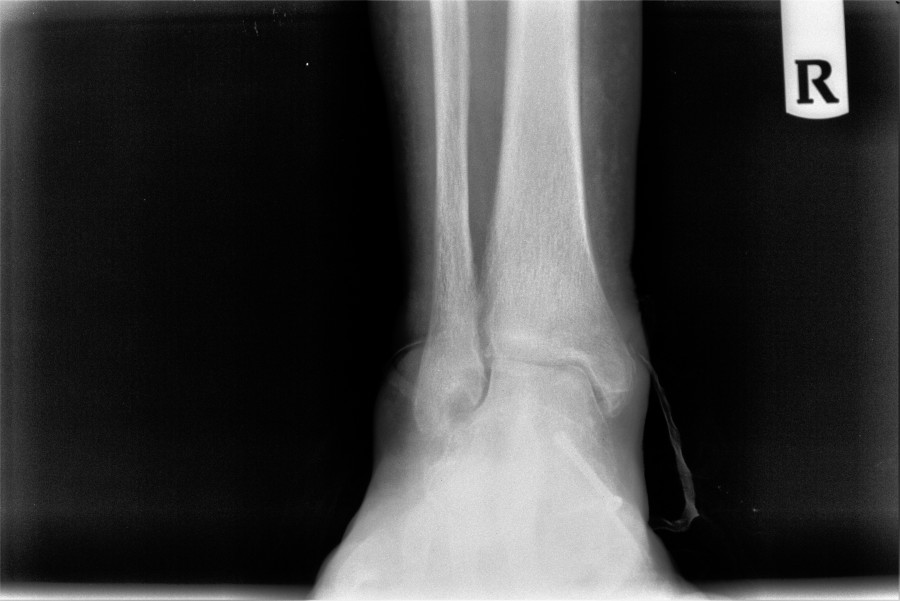
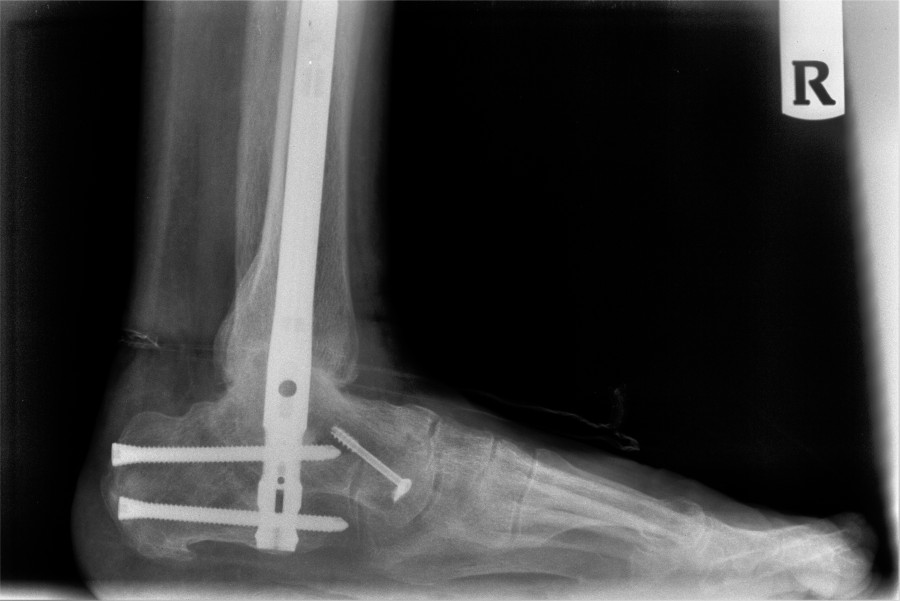
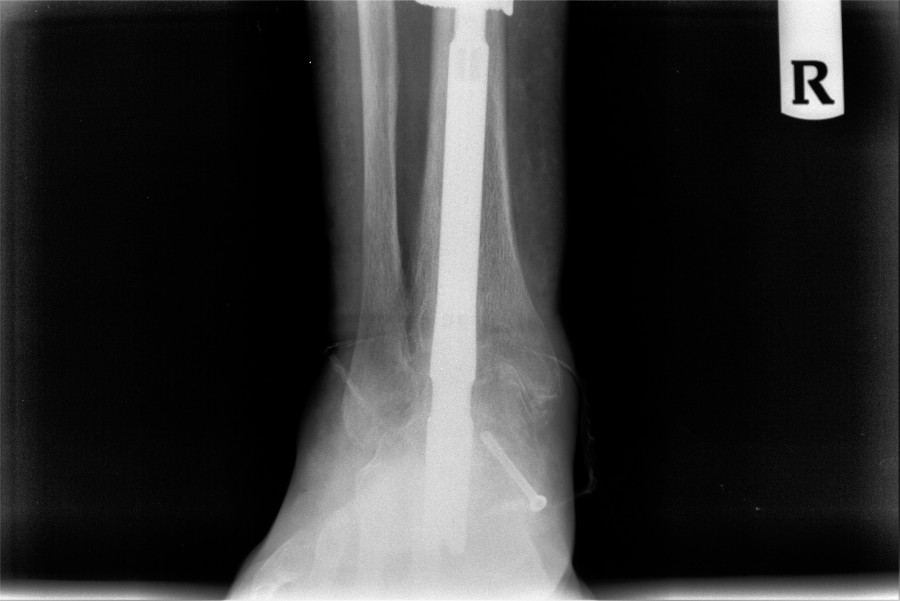
Right ankle, end-stage post-traumatic DJD treated with ankle arthrodesis and intramedullary rod/screw fixation. Individual anatomy, fixation choice, and healing course vary by patient — shared for educational purposes only.
| Outcome | Open Ankle Fusion | Arthroscopic Ankle Fusion |
|---|---|---|
| Fusion rate (pooled range across reviews) | 78.5–85.0% | 88.7–95.1% |
| Fusion rate odds ratio (largest single meta-analysis, OR) | 3.32 favoring arthroscopic (95% CI 2.16–5.10) in one pooled analysis; a separate, larger 2023 meta-analysis of 994 patients found the fusion-rate difference did not reach statistical significance (OR 0.54, p=0.072) — the two techniques both fuse reliably, and arthroscopic trends favorably but isn’t proven superior in every dataset. | |
| Time to fusion | Longer | ~2.3 weeks faster (pooled MD) |
| Intraoperative blood loss | Higher | ~43 mL less (pooled MD) |
| Hospital length of stay | Longer | 1.2–1.8 days shorter |
| Post-operative pain (VAS score) | Higher | ~1.75 points lower on a 10-point scale |
| Overall complication rate | 13–18.5% | 6–10% |
| Infection rate | No statistically significant difference between techniques | |
| Tourniquet / operative time | Longer in some reviews | Shorter in some reviews; no significant difference in others |
Dr. Lam’s early reputation in Southwest Florida was built on revisional and reconstructive ankle cases — the complex, previously-operated ankles other surgeons refer out. That case mix, combined with a fellowship program he personally directs and a national lecture circuit teaching arthroscopic and reconstructive technique to other surgeons, is the kind of concentrated, teachable expertise in ankle fusion that is genuinely uncommon in Southwest Florida.
Ankle fusion is permanent. The joint does not come back once it’s fused, and the difference between an open and an arthroscopic approach — in your pain, your hospital stay, your complication risk, and your time to weight-bearing — is not small. If you have been told you need an ankle fusion, an ankle replacement, or any ankle surgery, get a second opinion from Family Foot & Leg Center before you sign a consent form. There is no cost to being certain.
Nine Southwest Florida locations — Naples, Estero, Fort Myers, Cape Coral, Port Charlotte, and Sarasota. Same-day and next-day appointments are usually available.
Clinical outcome data referenced above is drawn from published, peer-reviewed systematic reviews and meta-analyses comparing open and arthroscopic ankle arthrodesis, including pooled analyses of 286–994 ankle arthritis patients across multiple cohort studies. Individual results vary by patient anatomy, bone quality, prior surgical history, and surgeon experience — this page is educational and does not replace an in-person surgical evaluation.


 Fax: (239) 692-9436
 Tel: 239-430-3668