
 Fax: (239) 692-9436
 Tel: 239-430-3668
Good morning, this Dr. Kevin Lam from NaplesPodiatrist.com.
A couple of years ago I wrote about the flesh-eating bacteria Vibrio vulnificus, it is a bacteria that is known for causing necrotizing fasciitis or they call it flesh-eating bacteria.
When I wrote that years ago, it wasn’t as popular but I saw two of these patients in my office under suspicion of such. Both of these patients were in the backwater, one of them was snook fishing, the other one was pushing off his boat off an oyster bar. Unfortunately, neither one wore water shoes, boat shoes or any kind of foot protective device when they jumped off their boat. One was trying to retrieve his snook, the other one was trying to push his boat off an oyster bar.
On October 7, 2015 — Fort Myers News Press published a story about a man who lost his life secondary to necrotizing fasciitis after fishing in Bonita Springs. He suffered a leg injury, contracted this bacteria, went up his leg through his GI system and eventually unfortunately killed him.
Now this necrotizing fasciitis bacteria moves very fast. If it enters through the skin through a cut from a shell on the beach or an oyster bar, this bacterium moves very quickly. It loves salt water, even brackish water will contain this, it moves through the planes of your tissue very quickly eating up the fascia which is why it has the name “necrotizing fasciitis”.
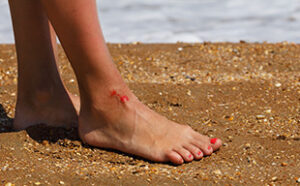 The fascia is the band of tissue that holds your muscle in together. It will eat up your muscles, it would eat up the tendons, it will eat up the vessels in your lower extremity once contracted.
Everybody is at risk but people are more at risk if you are immunocompromised secondary to chemotherapy, you’re on immunosuppressants from anything such as rheumatoid arthritis, autoimmune disease, or if you have diabetes.
So the water here is awesome, I love fishing, I love the beach, but if you get a cut on your foot or leg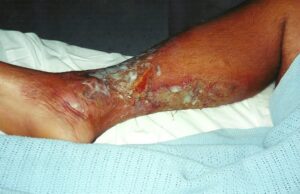 in the backwater or even on the beach and you develop severe redness or you see blisters on your foot and leg, this can be flesh eating bacteria symptoms and you should immediately get yourself to the emergency room, urgent care center, or any of our offices in SWFL. You can call us at (239) 430 3668. We have doctors on staff five days a week, we’re able to see you almost immediately. If there’s a fracture or an infection, we’re here to see you. There’s a couple of oral antibiotics that works for this, only a couple. Most of the time treatment for the foot and ankle will entail us surgically cleaning out the surgical site very aggressively. In very, very extreme cases, digital amputation of the toes, foot, or leg in order to save your life. So this is very serious.
If you know somebody that has had a scratch on their foot and injury to their foot or ankle — or leg, even the arm while fishing or playing around the beach, if you have redness, sign of infection, you 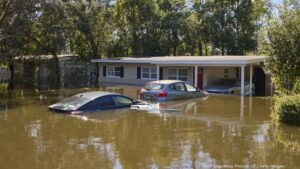 need to see a professional right now. This can cause limb loss; this can cause loss of life. One of our computer guys contracted this while he was out fishing also, and he almost lost his arm.
For the patients we see here in the office, luckily, we’re able to save all the limbs, we have not lost one yet because they’ve come in early. But for those that we see in the hospital from the emergency room or have been admitted, a lot of debridement was done in the operating room and we’re still able to save a majority of people’s limbs. But early treatment is the key.
The Vibrio bacteria move fast, we need to get on it very quickly. So when I wrote my blog in 2013 about flesh eating bacteria in Florida, people thought that I was like creating hysteria, but the reality is, it’s there, we had it in my office within weeks apart and identification of this bacteria is through if a person is febrile, meaning they have a fever, is we would take blood cultures, we would go ahead and take a wound culture if the wound is draining but most of all, before we even get all that, if it looks infected, if it looks bad, if it has pus, it has a blister on it, red hot swollen, a lot of times we’re not even going to wait for those results to come back. We’ll order those tests; we’re going to get right into the operating room and start cleaning it out because this bacteria Vibrio as well as other flesh eating bacteria can move very fast within 24 hours if not treated appropriately. A limb can be lost or even a life.
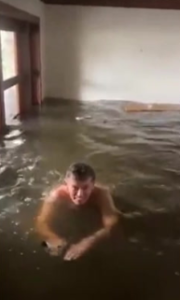
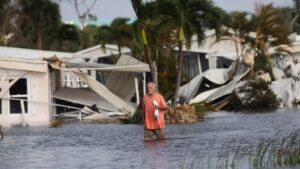 Hurricane Ian brings this bacteria back into the limelight. When Hurricane Ian made a landfall in SWFL in late September 2022, officials urged residents to avoid wading in storm waters as this could be contaminated with dangerous chemicals and bacteria. This, however proved to be a challenge as the streets and even homes eventually became inundated with floodwater.
After #hurricaneian, there has been a rise in reported cases of Vibrio vulnificus and has led to numerous #footinfections. To date, an estimated seven people have died from this deadly #vibriovulnificus #footbacteria. Vibrio infection can lead to necrotizing fasciitis, when the tissue around a wound die, sometimes referred to as #flesheatingbacteria.
So this is definitely not a light matter, please see a specialist, see the urgent care center or see the emergency room in after-hours ASAP if you suffer a foot or leg injury or even an upper arm injury and you think you might have an infection.
Time is of the essence.
If you live from Marco Island to Port Charlotte, you may schedule yourself today online through www.naplespodiatrist.com/offices
Thank you.
Dr. Kevin Lam, D.P.M., FACFAS, DABLES, DABPS
—————–