 Fax: (239) 692-9436
 Tel: 239-430-3668
Foot and Ankle Issues in Parkinson’s Disease
November 29 2025
Learn how Parkinson’s impacts foot function, gait, and balance, and explore practical steps and early podiatric care to maintain mobility and independence.

Parkinson’s Disease doesn’t just affect major movements; its impact on foot and ankle health can drastically increase fall risk and reduce quality of life. Our new article dives deep into how Parkinson’s causes issues like dystonia, rigidity, and neuropathy, leading to gait changes and pain. Learn about practical strategies – from focusing on your step to choosing the right footwear – and why early podiatric evaluation is key to maintaining mobility and independence. Don’t let these issues go unnoticed! Read the full article now to empower yourself or a loved one with knowledge.
Parkinson’s disease, progressive disorder, affects the feet and ankles, resulting in change in walking patterns and increasing fall risk. Foot and ankle problems have a very large impact in reducing the quality of life related to foot health in Parkinson’s patients.
Parkinson’s affects the foot and ankle in the following ways: dystonia, rigidity, gait/walking, balance disturbances, neuropathy, and foot pain.
Dystonia
With dystonia, the muscles contract, making them tighter and shorter than normal, making them stretch with difficulty. Dystonia affects the feet by causing the toes to start curling, resulting in toe cramping. Sometimes the ankle can be affected by turning inward. This may be associated with “off time.” this is more common the longer you live with Parkinson’s, the longer you take Parkinson’s medications and the higher the dose of medication, especially levodopa. It may be possible to change the dose or the actual medicine, and this can ease cramps and spasms.
Rigidity
In Parkinson’s disease, stiffness of the arms or legs occurs, beyond what we would expect from normal aging or arthritis. This is often described as “tightness”. This may occur on only one side of the body, or both. This leads to less range of motion, achiness and pain in the muscles and joints that are affected.
Gait/Walking and Balance Disturbances
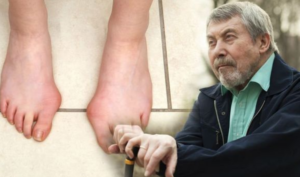
The signs include smaller steps, slower speed, less trunk movement (especially rotation), narrow base of support (feet too close together), less or absent arm swing (on one side of the body or both) and trouble turning.
The feet land flat on the floor with each step instead of on the heel. This can lead to a shuffling walk, heavy or dragging legs (feeling like legs are too stiff or weighted). All these changes in the walk cause balance issues and does put Parkinson’s disease patients at higher risk for falls.

Neuropathy
Peripheral neuropathy occurs around 40-50% of the time in Parkinson’s disease. Prevalence increases with the duration and severity of Parkinson’s disease. Symptoms include: numbness or tingling in the feet, legs, hands, or arms, pain, especially in the feet or toes, weakness or clumsiness in the hands and feet, difficulty walking or standing due to balance problems, foot drop and loss of sensation in the skin (e.g. to temperature, vibration). Loss of sensation also increases balance issues and fall risk.
Foot Pain
Achilles tendinitis is common due to the tightness of the calf muscle. Tight Achilles causes the foot to pull 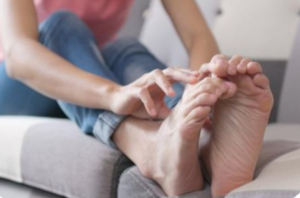 downward and makes it hard to straighten the foot on the ankle into a flattened position. When walking with a tight Achilles, more pressure is on the front of the toes than the heel and this can affect balance. Curled toes can come from dystonia. Hyperextension of the big toe is also common where the big toe extends upwards, rubbing against the top of shoes. Shuffling when walking can lead to excessive rubbing and friction to the toes and feet, resulting in corns/calluses and nail conditions.
Practical Strategies
- Be mindful of foot position when walking – think about hitting the heel first.
- Focus on the size of the step rather than the speed of the step.
- Avoid carrying too many things when walking.
- Stand tall and look out in front of view rather than looking down at your feet.
- Once shuffling or freezing is noted, come to a complete stop, take a breath/standing tall, and start again.
- Use of cane or walker (U step style), if necessary, for stability.
- Foot care – corns/calluses, thick nails, ingrown toenail: it may be helpful to avoid sharp tools, such
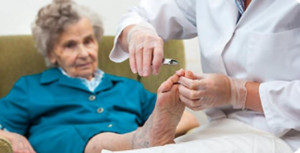 as nail clippers or scissors if you have a tremor or involuntary movements. You should file your toenails weekly with a nail file/emery board instead. Consider transferring this care to a podiatrist. This may or may not be covered by insurance.
 - Stretching exercises – to improve muscle flexibility, circulation, and reduce the effects of stiffness. Chair based exercises are effective.
- Appropriate shoe gear – Footwear modifications include textured insoles, Velcro or elastic laces and a low, broad heel that fastens over the top of the foot close to the ankle. Avoid leather soled shoes.
- Cushion curled toes with gel padding and make sure that shoes are a high and wide toe box to accommodate.
- Foot drop can be treated with bracing (AFO) and foot straps.
- Using a long-handled shoehorn and consider slip on shoes.
Addressing foot and lower extremity issues contributes significantly to patient’s independence and quality of life. Early podiatric evaluation can help manage pain, mobility and may prevent more serious long-term complications.
Dr. Lori DeBlasi is a board-certified podiatrist at Family Foot & Leg Center at the Estero office. She is accepting new patients. To make an appointment, call 239-430-3668 or visit www.NaplesPodiatrist.com.
Serving Southwest Florida Since 2005, Family Foot & Leg Center has multiple convenient locations throughout Collier, Lee, Charlotte, and Sarasota Counties. Offering pediatric to geriatric family care: Ingrown Toenails, Heel Pain, Bunions, Foot / Ankle Arthritis Pain, Plantar Fasciitis, Foot / Ankle Surgery, Custom Orthotics, and Diabetic Wound Care. In office X-rays, ultrasounds, and minor surgical suite exam rooms. Practice powered by EMR and advanced technologies.
Home of the Lam Minimally Invasive No-Scar Bunion Surgery! Come Discover Why Patients Love Our 5-Star Foot & Ankle Care!
For advanced wound management and diabetic wound healing resources, visit: WoundHealingExperts.com
Same Day Appointments! Easy Online Appointment Scheduling.