Fax: (239) 692-9436
 Tel: 239-430-3668
When conducting your skin self-exam, are you remembering to check your feet? Below the ankle, skin cancer can be a complete master of disguise, making it vital to understand exactly what to look for – and precisely when it’s time to see a specialist.
Read our detailed clinical guide from Dr. Lori DeBlasi of Family Foot & Leg Center in Estero, FL to stay protected.
Lori DeBlasi
Kevin Lam, DPM, FACFAS
While the face and shoulders are common focal points for dermatological concern, the lower extremities are equally susceptible to malignant skin lesions. At Family Foot & Leg Center in Estero, I observe that feet are the most overlooked region during routine self-examination and screenings. This clinical oversight is perilous because skin cancer of the foot often presents with atypical morphologies, leading to delayed diagnoses and aggressive treatment.
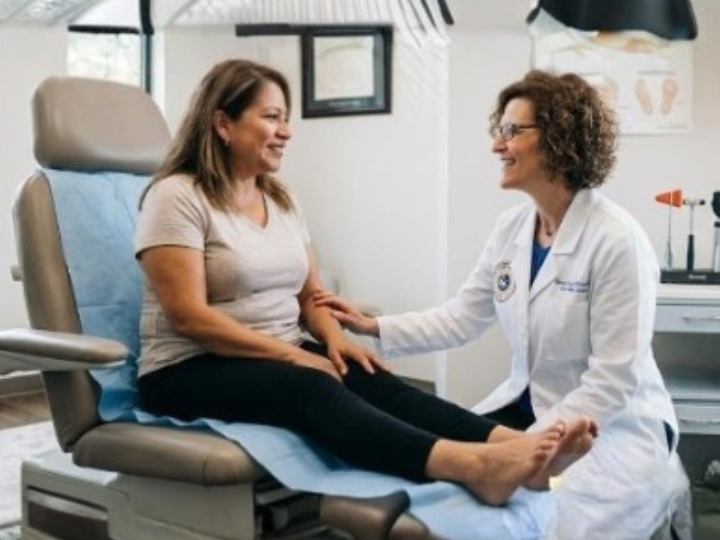
As a board-certified foot and ankle surgeon, it is my goal to ensure patients are equipped with the clinical knowledge necessary to identify these “hidden” threat before they progress.
But here is the reality: skin cancer doesn’t discriminate based on body part. In fact, because we rarely look at our soles or between our toes, skin cancer on the feet is often diagnosed at much later, more dangerous stages. Let’s talk about what I look for during a clinical exam and what you should be watching for at home.
The Deceptive Nature of Foot Skin Cancer
One of the biggest challenges we face in podiatry is that skin cancer on the lower extremities is a master of disguise. It rarely looks like the “textbook” melanoma you see in brochures. Instead, it often mimics common, benign conditions like warts, fungal infections, or even stubborn calluses.
Basal Cell Carcinoma (BCC)
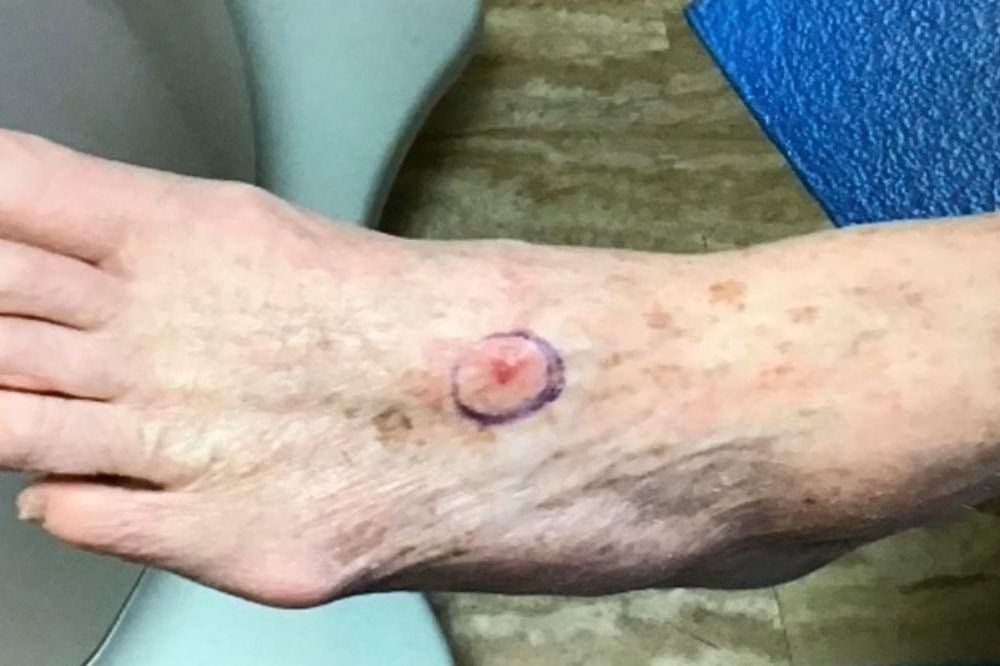
While BCC is the most common skin cancer overall, it’s actually less frequent on the feet. When i do see it in the office, it usually presents as a pearly, waxy bump. It might look like a small patch of eczema that just won’t heal, or a sore that crusts over, seems to get better, and then opens right back up. While it’s less likely to spread to other organs, it can cause significant local tissue damage if ignored.
Squamous Cell Carcinoma (SCC)
This is the most common form of cancer I find on the skin of the feet. In its early stages, it is often confined to the surface, but it can become quite aggressive. On the foot, SCC often looks like a scaly, inflamed plaque. It’s easily mistaken for a fungal infection or a patch of dry skin. If you have a “scaly patch” that hasn’t responded to anti-fungal creams or moisturizers, it’s time to come see me.
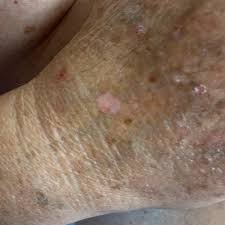
Actinic Keratosis (AK)
Think of these as your “early warning system.” These are pre-cancerous lesions. Often, you will feel them before you see them; they feel like a rough, sandpaper-like patch on the skin. They can range from tan to bright red and, if left untreated, have a high potential to develop into Squamous Cell Carcinoma.
Malignant Melanoma: The Hidden Threat
Melanoma is the most lethal form of skin cancer because it spreads (metastasized) so rapidly. On the feet, it doesn’t just appear on sun-exposed areas; it can show up on the soles or even under a toenail. A dark, vertical line on a nail (subungual melanoma) is often mistaken for a bruise, but if that “bruise” doesn’t grow out with the nail, it is a medical emergency.
The ABCDE Checklist
To help my patients in Estero remember what to look for, I recommend the ABCDE method for self-exams:
- Asymmetry: If you drew a line through the middle, the two halves wouldn’t match.
- Borders: Look for edges that are notched, blurred, or “ragged” rather than a smooth circle.
- Color: Be wary of multiple colors – shades of brown, black, or even blue and red within one spot.
- Diameter: Anything larger than 6mm (the size of a pencil eraser) needs a professional look.
- Evolution: This is the most important “E.” If a mole is changing in size, shape, or starts itching and bleeding, don’t wait.
Prevention: More Than Just Shoes
Living in Florida, we are at higher risk year-round. My advice to my patients is simple: Sunscreen is not optional for your feet. When you’re at the beach or wearing sandals, apply a broad-spectrum, water-resistant SPF 30 or higher to the tops of your feet and around your ankles.
Most importantly, make a habit of checking your feet daily. Check the spaces between your toes and the bottoms of your heels. As a podiatrist certified by the American Board of Foot and Ankle Surgery®, I am trained specifically to identify these subtle changes in the lower extremities.

If you’ve found a spot that looks suspicious or a “sore” that just won’t go away, please reach out to us here at Family Foot & Leg Center. Early detection is the difference between a simple procedure and a life-altering diagnosis. Stay vigilant, Estero!
Dr. Lori DeBlasi is a board-certified podiatrist at Family Foot & Leg Center at the Estero office. She is accepting new patients. To make an appointment, call 239-430-3668 or visit www.NaplesPodiatrist.com
Serving Southwest Florida Since 2005, Family Foot & Leg Center has multiple convenient locations throughout Collier, Lee, Charlotte, and Sarasota Counties. Offering pediatric to geriatric family care: Ingrown Toenails, Heel Pain, Bunions, Foot / Ankle Arthritis Pain, Plantar Fasciitis, Foot / Ankle Surgery, Custom Orthotics, and Diabetic Wound Care. In office X-rays, ultrasounds, and minor surgical suite exam rooms. Practice powered by EMR and advanced technologies.
Home of the Lam Minimally Invasive No-Scar Bunion Surgery! Come Discover Why Patients Love Our 5-Star Foot & Ankle Care!
For advanced wound management and diabetic wound healing resources, visit:
WoundHealingExperts.com
Same Day Appointments! Easy Online Appointment Scheduling.