
 Fax: (239) 692-9436
 Tel: 239-430-3668
What every diabetic patient in Southwest Florida needs to know about nerve damage, wound care, and why the right podiatry team can save your leg — and your life.

Every day in America, hundreds of people with diabetes lose a toe, a foot, or an entire leg — not from a sudden accident, but from a wound they never felt forming, a nail trimmed at the wrong angle, or a fungal infection dismissed as cosmetic. The devastating truth is that the overwhelming majority of these amputations were preventable. At the Family Foot and Leg Center in Florida, our board-certified podiatric physicians have dedicated their practice to making sure our diabetic patients never have to face that outcome. This guide explains exactly why diabetes puts your feet at such extreme risk, what the statistics around diabetic amputation really look like, and what you can do — starting today — to protect yourself.
Why diabetes makes your feet so vulnerable
To understand diabetic foot ulcers, you need to understand what elevated blood sugar does to the body over time — specifically to the two systems your feet depend on most: your nerves and your blood vessels. When these two systems break down simultaneously, the result is a perfect storm for catastrophic, life-altering wounds.
Peripheral neuropathy: when your alarm system goes silent
Chronically elevated blood sugar damages nerve fibers throughout the body, but the longest nerves — the ones running to your feet — are hit first and hardest. This condition is called peripheral neuropathy, and it affects an estimated 50 percent of all people with diabetes over their lifetime. It typically begins with tingling or burning in the toes, progresses to numbness, and eventually leaves patients with dramatically reduced or completely absent sensation in the feet.
Pain exists to protect you. It makes you pull your foot back from a sharp object, adjust a shoe that’s rubbing, or look at a spot that’s been bothering you. When peripheral neuropathy silences those signals, wounds form without warning. A pebble in a shoe causes a wound that a patient walks on for an entire day without knowing. An ill-fitting shoe creates an abrasion that deepens over two weeks while the patient remains completely unaware. A toenail grows into the skin and establishes an infection before anyone looks. The absence of pain is not comfort — in a diabetic foot, it is danger.
Poor circulation: when wounds can’t heal
At the same time, diabetes damages blood vessels and dramatically increases the risk of peripheral arterial disease — a narrowing and hardening of the arteries that supply blood to the legs and feet. Reduced blood flow means reduced oxygen delivery, reduced nutrient supply, and a reduced immune response at the site of any wound. In a healthy person, a minor cut or blister heals in days. In a diabetic foot with compromised circulation, that same wound may take weeks or months — or may not close at all.
When these two factors combine — no sensation to alert you, and no blood flow to heal you — even the most minor skin breach becomes a potential catastrophe. A blister. A cracked heel. A callus that breaks down. A small nick from a nail. In the wrong environment, any of these can progress to a deep, infected ulcer within weeks. Left untreated, that ulcer can reach tendons and bone. Bone infections in diabetic feet are notoriously difficult to eradicate. And when infection is out of control and tissue is dying, surgeons face the choice no one wants to face.
“The wound that a diabetic patient can’t feel is the most dangerous wound of all — because by the time it’s discovered, it’s rarely minor anymore.”
The statistics every diabetic patient must know
These numbers are not meant to frighten — they are meant to make clear that diabetic foot disease is a medical emergency masquerading as a routine complication. Understanding the scale of this problem is the first step toward treating it with the urgency it deserves.
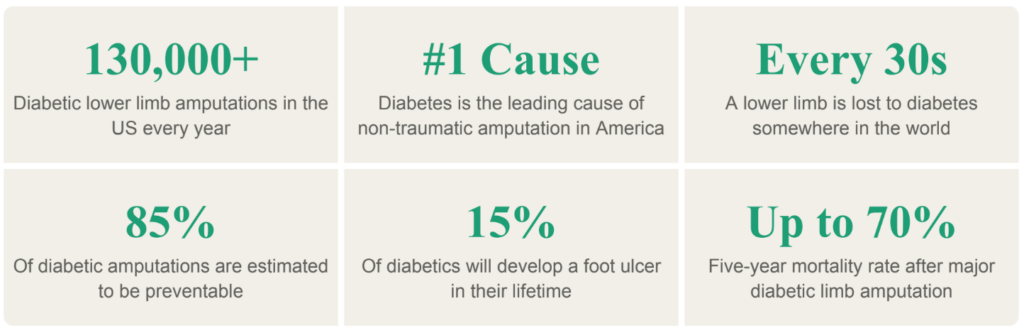
That last statistic deserves particular attention. The five-year mortality rate following a major lower limb amputation in diabetic patients — between 50 and 70 percent in multiple large studies — rivals or exceeds the five-year mortality of many cancers we rightly treat with enormous urgency. Amputation in a diabetic patient is not a solution. It is a marker of advanced systemic disease that dramatically accelerates decline.
What amputation really means
Beyond the surgery itself, diabetic amputation carries devastating downstream consequences: a rehabilitation process lasting a year or more, chronic phantom limb pain, high rates of clinical depression, loss of independence, cardiovascular deconditioning from reduced mobility, and a dramatically elevated risk of a second amputation on the same or opposite limb within five years. This is not a complication to manage after the fact — it is one to prevent at all costs.
To schedule an appointment, please contact Dr. Lam’s office at (239) 430-3668 (FOOT) or visit us online at www.NaplesPodiatrist.com
Serving Southwest Florida Since 2005, Family Foot & Leg Center has multiple convenient locations throughout Collier, Lee, Charlotte, and Sarasota Counties. Offering pediatric to geriatric family care: Ingrown Toenails, Heel Pain, Bunions, Foot / Ankle Arthritis Pain, Plantar Fasciitis, Foot / Ankle Surgery, Custom Orthotics, and Diabetic Wound Care. In office X-rays, ultrasounds, and minor surgical suite exam rooms. Practice powered by EMR and advanced technologies.
Home of the Lam Minimally Invasive No-Scar Bunion Surgery! Come Discover Why Patients Love Our 5-Star Foot & Ankle Care!
For advanced wound management and diabetic wound healing resources, visit: WoundHealingExperts.com
Same Day Appointments! Easy Online Appointment Scheduling.