 Fax: (239) 692-9436
 Tel: 239-430-3668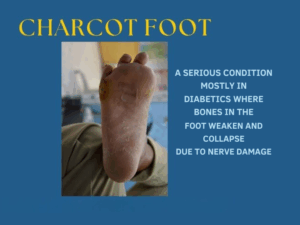
Ever wonder why a foot can become swollen and red without any pain?
In our latest article, Dr. Altepeter dives deep into Charcot Foot, a “silent” but serious condition where nerve damage masks bone collapse – making early detection the key to preventing amputation! Knowledge is your best defense, so learn the red flags today and keep your feet healthy and strong!
Joe Altepeter
Kevin Lam, DPM, FACFAS
When a patient walks into my clinic at Family Foot & Leg Center in Fort Myers, they usually come because something hurts. Pain is the body’s alarm system; it tells you to stop, rest, and seek help. But in my practice, the most dangerous conditions are often the ones that don’t hurt.
Among these, Charcot Neuropathy – commonly known as Charcot Foot – is perhaps the most serious. It is a condition that can turn a healthy, active individual into someone facing potential amputation in a matter of months, all while the patient feels little to no discomfort.
What is Charcot Foot?
Charcot foot is a progressive condition that involves the weakening of the bones in the foot. It occurs almost exclusively in people with significant neuropathy (nerve damage), most commonly as a complication of diabetes.
When you have neuropathy, you lose the ability to feel temperature, pain, or position. If a person with “normal” sensation sprains an ankle or suffers a small stress fracture, they limp. If a person with neuropathy suffers that same injury, they keep walking. Because they can’t feel the injury, they continue to put weight on the foot, causing the weakened bones to fracture and eventually crumble.
As the bones collapse, the joints shift, and the foot loses its natural arch. If left untreated, the foot can take on a “rocker-bottom” appearance, where the middle of the foot bulges downward.
The Red Flags: What to Look For
Since pain isn’t a reliable indicator, I tell my patients in Fort Myers to become “detectives” of their own feet. If you have diabetes or peripheral neuropathy, you must look for the following signs:
– Swelling: This if often the first sign. One foot may look significantly puffier than the other.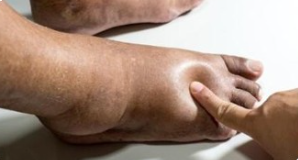
– Redness: The foot may appear flushed or “angry.”
– Warmth: If you touch your foot and it feels noticeably hotter than the other foot or your leg, that is a major red flag.
– Deformity: Any change in the shape of your foot, even if it doesn’t hurt, is an emergency.
I often see patients who think they just have a minor infection or a bug bite. They wait two weeks for the “swelling to go down,” but by the time they see me, the internal architecture of the foot has already begun to collapse.
In podiatry, we categorize Charcot into stages. In the Acute Stage, the bone is actively breaking down. This is the “melting” phase. If we catch it here, we can often save the structure of the foot.
Once it moves into the Coalescence and Reconstruction stages, the body begins to heal, but it heals in the deformed position. This creates new pressure points on the bottom of the foot. Because the skin wasn’t designed to bear weight on a collapsed bone, it eventually breaks down, leading to a diabetic foot ulcer. These ulcers are the leading gateway to bone infections (osteomyelitis) and, unfortunately, amputations.
How We Treat Charcot at Family Foot & Leg Center
If I suspect Charcot, the first thing we do is imaging. While X-rays are a starting point, an MRI or a bone scan is often necessary to see the early stages of bone edema before a full collapse happens.
The Golden Rule of Treatment: Off-Loading
The only way to stop the “melting” process is to take all the weight off the foot. This usually involves:
– Total Contact Casting (TCC): This is the gold standard. We apply a specialized cast that redistributes pressure away from the foot, allowing the bones to stabilize.
– Removable Walkers or Braces: Once the initial swelling subsides, we may transition to custom bracing.
_ Lifestyle Changes: This is the hard part. Patients may need to use crutches, a knee scooter, or a wheelchair for several months.
Surgical Intervention
If the deformity is too severe to fit into a shoe or brace, or if there is a chronic ulcer, surgery may be required. We perform “Charcot reconstruction,” which involves using internal screws or external frames to realign the bones and create a stable, plantigrade foot.
A Message to my Southwest Florida Neighbors
Living in Fort Myers, we are an active community. We love our golf, our walks on the beach, and our  independence. Charcot foot threatens all of that.
If you have diabetes, your annual foot exam isn’t just a “check-up” – it’s a preventative measure against a life- altering condition. If you notice one foot is warmer or redder than the other, do not wait. My team and I at Family Foot & Leg Center are here to catch these issues early.
Remember: In the world of diabetic foot care, red and warm is an emergency, even if it doesn’t hurt a bit.
Dr. Altepeter is a board-qualified podiatrist at Family Foot & Leg Center at the Fort Myers office. He is accepting new patients. To make an appointment, call (239) 430-3668 or visit www.NaplesPodiatrist.com
————
Serving Southwest Florida Since 2005, Family Foot & Leg Center has multiple convenient locations throughout Collier, Lee, Charlotte, and Sarasota Counties. Offering pediatric to geriatric family care: Ingrown Toenails, Heel Pain, Bunions, Foot / Ankle Arthritis Pain, Plantar Fasciitis, Foot / Ankle Surgery, Custom Orthotics, and Diabetic Wound Care. In office X-rays, ultrasounds, and minor surgical suite exam rooms. Practice powered by EMR and advanced technologies.
Home of the Lam Minimally Invasive No-Scar Bunion Surgery! Come Discover Why Patients Love Our 5-Star Foot & Ankle Care!
For advanced wound management and diabetic wound healing resources, visit: WoundHealingExperts.com
Same Day Appointments! Easy Online Appointment Scheduling.

Dr. Kevin Lam, DPM, FACFAS, DABLES, DABPS is Clinical Director of Family Foot and Leg Center, PA — Southwest Florida’s premier podiatric practice. He earned his Doctor of Podiatric Medicine degree with honors from Temple University School of Podiatric Medicine and completed advanced surgical training at Mount Sinai Medical Center and Jackson Memorial Health System, Miami. Named among America’s Top Podiatrists. Board-certified in foot surgery, reconstructive rearfoot and ankle surgery, and lower extremity surgery. Serving Southwest Florida since 2005 across 9 locations from Marco Island to Sarasota.